
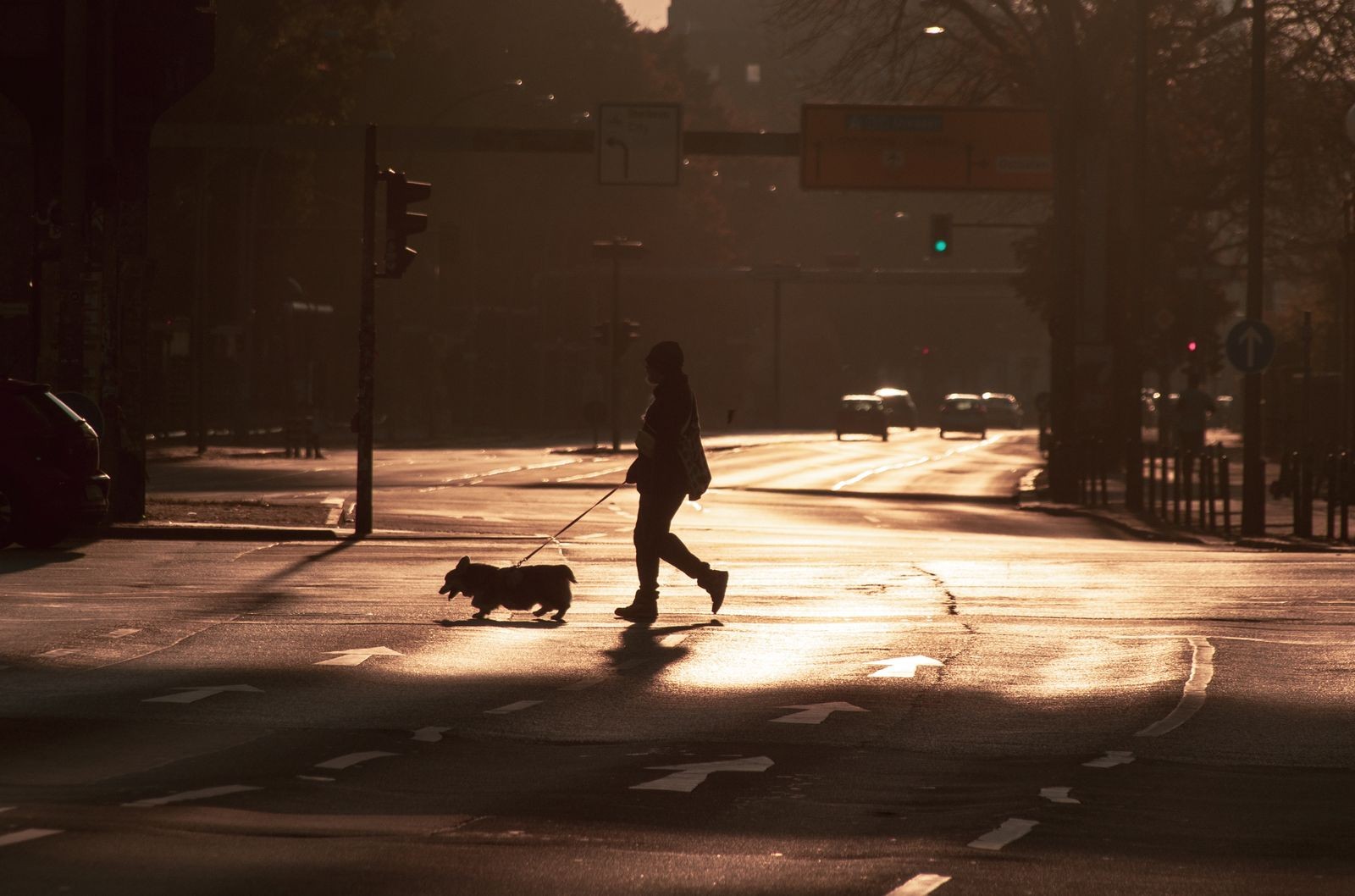
Help a dog who is afraid of strangers by letting your dog choose whether to approach, asking people not to reach for or loom over them, and rewarding calm behavior at a distance where your dog still feels safe. Forcing greetings — holding the lead short while a stranger pets a shrinking dog — usually deepens the fear. Controlled, positive exposure at your dog's own pace is what builds real confidence.
Read what your dog is actually saying
Fear of strangers rarely starts with barking. Earlier signals include turning the head away, licking lips, yawning, tucking the tail, freezing when someone approaches, or moving behind your legs. Some dogs go the other way: lunging and barking to make the scary person retreat — a strategy that works, which is why it grows.
Your first job is to become fluent in your dog's early warnings and act on them early: cross the street, step off the path, put a parked car between your dog and the approaching person. Every time you protect the distance, you teach your dog that you handle strangers so they don't have to. That trust is the foundation everything else is built on.
Give your dog the power of choice
On walks, let your dog decide how close to get to people. If they want to watch a neighbor from fifteen metres, reward that calm watching — soft praise, a good treat, then move on before your dog's worry climbs. If they choose to approach someone, let the encounter be on your dog's terms:
- The person stands side-on, crouches rather than looming, and ignores your dog at first
- No reaching over the head — if your dog invites contact, a brief chest scratch, then hands off to let your dog choose more
- Treats can be tossed on the ground near the person rather than taken from a hand, which keeps pressure low
- Any retreat by your dog ends the interaction, cheerfully and immediately
Brief, dog-controlled meetings repeated over weeks change emotional responses in a way marathon greeting sessions never will. Some dogs will always prefer admiring strangers from afar, and that's a perfectly acceptable outcome — the goal is a dog who feels safe, not a dog who loves everyone.
Build confidence away from the trigger
Confidence generalizes. Games and training your dog succeeds at — nose work, trick training, finding hidden treats in the garden — build a dog who copes better with novelty everywhere. Practice calm observation in low-stakes settings: sit on a bench well back from a park path and reward your dog for watching people pass at a distance that keeps them relaxed. Shrink the distance only across many sessions, and quit while your dog is still comfortable.
Also audit your dog's daily life for accidental flooding: the crowded café, the busy school gate, the houseguest who keeps trying to win your dog over. Manage those situations — a quiet room with a chew during parties, a different walking route at peak times — rather than hoping your dog habituates. Repeated overwhelm sensitizes; it doesn't toughen.
When to bring in a specialist
Get professional help if your dog has snapped or bitten, if fear is growing despite gentle work, if it generalizes to familiar people, or if daily life is becoming limited for either of you. Ask your veterinarian to rule out pain, which quietly lowers many dogs' tolerance for strangers, and seek a trainer who works specifically with fearful dogs using reward-based, gradual methods — avoid anyone promising to "fix" fear with corrections or forced exposure.
KinsLe's Pet Services Directory can match you with local trainers who specialize in fearful dogs, so you can compare experience before committing. Keep a simple log on your dog's profile — distances that work, progress, setbacks — to share with whoever helps you. Looking for more confidence-building ideas for shy companions? Pet Services Directory on KinsLe lets you find a nearby reward-based trainer experienced with fearful dogs, giving that specialist search a concrete starting point when gentle distance work needs support.