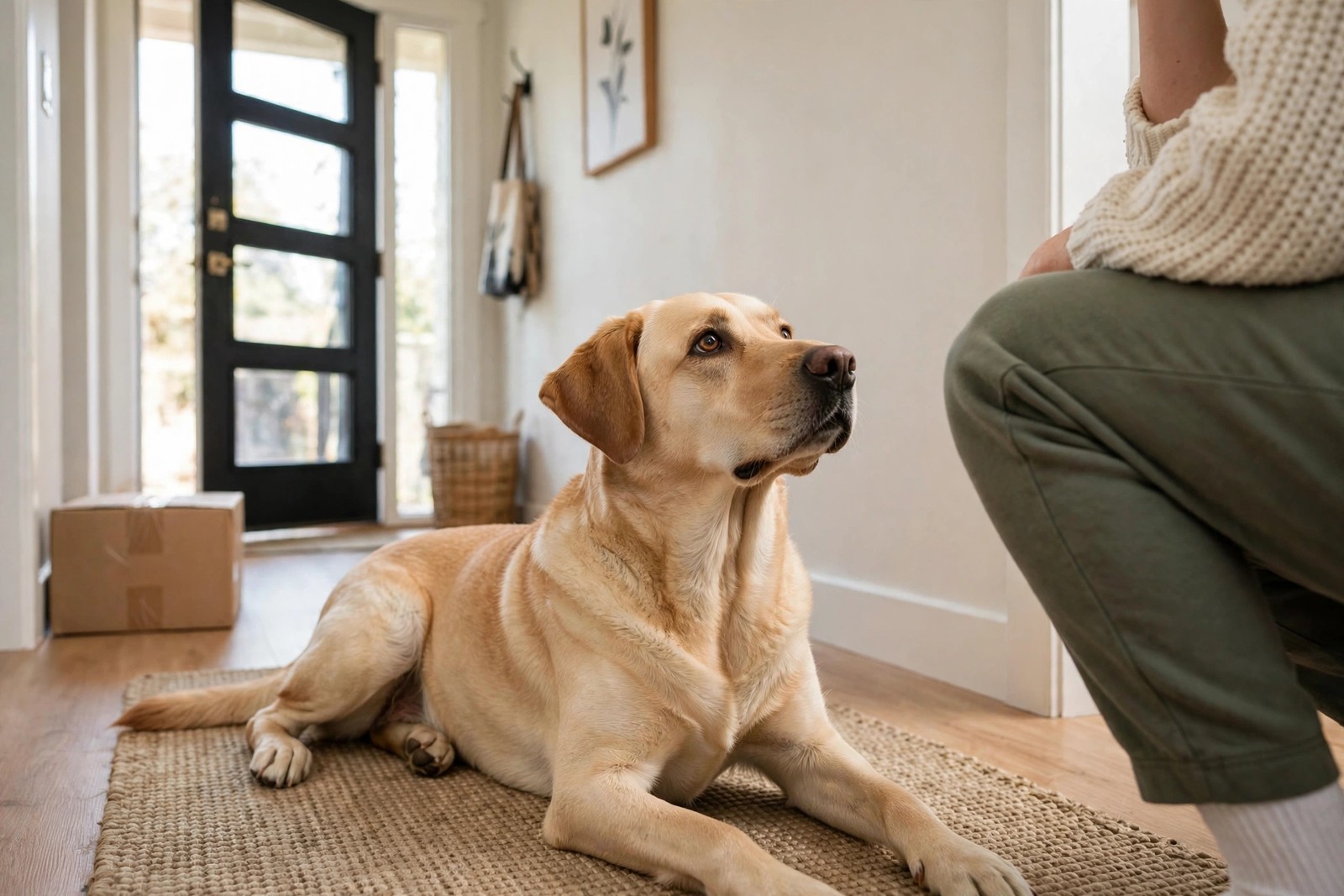
A dog who explodes at the doorbell is not being disobedient; he has learned that the bell predicts the most exciting event in his day, and possibly that his barking makes the visitor eventually go away. You cannot argue him out of that lesson, but you can replace it with a better-rehearsed one: the bell means go to your mat, settle, and good things arrive there. Building that replacement takes staged practice at volumes and realism levels he can handle, spread over days and weeks, plus a household routine for real deliveries that never contradicts the training. Shouting over his barking is worse than useless — from his side of the door, you are not correcting him, you are joining in, loudly, which confirms the bell really is a big event.
Stage One: A Recorded Bell at Low Volume
Begin away from the real door, with a mat he already knows as a settle spot, or teach the mat settle first in quiet sessions until lying on it is easy and pleasant. Then play a recorded doorbell at low volume — a phone recording or sound clip turned well down — and the instant it sounds, guide him to the mat, ask for the settle, and reward generously. Repeat in short sessions: bell at low volume, mat, settle, reward. The volume is right when he notices the sound without launching; if he barks through it, the volume or the session is too hard, so turn it down and shorten the session rather than pushing on. Raise the volume gradually across days, and vary the recording's realism as he succeeds, until a full-volume recorded bell earns a glance at the mat instead of a charge at the door.
Stage Two: A Helper at the Real Door
When recorded bells bore him, recruit a helper for the real door. The helper rings once and waits outside while you run the exact routine — bell, mat, settle, reward — with the dog on a leash at first if he needs the guidance, and with distance from the door generous enough that he can succeed. Repeat across several short sessions, letting the helper vary the pattern the way real callers do: one ring, two rings, a knock as well, pauses of different lengths. Only when the routine holds with a helper do you add the final layer — opening the door, greeting briefly, the parcel handed over — while he stays on the mat being rewarded for the hardest part, which is staying settled while the exciting thing happens ten feet away. Progress at his speed; a dog rushed to the open-door stage before the earlier stages are solid will simply rehearse the old explosion with an audience.
Delivery Days: One Routine, Run by Everyone
Real life is the exam, so make the exam identical every time. Settle on a delivery-day routine and hold it without exceptions: the bell rings, he goes to the mat, the reward lands, and for the real event he gets a long-lasting chew on the mat to work on while the door is answered — chewing occupies him through the voices and the door closing, which are the moments relapse happens. Barking, when it comes, is answered with the routine, never with shouting: calmly guide him to the mat, reward the settle when it arrives, and say nothing dramatic in between. Every household member must run the identical sequence, because a routine one person follows and another skips teaches the dog that the bell sometimes still means chaos. That shared consistency is what the Care Teams feature in KinsLe holds for behavior work like this — the delivery-day routine written down, with mat practice sessions assigned by name so the training happens between deliveries and not only during them. Practiced this way, most dogs downgrade the bell from an alarm to a cue within weeks, and delivery day becomes the most predictable part of his week. Once the bell, mat, and reward sequence is spelled out in the Care Teams plan inside KinsLe, a partner, a teenager, and a visiting grandparent can all run it exactly alike.