
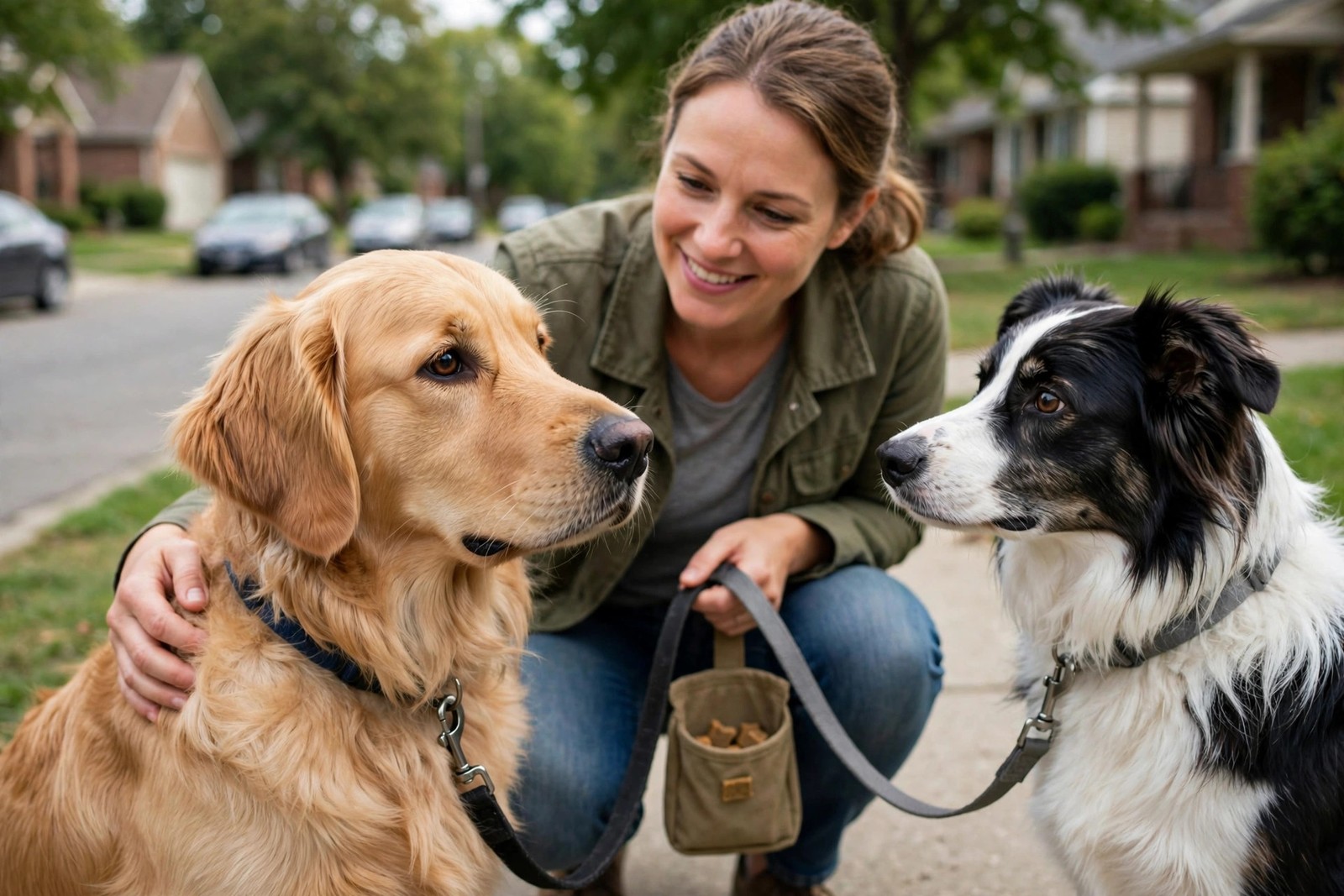
On-leash greetings are the most misunderstood moment of the daily walk. Two dogs who would play happily off leash can clash nose to nose on tight leashes, because the leash removes their option to approach in a curve, sniff briefly, and drift away. Polite greeting etiquette protects that natural choreography as far as possible, and it starts with the humans, not the dogs.
Ask the Other Owner First, Every Time
Never let your dog rush up to a stranger dog on the assumption that both will be friendly. Call out from a distance: ask whether the other dog is happy to say hello, and accept a no instantly and cheerfully. A no can mean many things you cannot see: a dog in training, a dog recovering from surgery or illness, a reactive dog having a good day its owner does not want to risk, or simply an owner in a hurry. Watch for the signals that mean keep your distance without asking: an owner who crosses the road or shortens the leash and turns away, a dog wearing a muzzle, or any dog already lunging, barking hard, or staring fixedly at yours. Skipping a greeting is always polite; insisting on one never is.
Set Up a Greeting That Can Succeed
If both owners agree, approach in a gentle arc rather than marching straight at the other dog, because head-on approaches read as confrontation in dog language. Keep leashes loose throughout: a tight leash transmits your tension, removes the dog's ability to move away, and is the single most common reason calm dogs snap during greetings, so if you find yourself pulling back, you have already stayed too long. Let the dogs curve toward each other's sides rather than meeting face to face, allow a brief sniff, and count roughly three seconds. Then call your dog away in a bright voice, reward the disengagement, and walk on. Three seconds sounds stingy, but most tension in greetings arrives after the initial sniff, when one dog goes still, stares, or tries to tower over the other, and leaving while things are friendly teaches both dogs that meetings are short and safe.
Read Both Dogs While It Happens
Relaxed greetings look wiggly: loose bodies, soft sweeping tails, sneezing, play bows, and dogs who glance away and back. End the greeting early, calmly, and without yanking if you see either dog go stiff, raise its tail high and still, fix the other with a hard stare, lift a lip, or try to mount or pin. Puppies need extra management, because adult dogs vary widely in their tolerance for rude young enthusiasm, and older or small dogs deserve greetings on their terms or none at all. Retractable leashes are poor greeting tools: they tangle around legs and dogs in seconds and give you no close control, so shorten and lock them well before any meeting, or step aside and let the other pair pass instead.
When the Polite Choice Is No Greeting
Narrow pavements, blind corners, vet clinic car parks, and any moment when either dog is already over threshold are all fine reasons to create distance instead. Crossing the street, stepping into a driveway, or asking your dog for a sit behind a parked car while the other dog passes are skills worth practising and rewarding in their own right. A dog who can ignore other dogs on a walk is not unsocialised; it is well-mannered.
Writing the household greeting rules, including which regular dogs are welcome hellos and which routes are no-greeting routes, into KinsLe Care Teams means every walker handles meetings the same way.