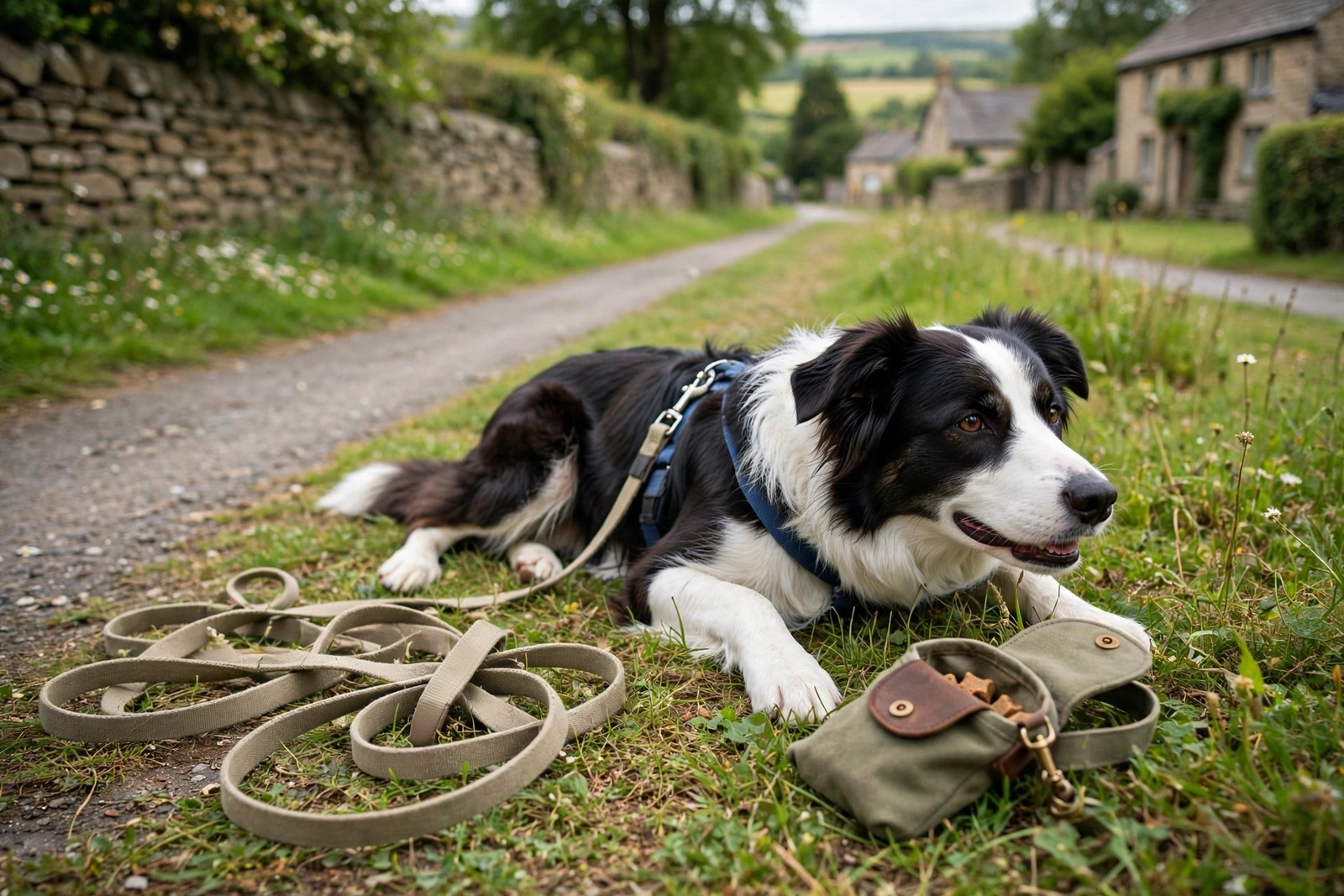
Freedom With a Safety Line Attached
A long line gives a dog room to range, sniff and practise recall in real countryside while you keep a physical connection for the moments when a deer, a pheasant or a livestock scent overwhelms training. It is not an extended lead and it is not off-lead freedom yet. Treated as its own skill — for the dog and for your hands — it bridges the gap between pavement walks and trustworthy free running without gambling on a recall that has not been proofed.
Gear That Prevents the Classic Accidents
Clip the line to a well-fitted harness, never to a collar: a dog who hits the end of a long line at speed on a collar takes that force through his neck. Choose a line you can grip when wet, handle it in loose loops rather than wrapping it around your wrist or hand, and let surplus line trail behind you rather than pooling around your dog's legs. Gloves matter more than pride here — rope burn happens on the one occasion a dog bolts for a hedge. Check the clip and stitching before countryside walks, because this line is safety equipment, not an accessory.
Learn Line Handling Before Livestock Country
Practise your own mechanics in an open field first: feeding line out as he moves away, braking smoothly through your hands rather than snatching, reeling in without creating a dragging tangle, and bringing him to a calm stop at the end of the line. Then practise recalls at increasing distances on the line, paying returns generously. Keep early countryside sessions on ground you can see across — a meadow, a wide track — before you work hedgerows and woodland edges where wildlife appears without warning and the line snags on every third bush.
Choose Ground and Distances Honestly
The line creates hazards as well as solving them. Watch for cyclists and horse riders on shared tracks, other dogs whose leads can braid with yours, and your own footing on slopes and stiles. Near livestock, shorten up early and treat fields with sheep or cattle as on-lead walking however good his recall looked last week; legal duties and basic courtesy both demand control around farm animals. Work at distances where his recall still functions — if he cannot respond at fifteen metres on the line, the answer is a shorter working range and more practice, not a longer line.
Build Toward Freedom Without Dropping Safety
Trustworthy off-lead freedom is earned in verified stages: recall on the line in quiet fields, then with distractions at distance, then in enclosed or genuinely secure spaces where a mistake costs nothing. Let the line drag only in those secure places, and keep holding it everywhere else. Some dogs graduate in a season; a dog with a serious chase drive may keep a line in livestock country for life, and that is responsible handling, not failed training. On shared walks, one handling plan keeps that progress intact, and KinsLe supports it through Care Teams: the walker for each countryside outing is assigned their session, and a timestamp on the completed duty confirms the practice was done.