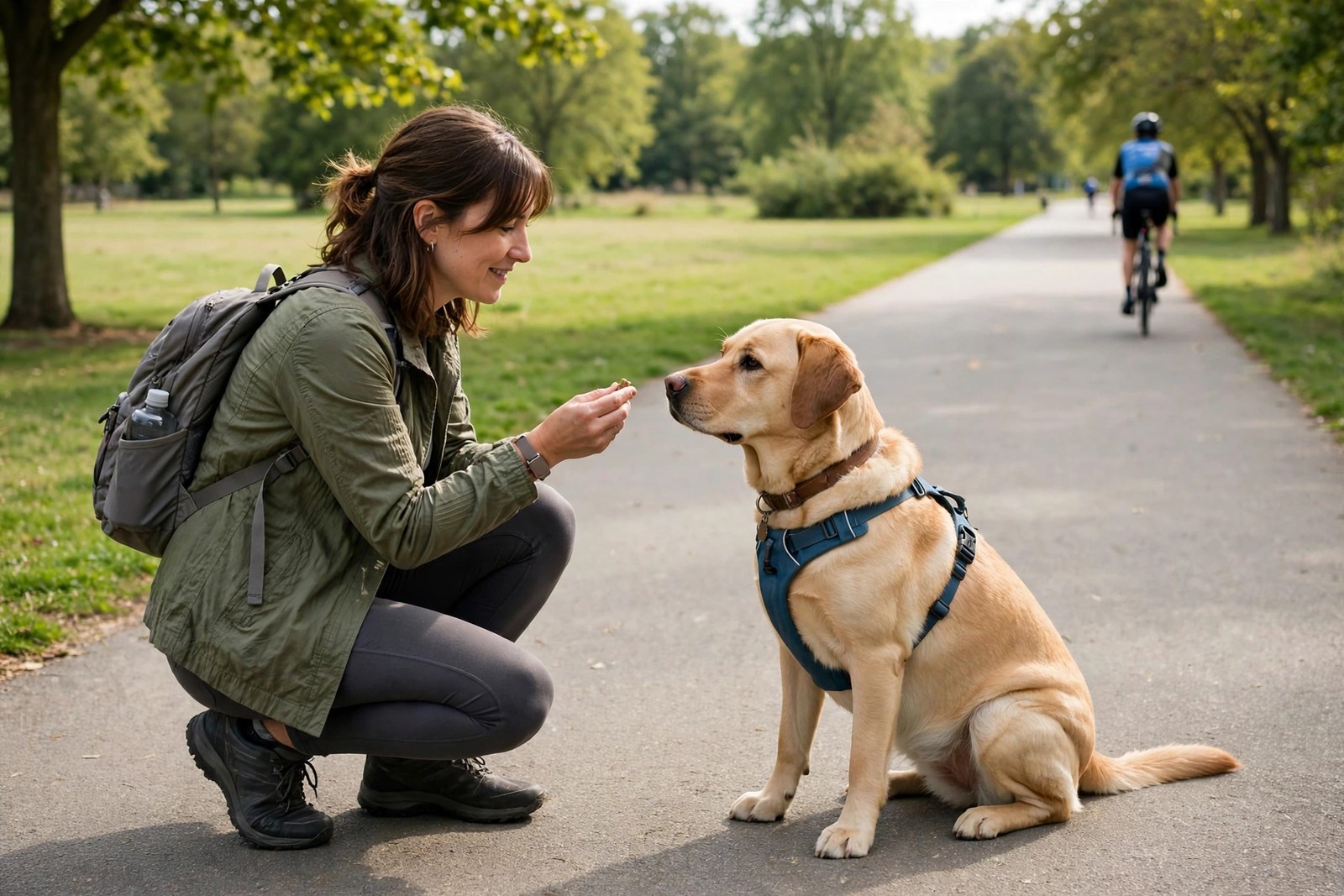
Work the picture in stages, at distances where your dog can still think. Lunging at bicycles and joggers is usually movement doing what movement does to a dog: wheels spinning at speed and legs pounding past switch on the chase sequence, and a frustrated or under-exercised dog at the end of a lead rehearses the grab part every single walk. Telling him off at the moment of the lunge teaches almost nothing, because by then he is not in a state to learn. The learning happens earlier, calmer, and further away.
Stage One: Still and Slow
Set up training away from real traffic first. Have a helper stand with a bicycle at a distance where your dog notices it, looks, and can still look back at you and eat; that distance is your starting line, and it may be embarrassingly far. Reward every calm look. When stillness is boring, the helper walks the bike slowly; when that is boring, they ride slowly in a straight line far away. Joggers follow the same staircase: a standing person, a person walking, a person jogging in place at distance, and only much later a person jogging past.
Each stage is earned by relaxation at the previous one. If he lunges, barks, fixates with a hard stare, or refuses food, you have skipped a step or closed the distance too fast; go back a stage without treating it as failure. Keep sessions short and frequent rather than heroic, and end on a success he found easy.
On Real Walks, Manage First
Until the staged work transfers, real pavements are management, not testing. Cross the road early when you see a bike or runner coming, step into a driveway or side path to make space, and feed a stream of good food as the trigger passes so the pavement picture starts to predict snacks rather than a lunge. Keep the lead short enough that a lunge cannot reach a wheel or an ankle, and hold it with both hands when a pass is unavoidable; a dog tipping a cyclist is a genuine injury risk, not a training embarrassment.
Choose routes and times that lower the rehearsal count while training proceeds: quieter streets, off-peak hours, and open spaces where you can see movement coming from far off and work at your chosen distance instead of being ambushed at corners. Every unmanaged close-range lunge is a rehearsal that slows the training down, so route choice is training.
Give Chasing a Legal Job
A dog with a strong chase drive needs somewhere sanctioned to spend it. Flirt-pole play, where he chases a lure on a line with clear rules — wait, chase, catch sometimes, drop on cue — satisfies the sequence safely, and fetch games with a proper warm-up and a stop while he is still keen serve the same purpose. What does not help is unlimited free chasing of wildlife or other dogs, which simply deepens the habit you are trying to redirect.
If lunging comes with snarling, snapping at wheels or ankles, or a history of making contact, or if it appears suddenly in an older dog, get a vet check for pain and vision problems and work with a qualified behaviourist in person, because staged work near traffic needs experienced eyes on safety. KinsLe Care Teams keeps the household's practice aligned meanwhile, because you can assign the staged sessions, the calmer walk routes, and the trigger notes to named helpers and see each completed task marked with a timestamp.