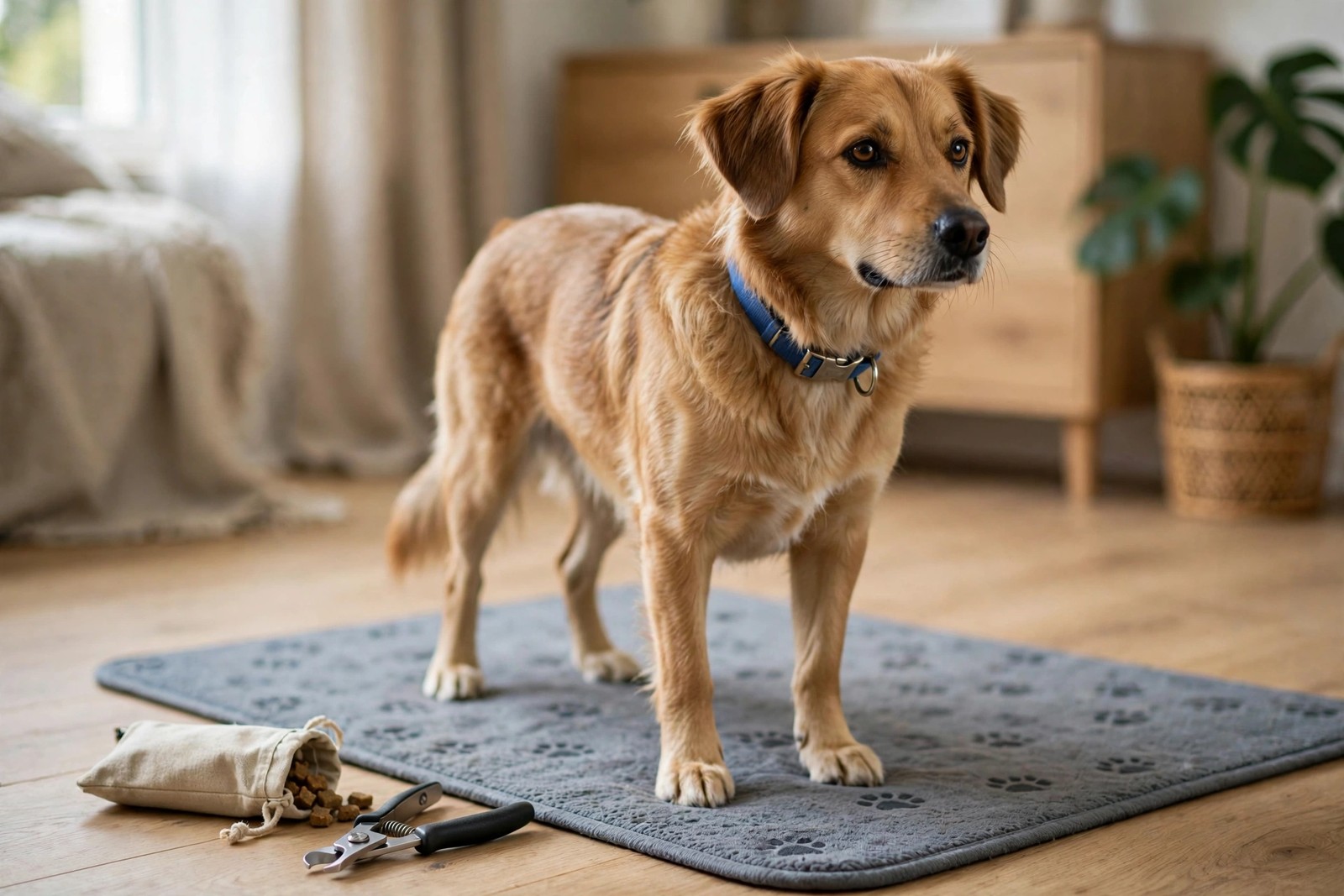
A dog who has been held down for nail trims has learned a clear lesson: nail care means losing control while something frightening happens. Cooperative care unteaches that lesson by reversing every term of it. The dog chooses the place, the pace is set by the dog's comfort, participation is invited rather than compelled, and walking away always works. Progress measured in weeks feels slow next to a groomer's quick restraint job, but it produces a dog who can cooperate for years of trims instead of one who needs more force every visit.
Start With a Station the Dog Chooses
Pick a mat, rug, or low platform and make it valuable before any nail equipment appears. The dog steps onto the station, good things happen, and the dog is free to step off whenever the wish arises; stepping off ends the session without scolding, coaxing, or a second attempt that day. That exit right is the foundation of the whole method, because a dog who knows leaving works can afford to stay and find out what happens next. Keep the station for this work only, so arriving there becomes a clear, predictable context: the dog knows what this place is for, knows the rewards, and knows the door is never locked.
Build the Gradient in Seconds-Long Steps
Work in a gradient so shallow the dog barely notices the difficulty rising. Touch a paw briefly and reward. Rest a hand on the paw a moment longer and reward. Touch a nail, reward. Pick up the clippers somewhere else in the room, reward. Touch the clippers to a nail without cutting, reward. Each step repeats until the dog's body stays loose and the dog remains on the station by choice, and a session may contain only a handful of repetitions and last well under a minute at first. When an actual cut finally enters the sequence, cut one nail, reward generously, and consider the session a triumph worth ending on. One nail per session, rotating paws across the week, trims a whole dog over time without ever recreating the marathon that restraint used to force. The dog who pulls a paw away or leaves the station has given information, not defiance: the step was too large, and the next session drops back to the last easy level.
Alternatives and Honest Next Steps
A scratch board earns a place in this plan alongside clippers. Many dogs happily file front nails by pawing at a board covered in abrasive material, a game-like action entirely under the dog's control, and it can maintain front nails while clipper confidence rebuilds. Hind nails usually still need gradual clipper or grinder work, though some dogs accept a grinder's sound sooner than the pinch of clippers once the sound itself has been paired with rewards at a distance. Never recreate the restraint at home as a shortcut: no pinning, no holding the dog down between knees, no recruiting helpers to immobilize, because one forced session can spend months of rebuilt trust. If progress stalls completely, if nails are curling into pads, or if the dog panics despite patient gradients, a fear-free groomer or the veterinarian is the honest next step, and saying so is part of good care rather than an admission of failure.
Record the gradient honestly as you go. Note the highest step reached without tension in the Pet Passport record on KinsLe after each short session, along with the rewards that worked and the step where the dog chose to leave, so the record shows pace rather than pressure.
Weeks of tiny, chosen steps usually produce the moment owners remember: the dog hears the station being set out and comes to it voluntarily, paw offered, because nail care has become a paying job with an open door. Share the nail-care notes through the Pet Passport file on KinsLe before an appointment so a new professional starts from the dog's pace, not from restraint.