
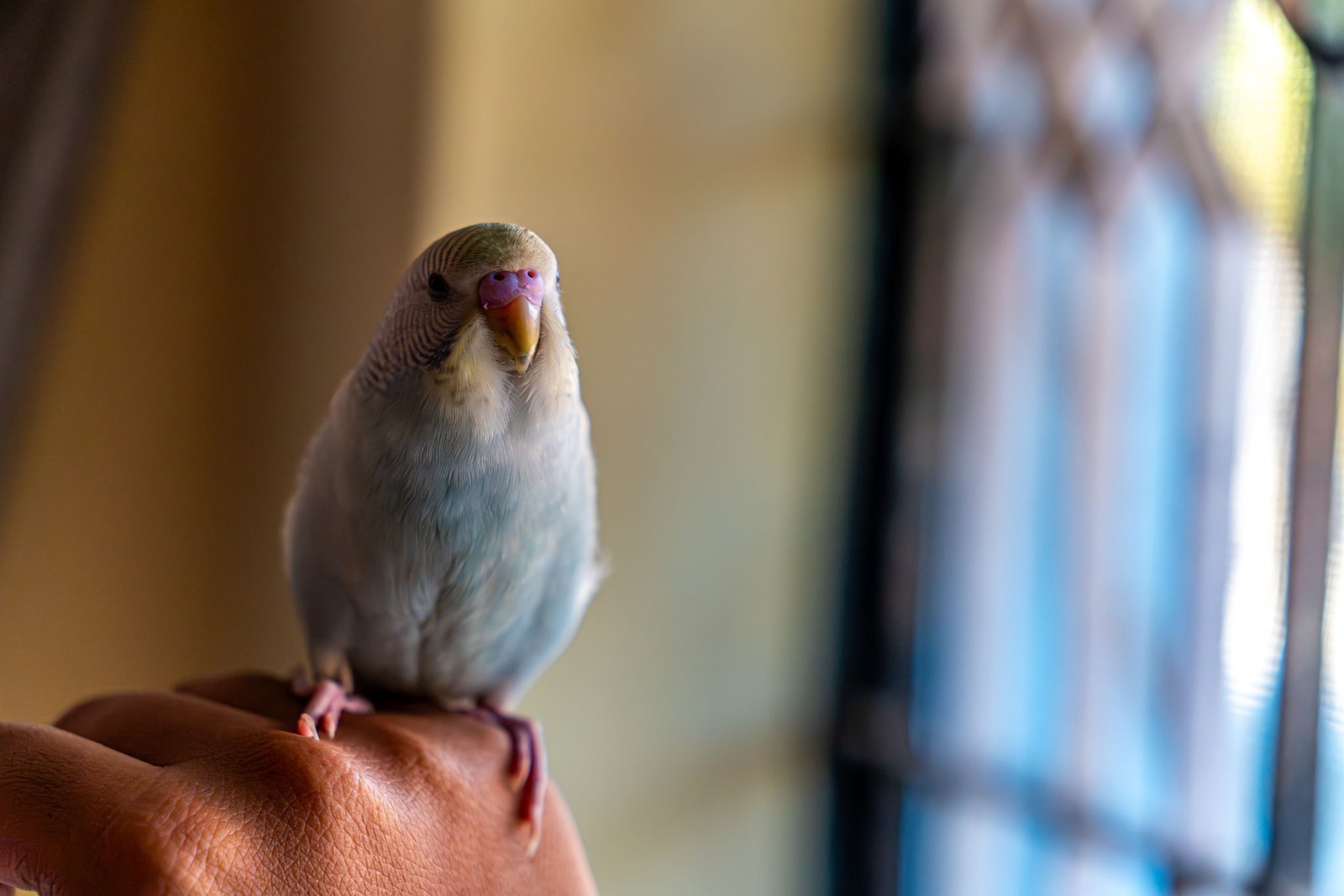
You teach a budgie to step up by making your finger a safe, predictable place to stand: once your bird happily takes a treat from your hand, present a steady finger just in front of its lower belly, reward any movement toward it, and build to a full step in tiny stages. There is no shortcut through chasing or grabbing. A budgie that chooses to step up learns trust; a budgie that is scooped learns to avoid hands.
Start Before the Finger: Hand Trust
Step-up training begins before you ever ask for a step. Sit near the cage and talk quietly so your budgie learns your voice means nothing scary. Rest your hand still on the outside of the bars, then inside the doorway, without moving toward the bird. Offer a small spray of millet held between your fingers and let your budgie come to you. Sessions of five minutes, a few times a day, work far better than one long session. If your bird flutters away, withdraw calmly and try again later — ending on a relaxed moment matters more than finishing a step.
The Step-Up Itself, Stage by Stage
When treats from your hand are routine, hold a perch or your index finger level, just in front of your budgie's feet and slightly above them, so stepping forward feels natural and upward. Add a cheerful cue like “step up” at the same moment. Reward the smallest progress at first: a lean toward the finger, one foot lifted, one foot placed. Then ask for both feet, praise warmly, offer millet, and let your bird step back down to its perch before it wants to leave. Ending the ride while it is still pleasant teaches your budgie that hands also let go.
Common Mistakes That Slow Everything Down
The biggest mistake is pushing the finger into the bird's chest until it has no choice — that may produce a step, but it also teaches wariness. Avoid looming over the cage from above, which reads as a predator to a small prey bird. Do not train when your budgie is sleepy, mid-molt and itchy, or freshly startled. Keep your hand steady; a wobbling finger is a moving branch no sensible bird trusts. If biting starts, your bird is telling you the session is too much — shorten it rather than scolding, since budgies respond to patience, not punishment.
Building the Habit Into Daily Life
Once the step-up works inside the cage, practice at the doorway, then onto a hand-held perch a short distance away, always returning your bird before it gets anxious. Use the skill for good things: a trip to a play stand, a favorite sprig of millet on top of the cage, a gentle weigh-in on a kitchen scale lined with a perch. Avoid making every step-up end in something your budgie dislikes, like going straight back into the cage after fun time, or the cue will start meaning the party is over.
How KinsLe Helps
Step-up training raises small questions as you go, and that is where KinsLe's built-in AI assistant, Kinny, fits in. When its feet hesitate at your finger, it turns away from the millet, or a session starts to run long, ask Kinny follow-up questions about that exact moment inside KinsLe. The questions can be as small as the moment itself: finger position, treat timing, or how long a session should run. You do the trust-building; Kinny is there for the questions that arise along the way. Kinny, inside KinsLe, can answer your follow-up questions about step-up training, drawing each reply from the KinsLe Answers library.