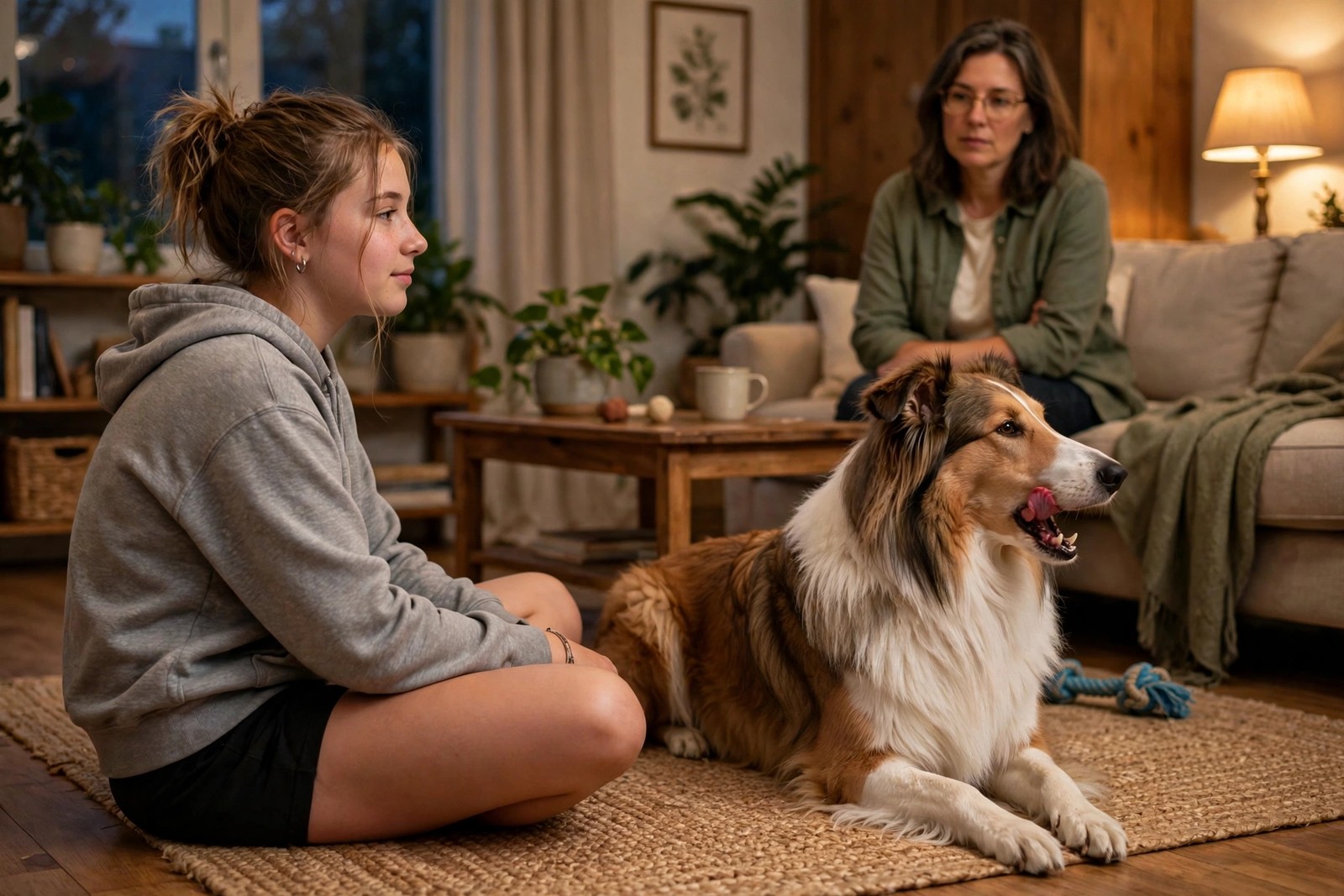
Dogs rarely bite out of nowhere. Long before a growl, dogs usually run through a quiet sequence of requests for space, and bites usually happen because every quiet request was missed or overridden. Teaching your family to spot the early rungs of that ladder is one of the highest-value safety skills a household can learn.
The early rungs: easy to miss, easy to learn
A lip lick when no food is involved — a quick flick of the tongue over the nose — is a classic early sign of unease. A yawn in a dog who is not tired, often paired with squinting or turning away, serves the same purpose. Turning the head, and then the whole body, away from a hand, a face, or another dog is a polite attempt to end the encounter. Add ears pinned flat back, a brow that wrinkles, and a mouth that goes suddenly from a loose, open pant to a tight closed line. Context is everything: a lip lick after a tasty treat is about food, while the same lick during a hug, a grooming session, or a toddler's approach is a request for space. Teach the family to read the situation and the signal together, never the signal alone.
The middle and late rungs
If the early signals are ignored, dogs generally escalate rather than repeat themselves forever. Whale eye — the whites of the eyes showing as the dog turns her head away while keeping her eyes fixed on the source of pressure — is a clear middle rung. A tail that tucks, a body that crouches or leans away, and walking off are louder requests. Freezing is the rung families most need to respect: a dog who goes suddenly still over her food bowl, a toy, or during handling is not calm, and reaching in at that moment is how bites happen. The growl that follows is honest communication, and it must never be punished; a dog punished out of growling does not feel better, she simply skips the warning next time.
Teach it like a game, then make it a rule
Families learn signals by spotting them in real life, not by reading about them. Start with photographs and short video clips and have everyone call out what they see: tongue, yawn, head turn, whale eye. Then move to real life in calm settings, narrating your own dog's signals as they happen — she licked her lips when the doorbell rang, she turned away from that stroke, so the stroking stops. The household rule is stated once and applied by everyone: any signal stops the interaction, the dog gets space, and nobody follows her for one more cuddle. Children need the rule in its simplest form: if the dog walks away, the game is over, and the dog is never chased, cornered, hugged around the neck, or disturbed while sleeping or eating.
Turn sightings into a pattern
A week of sightings reveals your dog's pressure map. Note what reliably precedes signals — visitors leaning over her, nail trims, the vacuum, a particular child's rough play — because that pattern is your management and training plan. Change what you can: guests let her approach them, grooming moves to short cooperative sessions, and busy gatherings give her a quiet room she can choose rather than a crowd she must endure. If signals are appearing daily around ordinary handling, or she has progressed to snapping, ask your vet to check for pain and refer you to a qualified behaviourist, since pain and fear often drive escalating cases.
One page everyone can check
Signals get missed when each person carries a different mental list, so write your dog's ladder down where the whole household can see it, including the situations that load her up and the rule that follows each rung. KinsLe's Family Sharing puts that ladder inside your dog's shared profile, where family members and regular sitters read the same version before they handle her rather than learning her limits by trial and error.