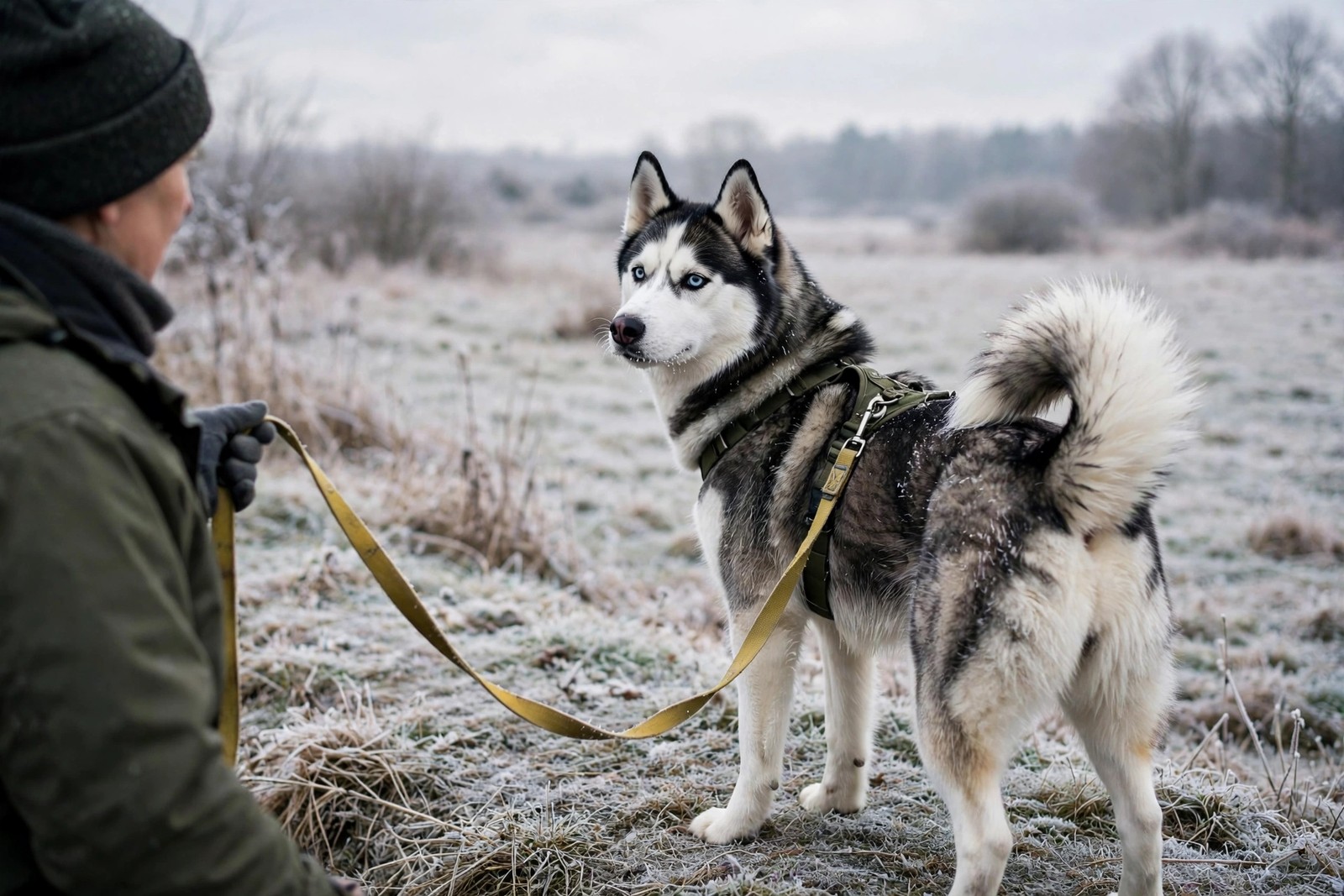
A Husky who ignores you outdoors is rarely being stubborn in the human sense. She is making a rational trade: the environment is offering running, sniffing, chasing, and exploring, while your treat pouch is offering a biscuit she can take or leave. Traditional training tries to outbid the world with better food and often loses. Environmental training changes sides: you stop competing with the world and start controlling access to it, so that your cues become the toll gate every good thing passes through.
The Premack principle in plain terms
Premack's principle says a behaviour an animal wants to perform can reinforce a behaviour it is less keen on. For a Husky, the high-value behaviours are clear: sprinting, sniffing a scent-rich verge, greeting a known dog, digging in an allowed spot, pulling in harness. The low-cost behaviours you ask for are equally modest: glance at you, come three steps toward you, sit for two seconds, touch your hand. The exchange must be immediate and obvious — cue, response, release word, and straight to the activity — so the dog can draw the line between the ask and the payoff. Within a few sessions many Huskies start offering the glance before you ask, because the glance is what makes the run start.
Set the exchange rate honestly
Begin somewhere boring: a quiet field edge or a familiar street, on a long line of ten metres so she cannot self-pay by bolting to a distraction. Ask for the smallest possible response, release instantly, and let her enjoy the reward rather than snatching her back after two seconds. Raise the price gradually as the environment gets more exciting: a look in the quiet field becomes a recall of a few steps at the park entrance, then the same recall with dogs visible at a distance. If she blows off a cue at a new level, the price was too high for that marketplace; drop back to the last level she could pay, rather than repeating the cue. Repeating a cue she is ignoring only teaches her that the first three versions are optional.
Build the rewards into the walk itself
A walk structured as a series of earned releases teaches continuously instead of in one formal session. The gate does not open until she looks at you. The boring pavement stretch earns the sniff patch at the corner. Standing calmly while you clip the long line earns the run across the field. A recall away from an interesting smell earns a game of chase with you or a scatter of treats to hunt in the grass. Huskies are built to work in harness, so a pulling session can be the grand prize after a week of good exchanges, with experienced club guidance if she is new to it.
Respect the breed's hard limits
Environmental rewards never include unsafe freedom. Huskies are poor off-lead candidates around roads, livestock, and wildlife, because prey drive plus selective hearing is a dangerous combination; the long line and secure fields are permanent management, not a failure of training. Never release her toward another dog without the other owner's agreement, and never let the release reward be chasing birds or squirrels, which practises exactly the behaviour you may need to interrupt one day. Heat is the other limit: summer sessions belong in the cool of the morning, with rewards chosen from shade, water play, and sniffing rather than hard running.
Why this outlasts treat-only training
The lasting change is the dog's belief about what your voice means outdoors. A cue stops being a competing offer and becomes the mechanism that starts everything she loves, which is why Premack-trained dogs often look more engaged, not less: they watch you in exciting places, waiting to find out what the toll will buy. KinsLe's Care Teams keeps that belief intact across handlers, because each person who walks or runs your Husky can be assigned the same ask-then-release routine and mark sessions complete, so the toll gate never stands open for one walker and closed for another.