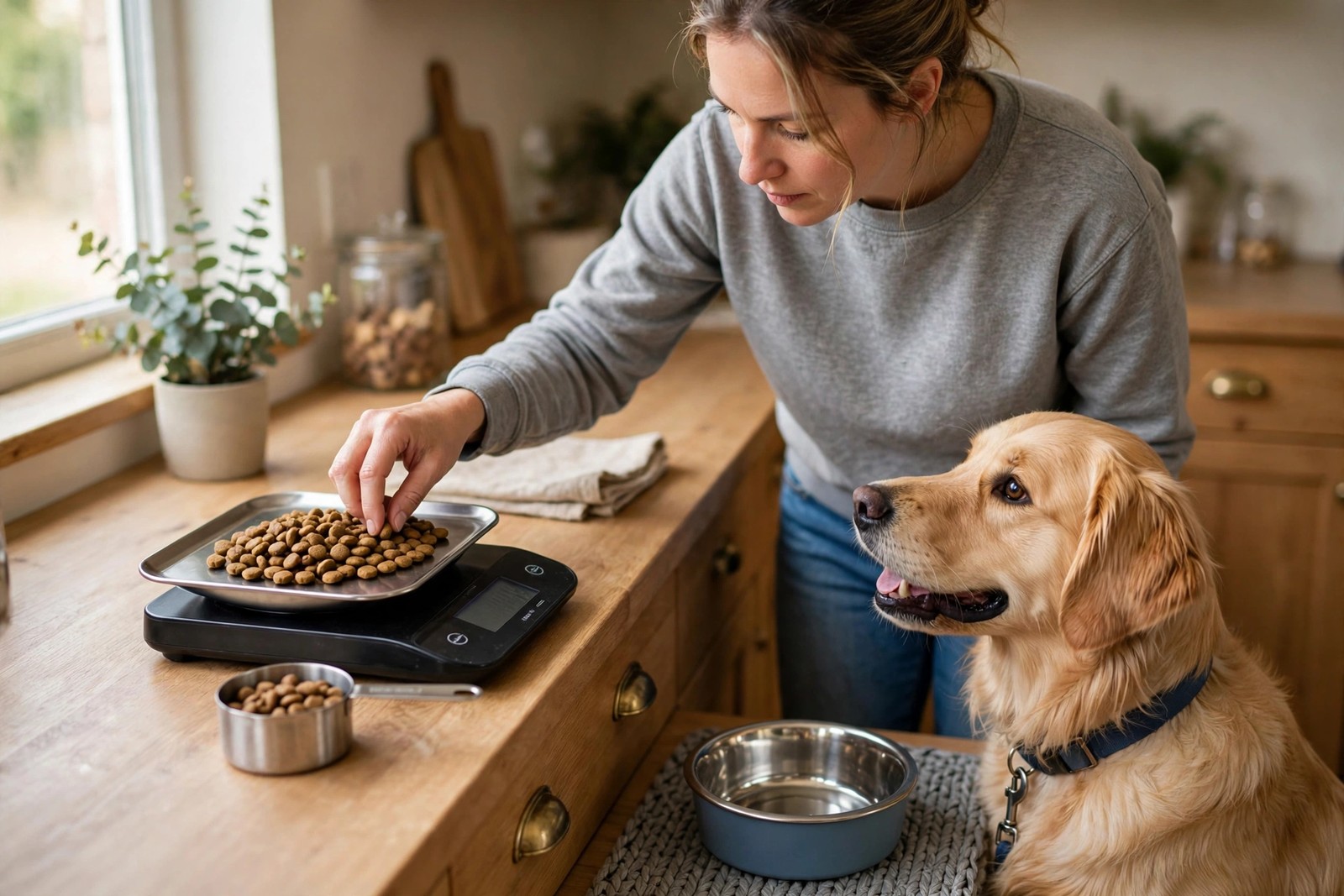
No chart can hand you a final portion, because two dogs of identical weight can need noticeably different amounts. Metabolism, neuter status, coat, climate, and daily movement all shift the requirement. The reliable method treats the printed guide as a starting draft and your dog's body condition as the editor. You measure carefully, observe over a set period, and adjust in small steps until condition holds steady.
Start With the Guide and a Scale
Find the feeding guide for your dog's food and read the row that matches current weight and life stage. Weigh the suggested portion on kitchen scales instead of trusting a cup or a scoop, because scoops vary widely between households and even between hands. A worked example clarifies the process. A guide suggesting 240 grams a day for an adult dog of a given weight becomes your test ration, split across the day's meals, and that exact amount stays fixed for two full weeks.
During the test period, keep treats inside a small, counted allowance and hold exercise roughly constant. Changing food, treats, and activity at once destroys the experiment, and you end the fortnight unable to say which change moved the dog's condition.
Judge by Condition, Not by Appetite or the Bowl
At the end of two weeks, assess the dog with your hands and eyes. Ribs should be easy to feel under a thin layer of fat when you run flat palms along the ribcage with light pressure. From above, a waist should narrow behind the ribs. From the side, the belly should tuck upward behind the ribcage rather than hang level or sag. A dog who meets those marks holds the current portion. A dog whose ribs hide under padding needs less, and a dog whose ribs, spine, and hip bones feel sharp needs more, provided health checks raise no concerns.
Appetite alone misleads. Plenty of dogs request a second dinner with complete sincerity and no nutritional need, and the empty bowl after a meal proves enthusiasm rather than insufficiency.
Adjust in Small Steps and Recheck
Change the ration by roughly a tenth at a time. In the worked example, a tenth of 240 grams is 24 grams, so the next test ration becomes 216 grams for a dog who needs less or 264 grams for a dog who needs more. Hold the new amount for another two weeks and assess again. Small steps protect digestion, and the fortnightly rhythm distinguishes a real trend from a single heavy week of training treats or a quiet week during bad weather.
Apply the Method Across Life Stages
Puppies need the method applied more often. Growth changes the target weekly in the early months, meals divide into three or four servings, and regular weighing confirms steady gain along a smooth curve rather than abrupt jumps. Follow the puppy guide for the food you use and let your vet review growth at each vaccination and check-up visit.
Active adults who run, train, or work most days often settle toward the upper part of a guide's range, and their requirement can rise during a busy season and fall during rest. Seniors and neutered dogs frequently maintain condition on less than the mid-range figure, because activity drops and metabolism eases. Any dog who loses or gains weight despite careful measuring and honest treat accounting deserves a vet conversation, since a vet can investigate possibilities that portion arithmetic cannot explain.
Once you settle the amount, the household must serve that amount rather than each person's interpretation of it, and KinsLe Care Teams pins the weighed portion to the dog's feeding duty so the figure survives handovers.