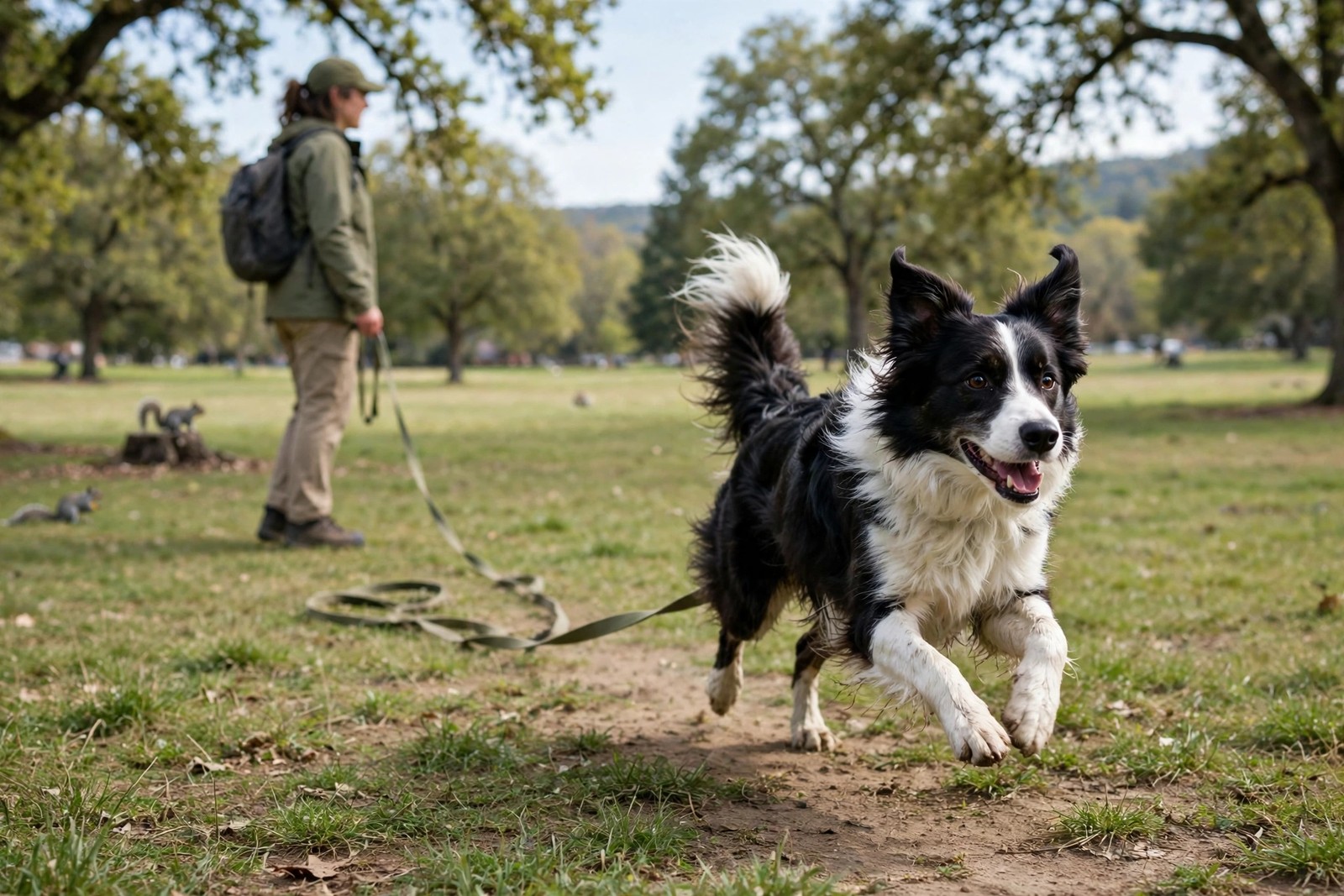
Class recall and park recall are different sports. In the hall, your dog works at short range, on a familiar surface, with no wildlife, few smells, and a head already in training mode, so coming back to you is an easy option for him to choose. The park reverses every one of those conditions: distance opens up, scent saturates the ground, other dogs appear, and squirrels move in the exact way that switches on chase. A recall that collapses there is not a dog being stubborn about a cue he knows. It is a cue that has never been trained at that level of difficulty.
Diagnose Before You Retrain
Ask honestly what the recall is competing against and what it pays. If your park recall pays the same ordinary treat as a sit in the kitchen, while the squirrel pays a full-speed chase, the arithmetic is not in your favour. Ask also how often the recall has predicted the end of fun: if coming back usually means the lead goes on and the walk ends, a thoughtful dog learns to delay it. And ask how many times he has been called when he was never going to come, because every ignored recall in the park is a rehearsal of ignoring you that he logs as evidence the cue is optional outdoors.
Rebuild on a Long Line, in Graded Places
Move training into the real world at the lowest rung that still counts. Start in a quiet field or a fenced area on a long line, with no wildlife in play, and pay every recall with something exceptional: warm chicken, cheese, a thrown favourite toy, whatever your dog genuinely values highly. Recall often and release him back to exploring most of the time, so returning predicts a bonus rather than a confiscation.
Raise difficulty in deliberate steps: a busier park at quiet hours, recalls at greater distances, recalls away from interesting smells, then recalls with other dogs in view at a distance. Wildlife is the final examination, not the practice ground. Practise the precursor skills squirrel encounters actually need: an emergency stop, a look-away rewarded heavily, and a recall that begins before he locks onto movement, because calling a dog who is already staring, stiff and trembling, is calling too late.
Manage the Gap Honestly
Until park recalls hold around real distractions, the long line stays on in unfenced places. That is not a permanent failure state; it is insurance that keeps him safe near roads and livestock, prevents rehearsed disobedience, and protects the retraining. Let him earn freedom area by area: off lead first in the secure field where his recalls have been flawless for weeks, then in one quiet corner of one familiar park, with the line ready to return if the standard slips.
Never chase him down, scold a late return, or repeat the cue in a rising chant while he ignores it. A dog who eventually comes, even slowly, gets paid like he came instantly; the alternative teaches him that returning ends in trouble, and a dog who believes that stops returning at all. If recalls fail completely in a new environment, go back down a grade rather than pushing through.
Class-perfect, park-hopeless dogs often become reliable with a season of graded work, because the understanding was always there and only the difficulty needed scaffolding. KinsLe Care Teams helps that scaffolding survive busy weeks, because you can assign the long-line practice sessions and the graded park visits to named family members or helpers and see each completed session marked with a timestamp.