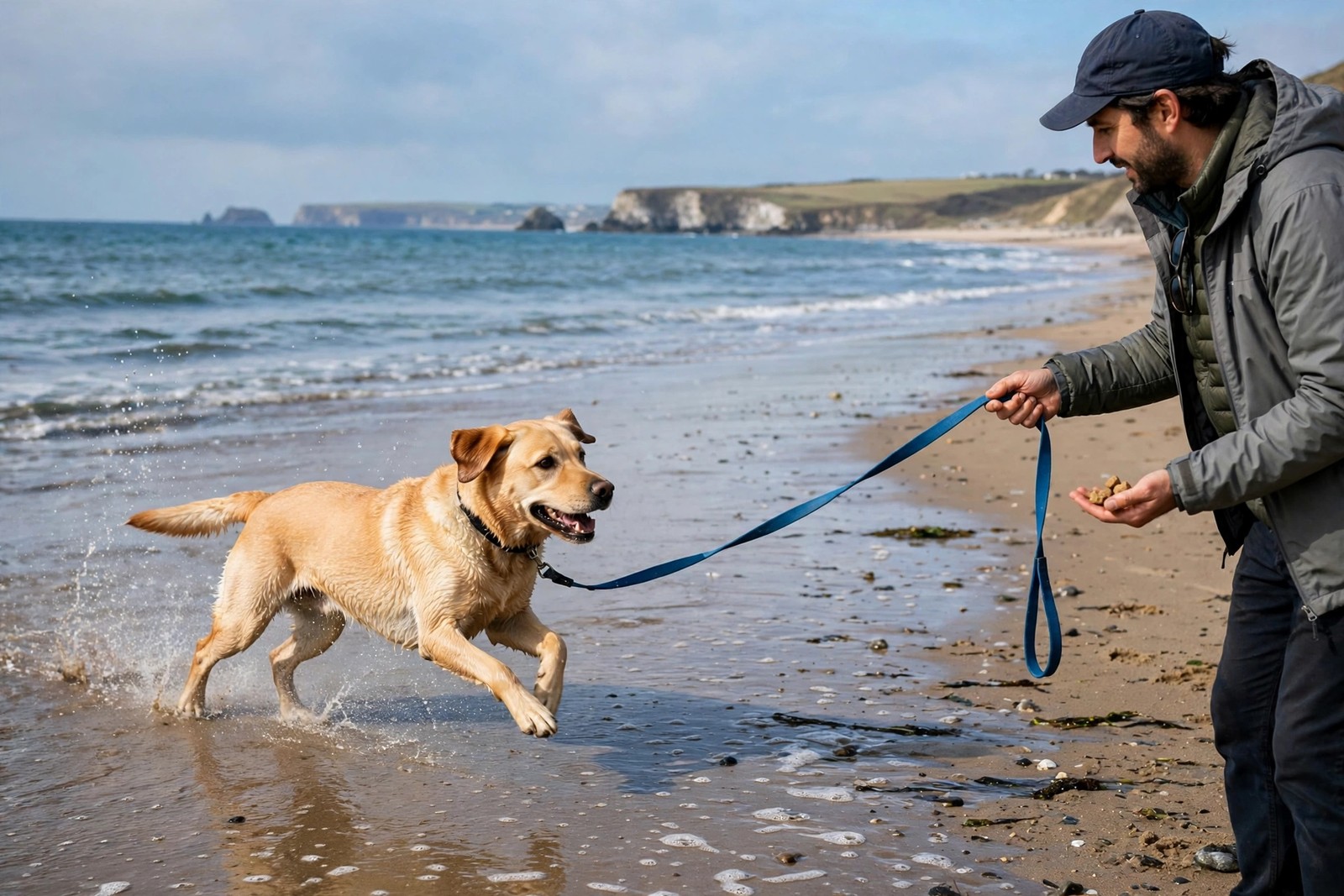
A garden recall can look rock solid while telling you almost nothing about the beach. Your dog has practised in the garden hundreds of times, in a small, familiar space where nothing competes with you, and she has been paid every time. The beach reverses every one of those conditions at once. It is huge, it changes daily, it smells of fish, seaweed, picnics and other dogs, and it contains water she can charge into and birds she can chase. She is not being disobedient in a new way; she is showing you that recall, like every cue, is learned place by place.
Why the Same Treats Lose at the Beach
Rewards are relative. A treat that wins against a quiet garden loses against the chance to sprint into surf, because your dog is comparing offers in the moment, not remembering what the treat was worth at home. History matters as much as value. Each beach visit where she was called, did not come, kept playing and was eventually collected has taught her that the beach cue can be waited out. Calling repeatedly makes it worse: a string of ignored calls trains her that the first several mean nothing. There is also an ending problem. If a beach recall usually means the lead goes on and the fun stops, a thinking dog delays the recall that ends the party, however good the treat attached to it is.
Rebuilding Recall Where It Has to Work
Train at the beach, on a long line, so she cannot rehearse ignoring you and cannot get into trouble while she learns. Start with recalls at moments you can win: when she is already turning towards you, is nearby, or has just checked in. Pay those wins with a jackpot, meaning a rapid handful of high-value food, genuine delight from you, and then the part owners often skip: release her straight back to the beach. Recall followed by release teaches her that coming does not end anything, and that lesson is what makes the cue strong in exciting places. Build a separate, fresh whistle recall at home if your voice cue is already worn out at the beach: charge the whistle with jackpots in easy places first, then layer it in on the line at quieter stretches of shore. Practise little and often across several visits rather than drilling her until she is tired and sloppy.
Safety and Honest Milestones
Until the beach recall is proven, the long line stays on whenever she is near water, cliffs, roads, livestock or other beach users, and she stays on it around dogs or families who have not invited an approach. Choose practice zones away from the busiest stretch, read local rules about where dogs may be off lead and when, and keep her out of wildlife areas and nesting zones. Proof in stages: quiet beach on the line, busier beach on the line, quiet beach with the line trailing, and only then freedom in the setting where she has succeeded repeatedly. A recall that works nine times out of ten at a crowded beach is not ready; the tenth miss may be a run at an old, frightened or reactive dog. If she is a determined chaser of birds or wildlife, a trainer can help you build the intermediate steps safely.
Everyone who takes her to the shore needs the same rule set: one call, jackpot pay, release back to play, and no testing her off the line before her stage allows it. KinsLe's Care Teams keeps those stages and practice turns assigned across the family, with each session marked complete with a timestamp so her progress is tracked honestly.