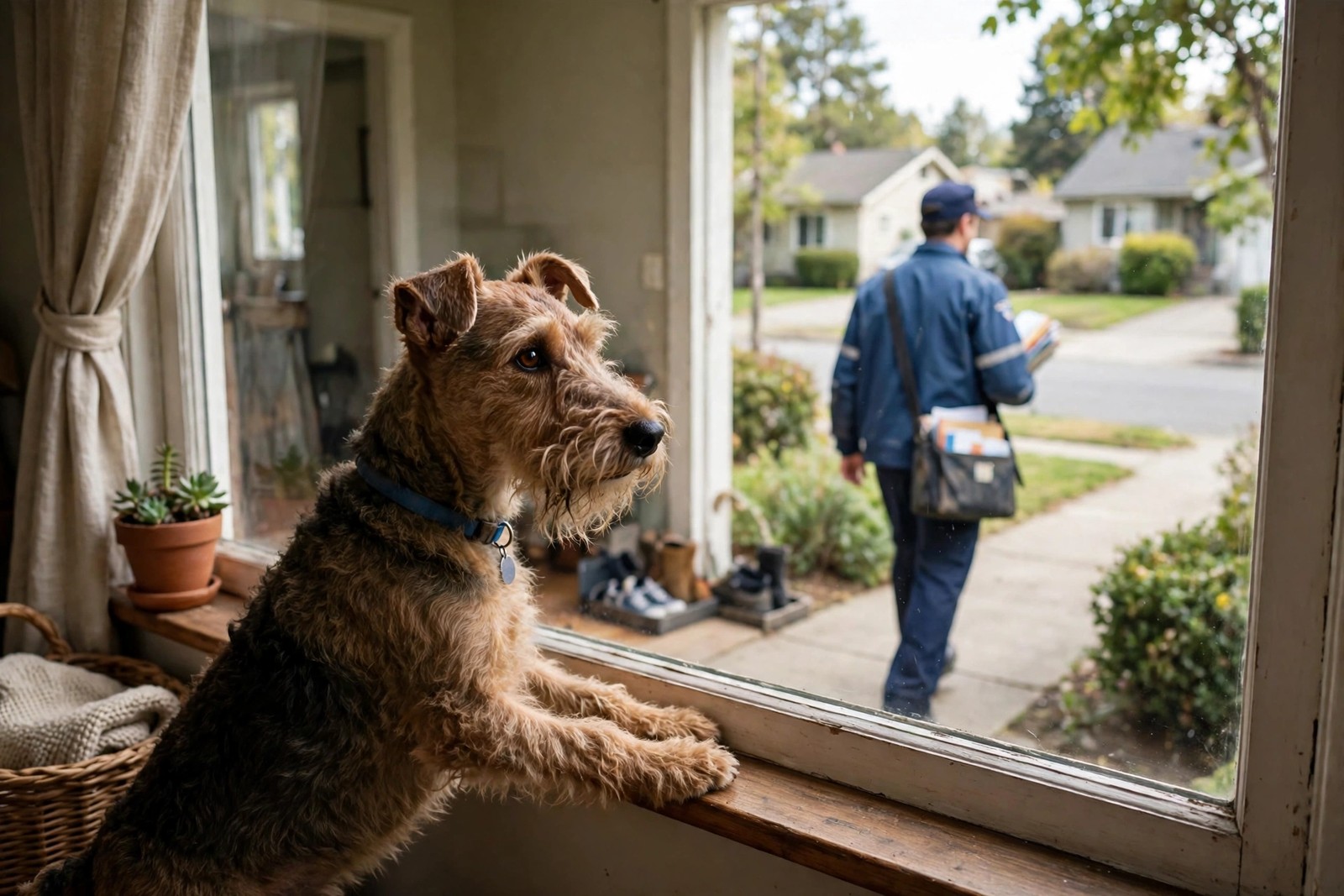
The mail carrier is the one visitor your dog believes she defeats every single day. She hears the van or the footsteps, races to the door or window, barks hard, and then the person walks away. In her mind the sequence proves itself: a stranger entered her territory, she raised the alarm, and the stranger left. That daily reinforcement loop, repeated at roughly the same time, is why this barking is so reliable and so hard to shift with scolding alone.
What the Barking Is Guarding
This is mainly territorial and alert barking. The front door, porch, and front window are the boundary of your dog's home, and a person who approaches, pauses, pushes something through the letterbox, and leaves without being greeted by you looks very different to a dog from a welcomed guest. Barrier frustration adds fuel: she can see and hear the carrier but cannot reach or investigate, so arousal climbs. Some dogs also learn the early cues, such as a particular vehicle sound, a gate click, or footsteps at a set time, and start winding up well before the carrier reaches the door.
Retraining the Delivery Moment
Start by cutting rehearsal. Close blinds, use a baby gate to keep her back from the front window, or settle her in another room with a food toy shortly before the usual delivery time. Every unseen, unbarked-at delivery weakens the habit a little.
Then build a replacement behaviour at quieter moments first:
- Practise a look-at-me cue and a go-to-your-mat cue away from the door, paying with small treats the moment she complies.
- Play delivery-type sounds at low volume, such as keys, a letterbox flap, and footsteps, and reward calm glances toward you instead of barking.
- With a helper playing carrier, have the person approach slowly, stop at a distance where your dog notices but can still look away, and reward that look away and any quiet moment.
- Shorten the distance over many short sessions, never in one big test, and end while she is still succeeding.
During real deliveries, scatter a few treats on the floor or hand over a stuffed food toy just before the barking usually starts, so the carrier's arrival predicts something good happening away from the door. Keep your own voice low and boring. Shouting over the barking often sounds to a dog like joining in, and punishing a dog for guarding can add fear to an already aroused moment.
When the Barking Needs More Help
Get a qualified trainer involved if your dog lunges at windows or doors, cannot be redirected with food, barks with a stiff body and raised hackles at all passers-by, or is starting to redirect excitement onto people or other pets in the house. Mention a sudden change in barking, appetite, or sleep to your vet as well, because pain and illness can lower a dog's tolerance generally. Most carrier barkers, though, improve steadily once the daily win is removed and quiet behaviour starts paying better, and KinsLe Care Teams keeps that progress on track by assigning the pre-delivery settle and practice duties to whoever is home, with each completed task timestamped.