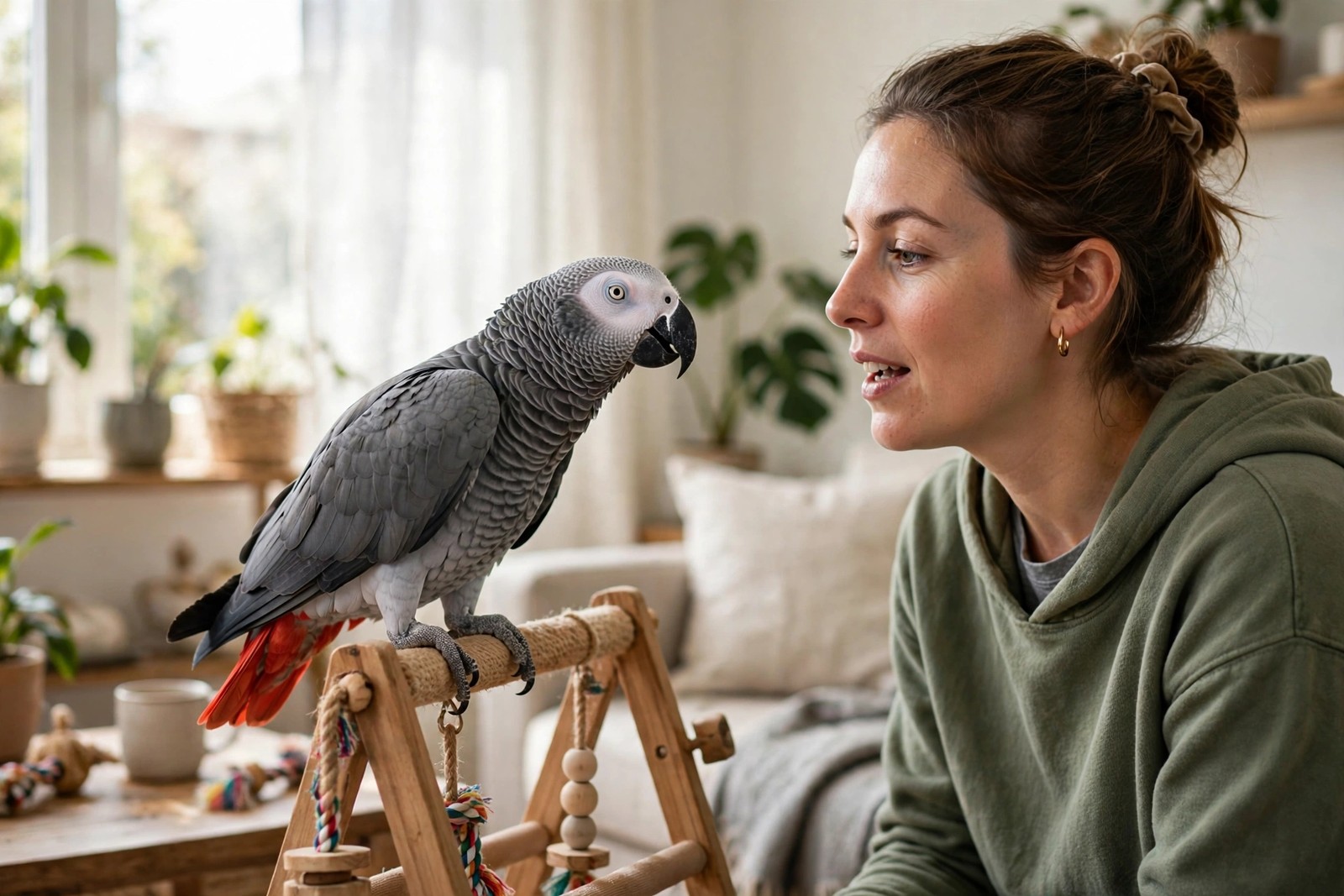
Yes, really. African grey parrots are widely regarded as the most accomplished talkers among parrots — not just for how many sounds they can copy, but for how clearly they copy them and, in some birds, for using words in ways that fit the situation.
What a Grey Can Actually Do
A grey's mimicry is precise. Many learn to reproduce words and short phrases in a voice close to their owner's own pitch and tone, along with doorbells, phone rings, microwave beeps, coughs, and laughter. Vocabularies vary enormously: a typical pet grey may learn a handful of reliable words and phrases, while exceptional birds learn well over a hundred. Some greys use labels in context — greeting a specific person by name, asking for a particular food and refusing substitutes, or announcing a routine event as it happens. Careful research birds have demonstrated labelling of objects, colours, and shapes, though an ordinary pet's skill depends on how much deliberate, interactive teaching it receives.
What talking is not: a grey does not hold conversations or understand grammar. It is an exceptionally intelligent social animal using sound to interact, get responses, and be part of the flock — which is precisely why the teaching method matters.
Why Some Greys Talk and Others Whistle
Individual variation is large and normal. Many greys start producing recognisable words somewhere in their first year or two, but some start earlier, some much later, and some clearly prefer whistles, clicks, and perfect imitations of household sounds to human words. A quiet grey is not a broken grey: health, confidence, early socialisation, and how much one-to-one interaction the bird gets all shape output. Birds who are anxious, frequently rehomed, or left alone for long stretches often vocalise less in words and more in contact calls or stress behaviours. Never choose or reject an individual bird purely on a breeder's promise of talking; there are no guarantees, and a grey can live for decades, far longer than the novelty of a talking pet.
How Owners Actually Teach
Greys learn best from live social interaction, not recordings on loop, because the learning is social: the bird watches your face, hears the word at the moment the thing happens, and gets your delighted reaction as the reward. Practical teaching looks like this. Pick one or two useful labels — a favourite food, the bird's name, a greeting. Say the word clearly at the real moment, every time: the food as you hand it over, the greeting as you enter. Keep sessions short, around five to ten minutes of focused interaction a few times a day, woven into normal handling rather than drilled. Repeat words the bird is already attempting, shaping rough versions with praise, and never punish mistakes or withhold food to force performance. Most owners find words appear first in practice sessions alone — owners often hear muffled rehearsing from another room before the bird performs publicly.
The Bigger Commitment Behind the Talking
A talking grey is an intelligent, sensitive, long-lived companion who needs hours of daily social contact and out-of-cage time, mental work in the form of foraging toys and new problems, and a stable household; bored or lonely greys can develop feather-damaging behaviour and loud screaming. Buy the bird for that companionship, and let talking be a bonus.
In a multi-person home, share both the fun and the work: feeding, cage care, social time, and those short teaching sessions. KinsLe's Care Teams assigns each duty and logs it with a timestamp, so your grey gets the consistent daily interaction that speech grows from — whoever happens to be home.