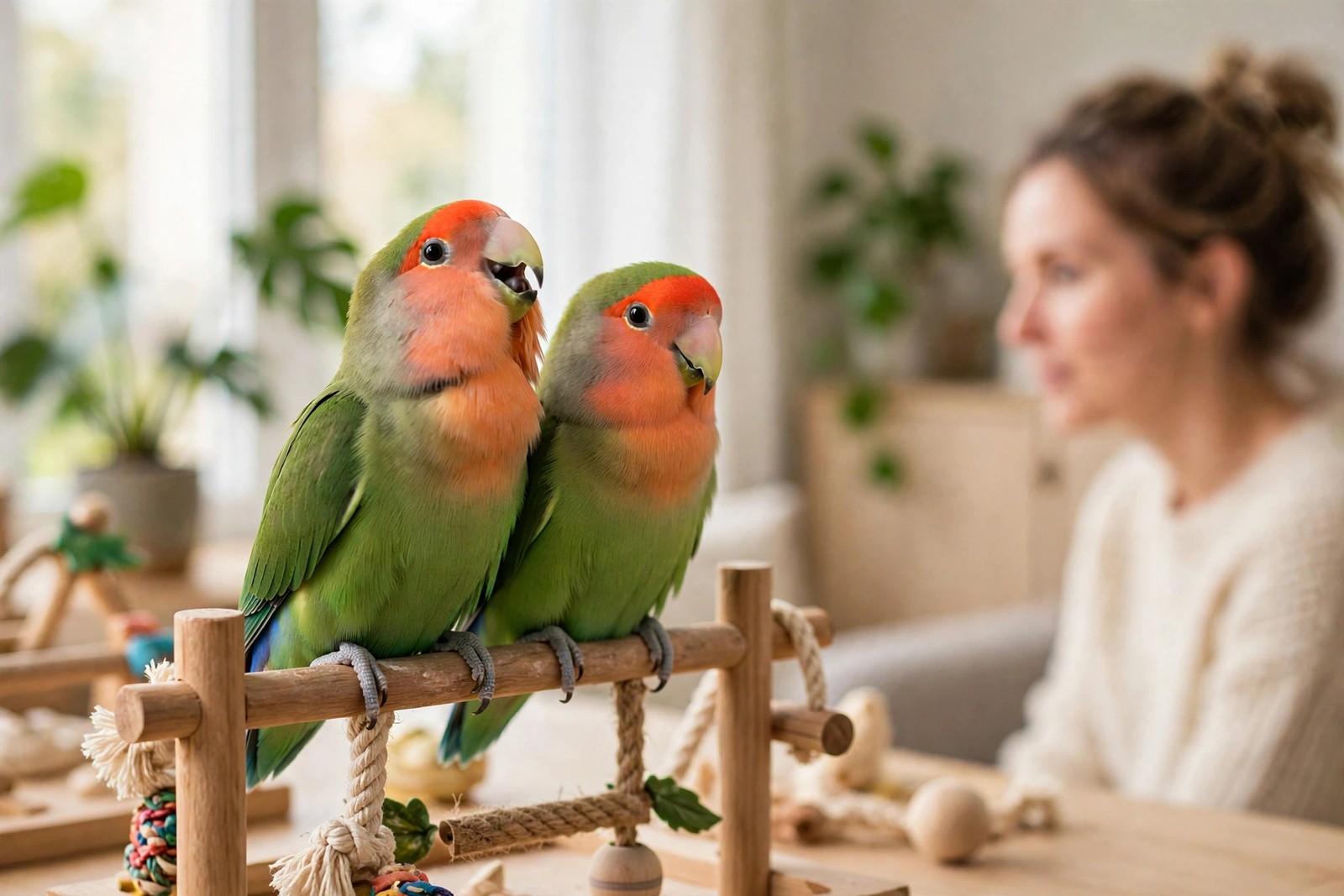
Rarely, and that word deserves emphasis. Lovebirds sit near the bottom of the talking table among pet parrots. Most lovebirds never produce a recognisable word in their lives. A small minority, usually hand-raised single birds closely bonded to one person, learn one or two short sounds that resemble a word, delivered in a fast, high, scratchy voice that visitors almost never understand until the owner translates. If clear speech is what you want from a bird, a lovebird is the wrong purchase, and it is kinder to know that before one comes home than after.
Why lovebirds are built differently
Talking parrots combine a particular vocal anatomy with a strong drive to mimic the sounds of their flock. Lovebirds have the flock drive in abundance, but their voices are small, rapid, and pitched for contact calls, chirps, and whistles rather than articulated mimicry. Budgies, their close small-parrot cousins, are far more gifted mimics, and even they speak in tiny, hurried voices. Large parrots famous for speech are a different league entirely. Expecting a lovebird to chat is asking a bird built for whistling to do a job its voice was never shaped for.
Individual variation exists. Females are sometimes said to mimic slightly more readily than males, and young birds learn sounds more easily than adults, but these are tendencies whispered among keepers, not promises. No training method overcomes the basic limit, and any seller guaranteeing a talking lovebird is selling something they cannot deliver.
What a lovebird can learn instead
Aim at the sounds lovebirds are genuinely good at and the training becomes enjoyable for both of you. Many lovebirds learn to copy a short, simple whistle: two or three notes, repeated at the same pitch, offered when the bird is alert and already vocal, typically in the morning chorus. Whistle the phrase, pause, and answer any attempt, however rough, with attention and a favourite food taste. Household sounds are also fair game; bonded birds sometimes reproduce a phone chirp, a microwave beep, or a regular door sound, usually without being taught at all.
Call-and-response games suit the species better than word drills. Make a contact call your bird already uses, answer theirs, and let exchanges build. Target training, step-up, and simple tricks give a lovebird mental work and deepen the bond far more reliably than speech lessons, and they succeed on the bird's actual strengths: boldness, curiosity, and devotion to a favourite person.
If you still want to try words
Keep it small and pressure-free. Pick one short word, said in the same bright tone, at the same moments each day, perhaps as you uncover the cage or offer a favourite food. Ten relaxed repetitions in context beat an hour of drilling. Record progress honestly over weeks, celebrate whistled replies as the wins they are, and stop any session where the bird turns away, flattens, or goes quiet. A lovebird who whistles back at you daily is communicating with you in its own language, and that exchange is the real prize the species offers.
What lovebirds give, they give generously: constant company, clownish play, and fierce affection. In KinsLe, Care Teams lets you assign the daily whistle games, training minutes, and social time that build that bond, each timestamped when done, so your lovebird gets the fluent conversation it actually understands: your time, every day.