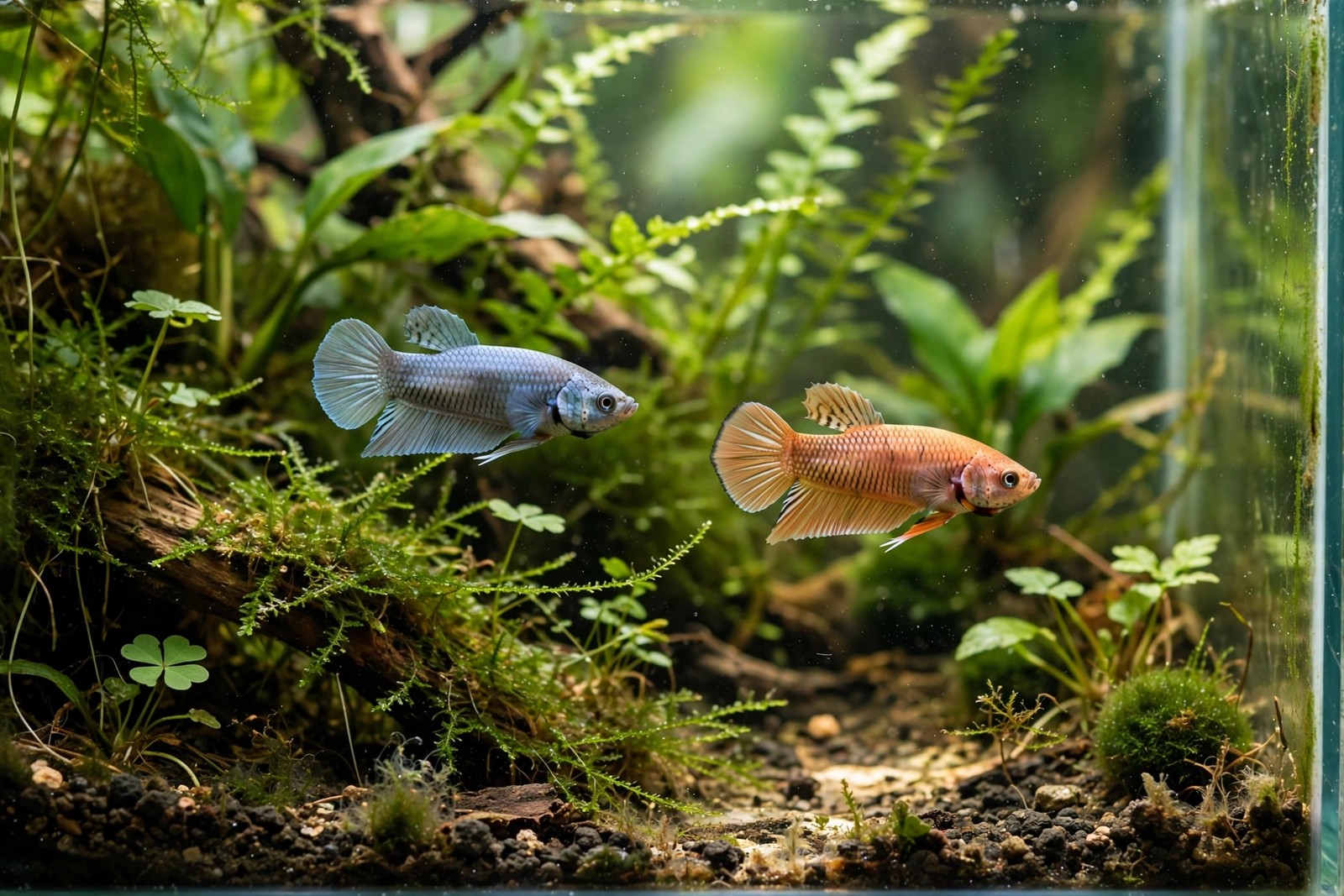
Usually, no — and the reason is arithmetic as much as temperament. Female bettas are less aggressive than males, but they still establish a hierarchy. With exactly two fish, every disagreement lands on the same individual: the stronger female chases, nips, and guards food, and the weaker one has nowhere to redirect the pressure and no group to disappear into. Owners often describe one bold fish out at every feeding and one fading fish behind the filter, fins ragged, colours dulled.
What a sorority actually requires
The community setup sometimes called a sorority spreads that hierarchy across a group — typically five or more females — so no single fish takes all the aggression. It needs a substantially larger tank than a lone betta's, commonly 75 litres or more, densely planted from substrate to surface with real or soft silk plants, caves, and floating cover that break sight lines in every direction. Females of similar size, ideally added at the same time, do better than a resident fish defending an established territory against a newcomer.
Even a textbook sorority is an advanced, watchful project, not a beginner upgrade. Hierarchies shift as fish mature, a peaceful group can turn after a water change or a death reshuffles ranks, and disease spreads quickly in a stocked tank. Every sorority keeper needs a cycled spare tank or divider ready the same day a fish is being beaten, not on order.
Signs it is not working
Act on patterns, not one scuffle. Separate fish if you see repeated chasing that ends with one hiding for hours, torn or missing fin tissue, bite marks, one fish consistently missing meals, stress stripes that do not fade, or a fish who only surfaces cautiously at the edges. Minor posturing in the first day — flaring, parallel swimming, then dispersing — can settle; relentless targeting does not improve with patience, and waiting risks infection setting into fin wounds in warm betta water.
Water quality underpins all of it: a heated, filtered, cycled tank, stable warm temperature, gentle flow that does not exhaust long fins, and prompt partial water changes. Stressed fish in deteriorating water get sick first, and a bullied fish is already stressed.
The option most owners enjoy more
A single female betta in her own planted tank is active, personable, and genuinely low-conflict — she will patrol, build bubble nests in some cases, and learn feeding routines without any hierarchy to police. If you want a community, build it around species chosen for a betta tank with great care, or keep several bettas in separate tanks where each fish is the whole story.
Close daily observation is what catches a sorority turning, before fins become wounds, and KinsLe's Care Teams keep that watching consistent: feeding, fin checks, and water tests can be assigned across the household with timestamped completions, so a subtle change noted on Tuesday is still visible to whoever checks on Thursday.