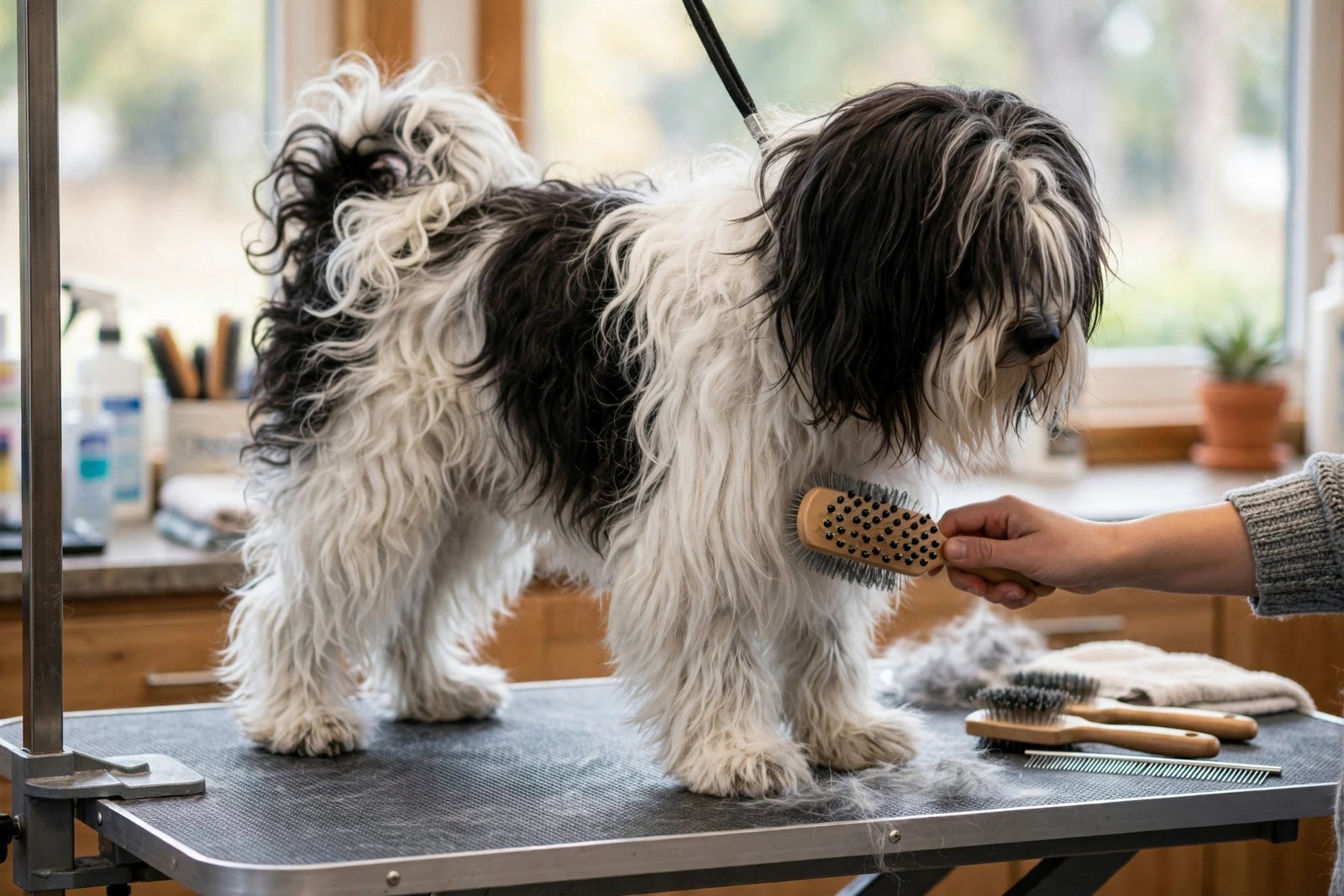
Two Legitimate Ways to Keep This Coat
Unlike many double-coated breeds, the Tibetan Terrier truly offers a choice. The natural coat is long, fine, and profuse — a soft, woolly undercoat under a heavier topcoat that falls over the body and face — and it can absolutely be maintained on brushing alone, with no haircuts at all. Equally, a great many pet Tibetan Terriers live happily in a puppy clip, where the coat is scissored or clipped to a few inches all over. Neither choice harms the coat; the breed's hair does not depend on being uncut the way a wiry terrier coat does. The decision is about your time, made honestly.
What Full Coat Actually Demands
A full-coated Tibetan Terrier needs brushing most days, and it must be done properly: mist the hair lightly, brush in layers down to the skin with a pin brush, and follow with a comb, because this undercoat mats from the inside out while the surface still looks smooth. The worst period is the coat change in the young dog's second year, when puppy coat and adult coat tangle together almost daily and many owners give up and clip — a reasonable surrender, not a failure. Mats concentrate behind the ears, in the armpits, at the elbows, and under any harness, and a mat left a week becomes a felted pad that must be cut out.
Bathing a full coat is a half-day rhythm of brush out, wash, condition, and careful drying with the hair brushed as it dries, since damp Tibetan hair tangles as it sets.
Life With a Puppy Clip
Choose the clip and the breed's grooming transforms. A puppy-clipped Tibetan Terrier needs a haircut roughly every month or two to hold the length, a simple weekly brush to keep the shorter coat from felting at the friction points, and far quicker baths and drying. The dog keeps the breed's fall of hair over the eyes in a softer form and all of its personality — only the maintenance calendar changes. For households that were missing full-coat sessions and fighting mats, the clip is the kinder option for the dog as well as the people.
Details That Apply Either Way
However long the coat, keep the hair between the paw pads trimmed — Tibetan Terriers grow generous foot hair that mats and collects ice and grit. Decide how to manage the hair falling over the eyes: many owners tie it up so the dog sees clearly and discharge does not crust into the fringe. Check ears weekly beneath the heavy ear hair, and wipe the beard, which in this breed collects water at every drink.
Coat Signals Worth a Vet Conversation
Raise it with your veterinarian if a Tibetan Terrier's coat thins noticeably, the skin under the coat turns red, flaky, or greasy, or scratching persists in a clean, mat-free coat. Heavy matting that suddenly worsens in an older dog can also be a flag that the dog is sore or unwell and tolerating less handling, which is information worth sharing rather than a grooming problem to push through.
Matching the Schedule to the Choice You Made
Full coat fails when daily brushing quietly becomes weekly, and clips fail when appointments drift — both are scheduling problems more than grooming ones. In KinsLe, Care Teams can hold a Tibetan Terrier's brush-outs or clip appointments as recurring assigned duties with completion timestamps, making a slipping routine visible while it is still easy to rescue.