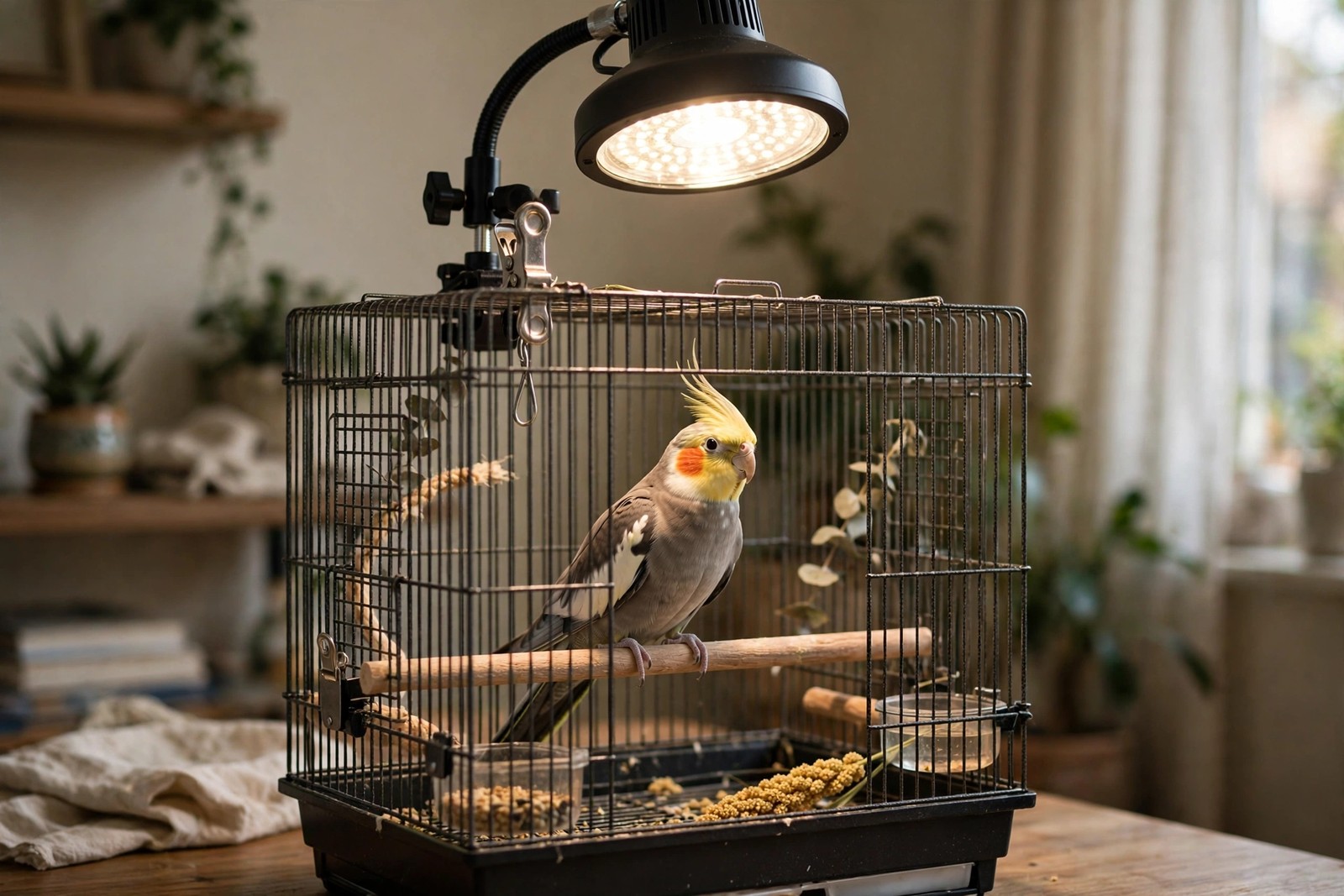
Indoor life leaves most pet birds short of something the outdoors provides free: ultraviolet light. Birds see into the ultraviolet range, so ordinary indoor light looks dim and colour-flattened to them, and UV exposure supports normal vitamin D and calcium metabolism, feather condition, appetite, and natural behaviour — which makes a proper full-spectrum lamp a genuine health provision, not a decoration. A window does not solve it: glass blocks the UV part of sunlight almost completely, so a bird beside a sunny window gets the warmth and the view but not the UV. Use a lamp made for birds, positioned and timed as its maker directs, typically providing a consistent day length of around 10 to 12 hours.
Setting Lighting Up Safely
Details matter: the lamp should be close enough to the cage to be effective (UV fades fast with distance — follow the manufacturer's distance), fitted with a guard so the bird cannot chew cables or reach the hot bulb, and replaced on schedule because UV output dies long before visible light does — most tubes and bulbs have a stated UV life of months, not years. Provide a shaded retreat in the cage so the bird can choose to move out of the light, keep a regular day/night rhythm with genuinely dark, quiet sleep time of around 10 to 12 hours, and never use reptile lamps, tanning lamps, or high-output UV meant for other species — too-strong UV damages eyes and skin. Supervised time in an outdoor cage or aviary on mild days, with shade available, is the natural alternative birds visibly enjoy, but it supplements rather than fully replaces a consistent indoor setup in most homes.
Working With Your Vet
Lighting questions are worth raising with an avian vet in a particular order: first record what you have actually set up — lamp type, distance from the main perch, hours it runs each day, and when the bulb was fitted — then note the changes that prompted the question, whether a duller feather finish, a drop in appetite, or eggs with thin shells. A vet can judge from that record whether lighting is a plausible part of the picture or whether something else needs examining first, and no article can make that call for your bird.
Bring the setup details with you, not just the symptoms. For a lighting conversation, the useful page lists bulb age, because UV output fades months before a tube looks dim, the day length your bird gets across the seasons, and how much supervised outdoor time there is, since those are the variables a vet will ask about before recommending any change.
A bird who is lethargic, losing feathers abnormally, laying soft or shell-less eggs, or showing weakness should see an avian vet promptly — lighting is prevention, not treatment for an established deficiency, and those signs deserve an examination rather than a new bulb.
Keep that record where it travels: KinsLe helps here through Pet Passport, which holds your bird's lamp details, bulb-change dates, and vet history as a single travelling record, so the next appointment builds on the setup you have already tried.