
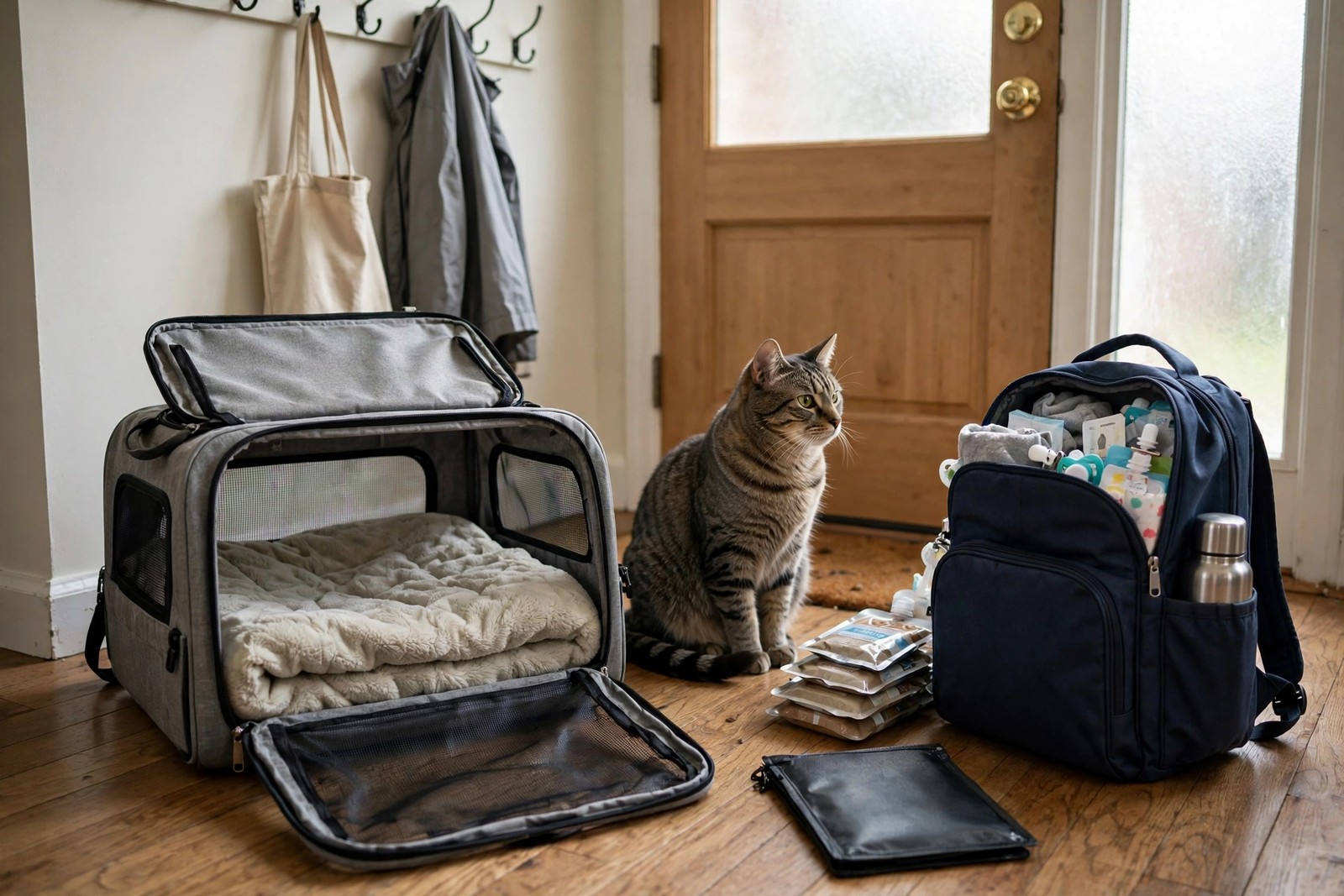
An evacuation kit for a cat in a home with a newborn has one design rule above all others: it must work for an adult carrying a baby. That means the kit is staged by the door, next to the baby's own bag, packed in advance, light enough to lift one-handed, and simple enough that no one is hunting through cupboards while an alarm sounds. Build it on a calm afternoon, check it when you check the baby's supplies, and let it sit ready.
The Carrier and the First Minutes
The carrier is the kit's foundation, and it only works if the cat already accepts it. A carrier that lives in a closet and appears only for vet trips teaches the cat to run from it, which is the last lesson you want rehearsed during an evacuation. Keep the carrier out in daily life, door open, with bedding inside, so the cat naps in it and treats it as furniture. In an emergency you are then closing a door on a settled cat instead of wrestling a frightened one into a strange box one-handed, possibly with a baby in the other arm.
Stage it with a cover ready to drape over it, since a covered carrier calms most cats in a car or a crowded hall. Practice the whole grab once: baby, baby bag, cat kit, carrier. If any step needs a second free hand, rearrange the staging until it does not.
Food, Water, and Litter
Pack a few days of the cat's own food, the food the cat is actually eating now, in sealed portions that need no can opener or measuring. Sudden food changes upset stomachs at the best of times, and an evacuation is not the best of times. Add bottled water for the cat alongside the household's own supply, a lightweight bowl, and a small supply of litter with bags and a compact tray or a few disposable liners, enough to keep the cat comfortable in a car, a relative's spare room, or a hall for the first stretch away from home.
Refresh the kit's food the way you refresh the baby's spare supplies: oldest portions used at home and replaced, so nothing sits forgotten past its best. Write the packing date on the kit itself so the check takes seconds.
Records, Medication, and Comfort
Copies of the cat's records travel in a sealed waterproof wallet inside the kit and as photos on your phone. Include the vaccination entries, your veterinarian's name and contact details, and a clear recent photo of the cat showing markings plainly. If the cat takes any medication, it goes in exactly as prescribed, with the routine written in plain words on a card: what it is, when it is given, and how the cat takes it, so another adult, a relative, or a shelter worker could follow it without guessing.
Finish with comfort, which is practical rather than sentimental: a familiar-smelling blanket, worn by the household and unwashed, lines the carrier and gives the cat one unchanged thing in a changed place. A small favorite toy earns its space for the same reason.
If the Cat Is Lost During the Evacuation
The kit is built to prevent loss: the accepted carrier, the door-side staging, the one-hand grab. But an evacuation is chaotic, doors stand open, and a cat can slip out in a strange place while the family is focused on the baby. That event, the cat actually unaccounted for during an evacuation, is the one moment the fallback exists for, and it is scoped to that moment only. For that one event, and no other, KinsLe's Lost Pet Alert System stands ready behind the kit. Only for a cat actually lost amid an evacuation does that fallback matter: you send word through the Lost Pet Alert System on KinsLe to nearby owners, while anyone who finds the cat reaches the owner directly from the profile.