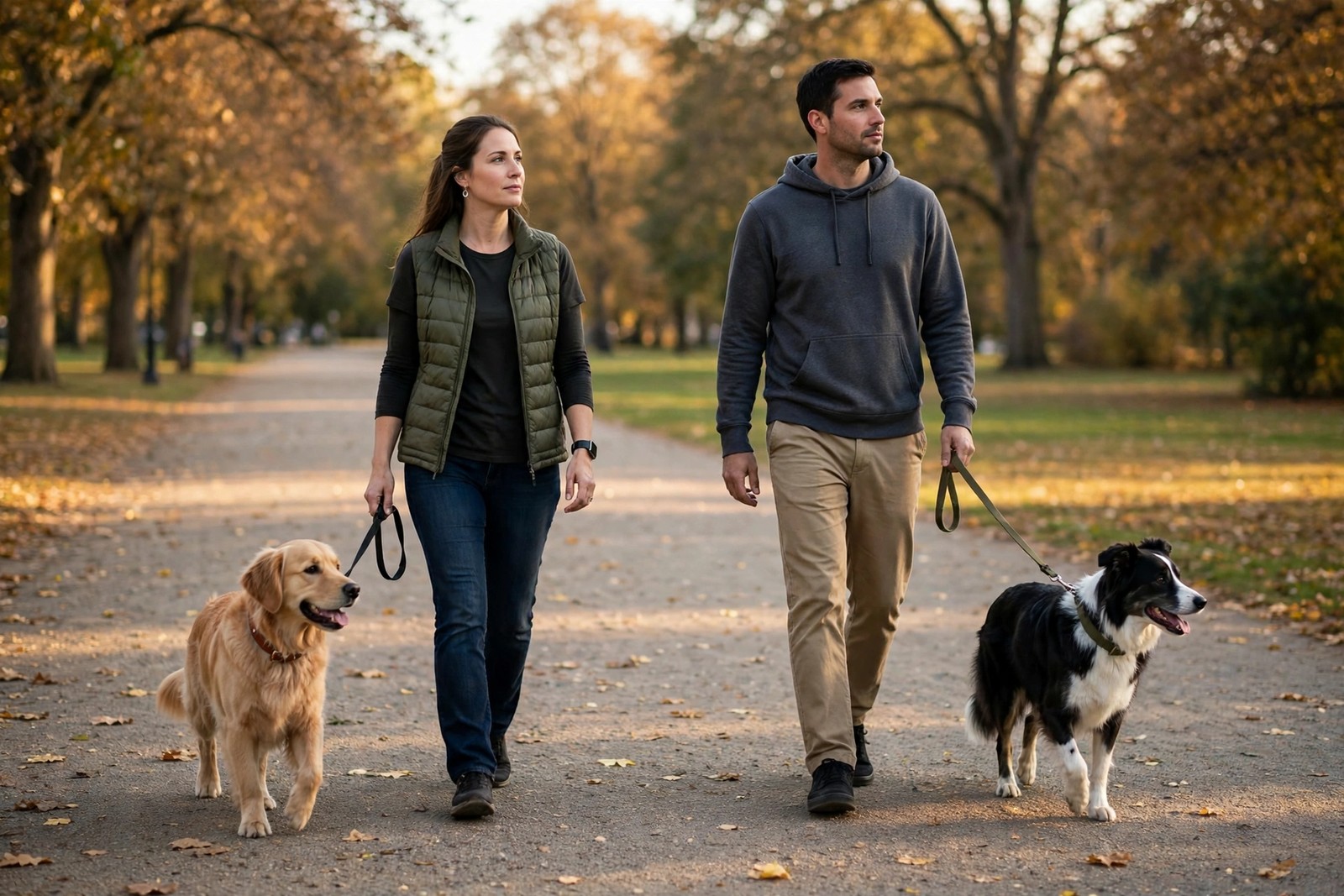
This meeting goes best when it is deliberately undramatic. Neither dog should first learn about the other through a doorway, a hallway, or a garden gate on home territory, where one dog has something to defend and the other has nowhere to put distance between them.
Start With Parallel Walks, Not Face-to-Face Greetings
Pick a neutral, open place neither dog associates with its own patch: a quiet park path or wide pavement. Each dog has its own handler, its usual lead and harness, and treats it genuinely likes. Begin walking in the same direction with enough distance between the dogs that both stay loose: soft bodies, tails at a natural height, able to glance at each other and then look away and take food.
Close the gap gradually over ten to twenty minutes if, and only if, both dogs stay relaxed. Let them drift closer, allow a sniff of two or three seconds, then cheerfully call away and keep walking. Long, stationary greetings are where tension builds, leads tangle, and dogs run out of polite options. End the first walk while it is still going well, and repeat the whole exercise on at least two or three separate days, including one walk that starts from further apart on a busier route.
Read the Dogs, Not Your Hopes
Green lights are loose, wiggly movement, play bows offered and accepted, soft eye contact broken easily, and both dogs choosing to look back at their handlers. Slow down or add distance if you see hard staring, a high stiff tail, a closed mouth and leaning forward, growling, or one dog repeatedly trying to get away. Do not scold warnings away: a growl is information. If either dog has a history of biting, guarding, or fighting, involve a qualified behaviourist before you move to home visits at all.
Stage the First Home Visits
Let the first visit be to the garden or yard, not the living room. Pick up toys, chews, bones, and food bowls beforehand, because familiar possessions are the most common flashpoints between dogs who were fine on walks. Let the dogs explore together with leads trailing only if the space is secure and both are relaxed, keep the visit short, and separate them for rest before either gets tired and grumpy.
Feed those first shared-house meals well apart, ideally either side of a gate, and give each dog its own bed, water, and retreat space from the very first visit. Walk them together before visits when you can: shared walks are the social glue that makes indoor time feel ordinary rather than intense.
Move-In Day and the First Weeks
On moving day, bring the dogs into the settled house separately after a joint walk, rather than carrying boxes around two loose, excited dogs. Keep the first weeks more managed than you think necessary: gates between rest areas, no unsupervised time together, chews and high-value toys kept for separate spaces, and the same walking, feeding, and sleep routine every day.
Most pairs settle in layers: easy on walks first, then calm in the garden, then relaxed indoors, then genuinely choosing each other's company. If tension appears at one layer, drop back to the previous one for a few days instead of pushing through. To keep all of that consistent between two adults with different habits, KinsLe's Care Teams lets you assign the joint walks, separate feeds, and rest-space checks to named people, with each task timestamped when done, so neither dog's routine depends on who remembered what.