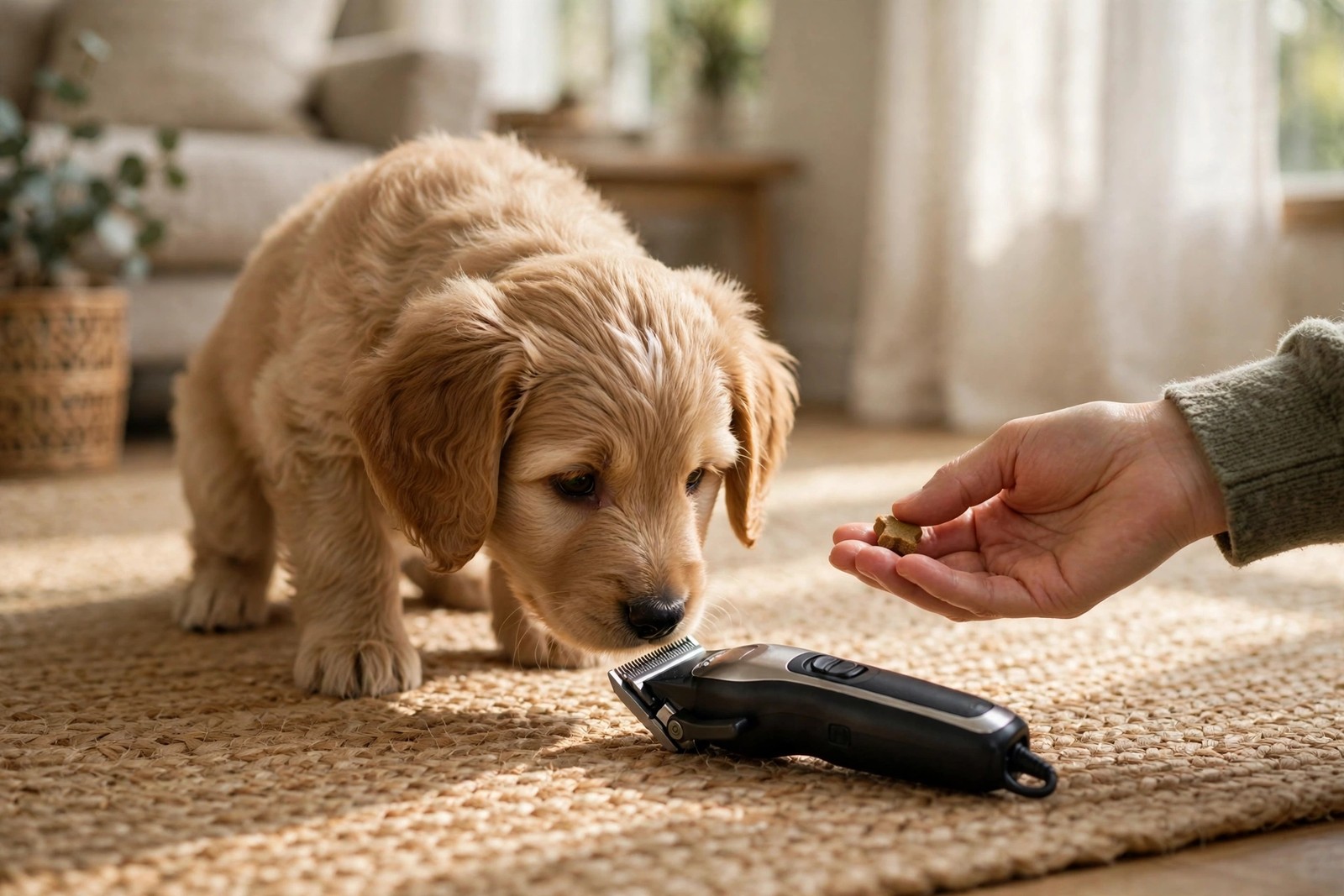
A puppy who meets clippers as ordinary background rarely grows into an adult who fights them, so the goal before her first full groom is familiarity rather than any actual trimming. Everything happens in brief, food-paired steps of about a minute, fitted around play and naps, and every session ends before worry appears. Puppies tire and flood quickly, which is why short and frequent beats one ambitious rehearsal.
Work on the floor at her level, in a room she already likes, and let her wander away whenever she wants. A puppy who can leave usually drifts back, especially when the treats near you are better than anything across the room.
Step One: Sniffing the Switched-Off Clippers
Place the quiet clippers on the floor and let her sniff them, feeding a small treat each time she noses toward them or chooses to settle nearby. If she backs off, leave the clippers where they are and reward her for simply staying in the room, then try again later in the day. Repeat across a few days until the object itself draws a hopeful glance at you, which tells you she has connected it with food and safety.
Resist tidying the clippers away into a cupboard between sessions. Seeing them daily, doing nothing at all, is part of the lesson: this object belongs to normal life and predicts nothing alarming.
Step Two: Hearing Them During Play
With her absorbed in a game across the room, switch the clippers on briefly, then off again, feeding or rejoining the play straight away. Distance does the heavy lifting here; the sound should register as a faint hum behind the fun rather than the main event. Across several days, let the running time stretch a little and the distance shrink a little, never both at once.
Watch her ears and tail rather than the clock. A puppy who glances up and returns to her toy is coping well. One who freezes, tucks her tail, or leaves the game needs the sound farther away and shorter next time, with no sense that the session failed.
Rotate the setting gently as she improves, because a puppy who has only ever heard clippers in the kitchen may still startle at the same sound in a tiled bathroom where it rings louder. Practise on different floors, at different times of day, and occasionally with another familiar person doing the switching on and off, so the sound belongs to ordinary life rather than to one person in one room.
Step Three: Feeling the Handle's Vibration Near Her Shoulder
Once the sound bores her, hold the running clippers so the back of the handle rests lightly against your own hand near her shoulder, letting her feel a whisper of vibration without anything touching her coat directly. Feed steadily through a few seconds of this, then switch off and play. Over later sessions, rest the handle gently against her shoulder itself for a moment or two, always pairing the buzz with food and stopping while she is still cheerful.
Tell the salon exactly where she has got to and book a short puppy visit first: a bath, a tidy of face and feet, and home again before a full groom is ever attempted. Writing the current step into KinsLe, where Care Teams practice is shared, keeps your partner or an older child from helpfully leaping straight to clipping her back.