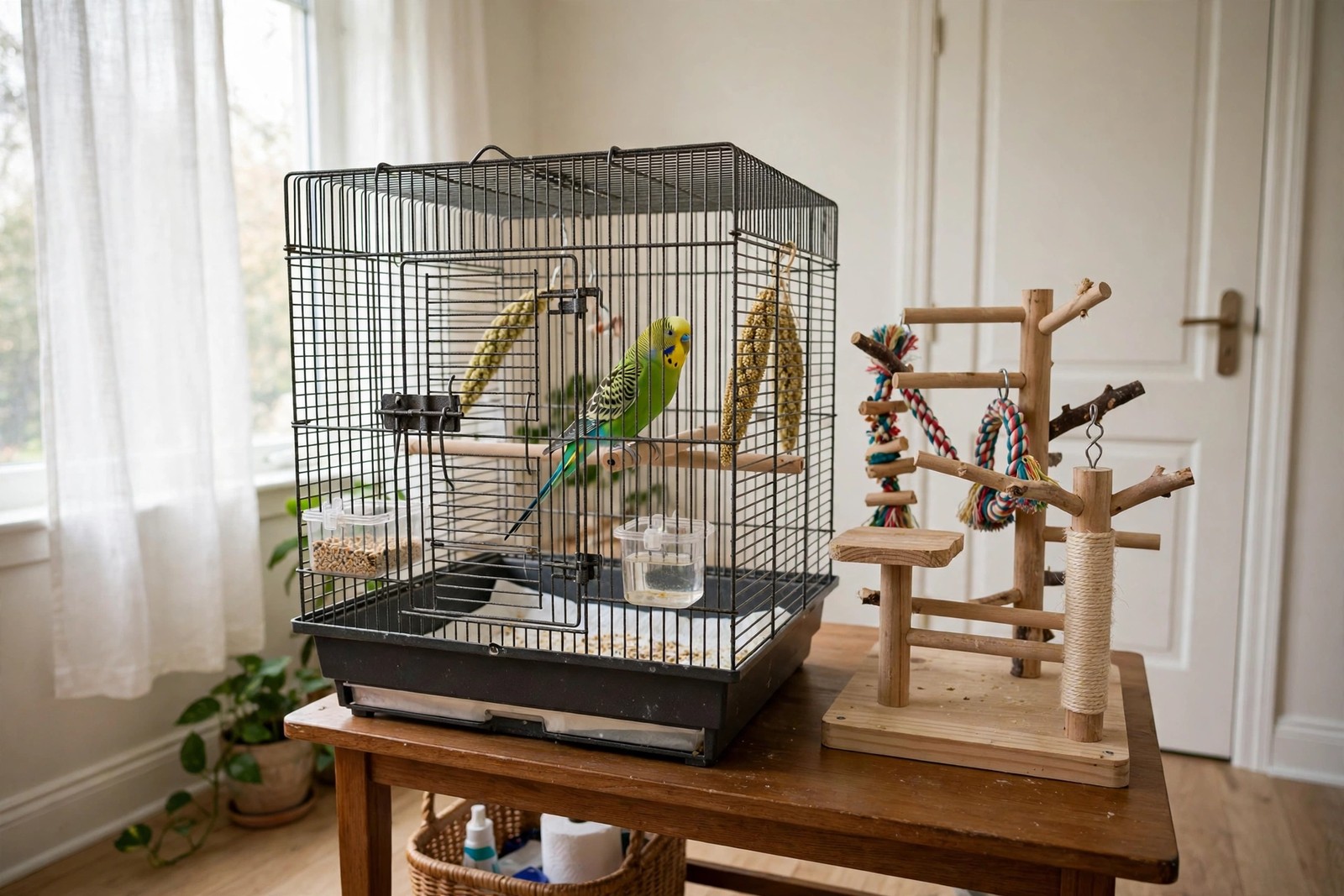
This is the one multi-pet problem where training is not the answer. A cat does not need to be aggressive, hungry, or badly behaved to kill a bird; it needs one curious swipe through the bars. Cat saliva and claws carry bacteria that can cause a rapidly fatal infection in birds even from a scratch that looks trivial, and a bird can also injure itself fatally crashing against the cage in panic. So the goal is not a cat that behaves around the cage. The goal is a cat that cannot reach the cage at all.
The Bird Gets a Room of Its Own
The reliable setup is a room the cat does not enter: a spare room, study, or bedroom where the bird lives, socialises with you, and has its out-of-cage time, with the door closed as the default state. Everyone in the household, including visitors and children, needs to treat that door the way they treat a front door, and a self-closing hinge or a clear sign helps while the habit forms. If a separate room is impossible, the cage must be in a space the cat is excluded from whenever you are not physically present, which in practice means the bird's area needs a barrier the cat cannot climb, jump, or slip through, not a verbal rule.
Never rely on being in the room as the barrier during out-of-cage time. A bird that flies unexpectedly, or a cat that arrives faster than you can stand up, turns supervision into an incident in under a second. The cat is shut out of the room before the cage door opens, every time, without exceptions for a sleeping cat that seems uninterested; uninterested cats wake up.
Cage Placement That Cannot Be Defeated
Within the bird's room, place the cage so it cannot be toppled or used as a landing platform. A sturdy stand or wall-secured position is safer than a hanging cage a determined cat could swing or bring down, and keep the cage away from furniture, shelves, and curtains that would let a cat, if it ever did get in, reach the top or sides at bar level. Check that bar spacing suits your bird, since a cage a bird can put its head through is also a cage a paw can reach into further.
Assume a breach will one day be attempted and make it survivable: the door to the room latched properly, the cage door secured with a fastening a pawing cat cannot work loose, and nowhere beside the cage for a cat to sit and stare at close range, because chronic close watching stresses many birds even when no contact is possible.
Reduce the Cat's Interest From the Other Side
A cat fixated on the bird room is usually an under-occupied cat. Give it hunting substitutes elsewhere in the home: daily interactive play sessions that end with a small meal, scratching posts, window viewing spots away from the bird, and puzzle feeding. Redirect calmly if it camps outside the bird-room door, and reward it for settling in its own areas, so the rest of the house becomes more interesting than the forbidden door.
Do not carry the bird into the cat's areas to get them used to each other, and do not present them face to face through the bars for photographs. Familiarity does not remove predatory instinct, and the bird pays for every experiment. If your bird shows stress signs, such as freezing, alarm calling, feather changes, or reduced eating, even with the door closed, talk to an avian vet and consider moving the bird to a quieter room further from household traffic.
The system only works if every person follows it on their busiest day, and KinsLe's Family Sharing lets the household share both pets' profiles and the bird-room rule in one place, so a partner, housemate, or sitter sees the same closed-door instruction you follow yourself.