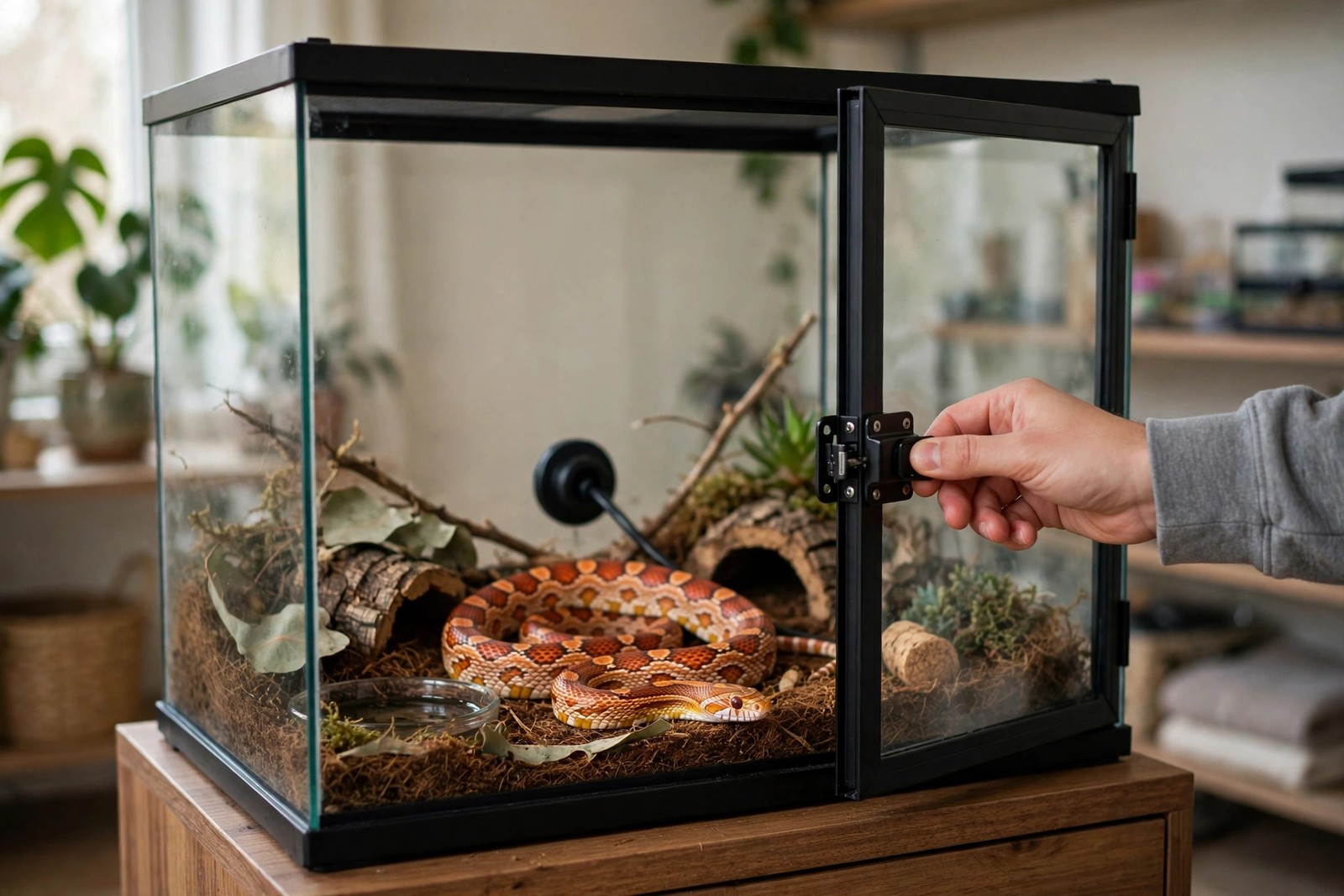
Snakes escape by method, not magic. A snake explores its enclosure nose-first, pushing at lids, corners, and door edges night after night, and it needs to win only once — through a gap the width of its head, a lid corner that flexes, or a door left resting shut instead of latched. Escape-proofing therefore means removing every 'almost' from the enclosure: almost closed, almost sealed, almost too small to matter.
Lids and Doors That Lock, Not Just Close
For a top-opening enclosure, the screen or solid lid must fasten down, not merely sit in place. Fit locking latches or clips on every side, not just the front two corners, because a growing kingsnake, corn snake, or boa pushes upward at the lid's weakest point, which is usually the middle of a long edge or an unclipped rear corner — and a snake's strength applied patiently at one flexing point is considerable. For front-opening enclosures, the doors themselves need a lock or a firm latch, and sliding glass doors need their overlap checked: sliding panels that can be nudged apart at the middle, or lifted out of a worn track, should get a track lock or wedge that blocks them travelling. After every feeding, cleaning, or handling session, run a hand along every fastening and physically test it. 'I shut it' is not a check; 'I pulled it and it held' is.
Seal the Small Gaps Snakes Actually Use
Walk the enclosure slowly with a torch and look for the unglamorous holes. Cable entries are the classic route out: the hole drilled for a thermostat probe or heat-mat cable is often far wider than the cable, so fit a snug grommet or plug around each cable, or seal the surplus space, and do the same where several cables share one port. Check the corners where silicone sealant beads the joints of a glass or wooden enclosure, and reseal any section that has peeled or cracked. Examine vents for bent mesh or a loose frame, and look along the gap between door and frame all the way round — if your snake's head could enter it, the gap is a door. Never use sticky tape inside the enclosure to block a hole: a snake that presses against tape can stick fast to it and be badly injured, so block gaps with solid material fitted from outside or with sealant left to cure fully before the snake returns.
Build the Room and the Routine Around the Enclosure
Assume a determined snake may one day beat the first barrier and make the second one boring. Keep the enclosure in a room whose door closes fully, block the gap beneath that door if it is wide, and keep the enclosure away from furniture a loose snake could climb to reach a window vent. In the routine itself, agree a house rule that whoever opens the enclosure closes and checks it, with no leaving a door ajar while fetching food or water — most escapes trace back to a thirty-second errand. Recheck all latches after a full clean, when lids and doors have been off and refitted, and add a weekly once-over of seams, clips, and cable ports to your normal care, because equipment loosens gradually and a clip that held in spring may be slack by winter. Growing snakes also change the calculation: re-measure gaps against the snake you have now, not the hatchling you bought.
Those repeated checks are easy to share and hard to skip when they are written down as jobs, and KinsLe's Care Teams lets you assign the after-feeding and weekly latch checks for your snake to whoever handled the enclosure, with each check marked complete.