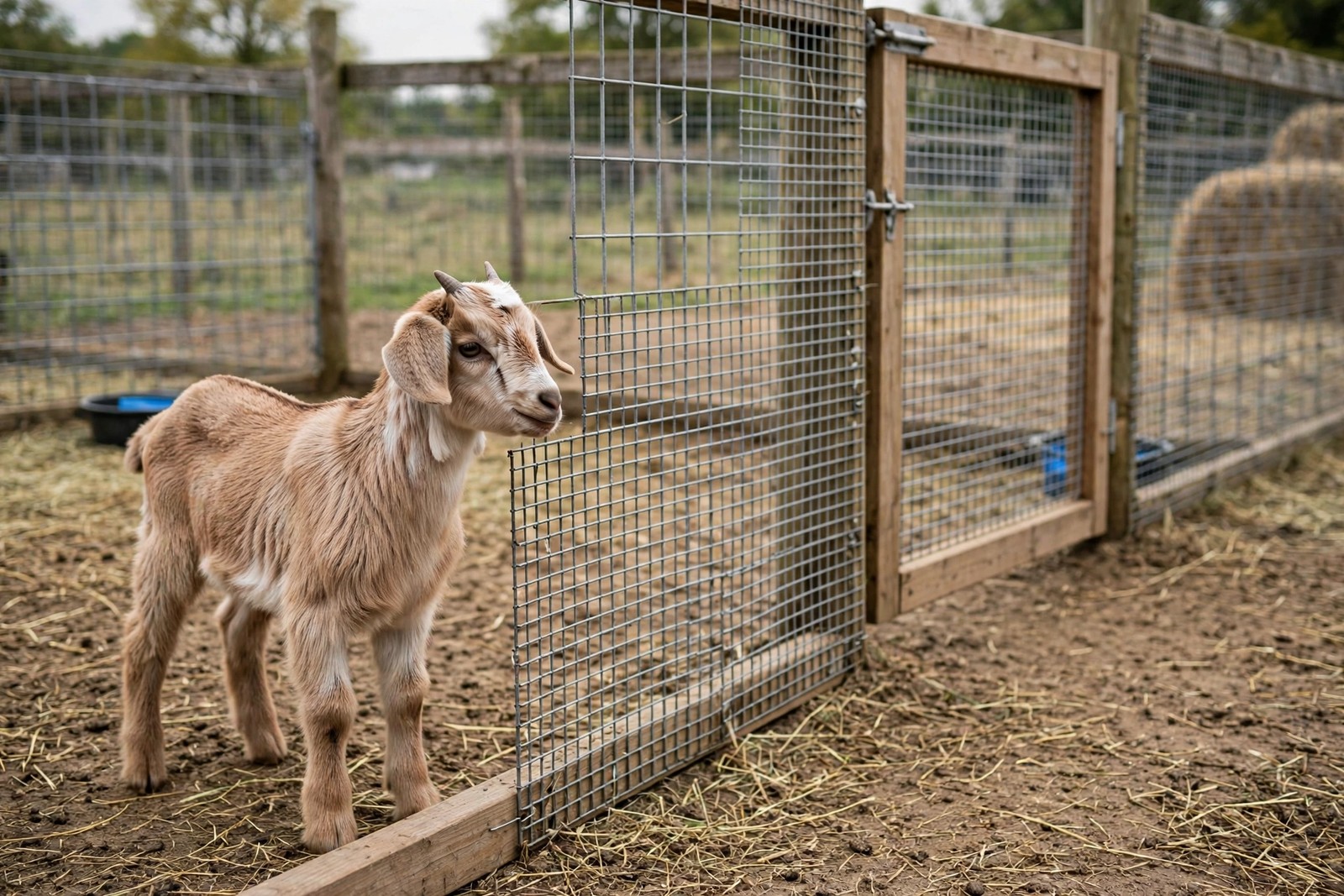
A kid goat is small, narrow, determined and able to flatten himself through openings that look far too tight, and he tests the fence at exactly the places adults ignore: the bottom corners, the gate edges and any spot where the ground dips. Fencing for young goats is therefore a separate job from fencing for the adult herd, with its own mesh size, its own gap audit, and a particular trap to design out — the head that goes through a hole the body cannot follow.
Mesh Small Enough to Keep Heads In
Line the kid paddock, or the lower part of its fence, with mesh whose openings are about 2 inches by 4 inches (5 cm by 10 cm). Openings of that size stop a kid pushing his head through, which matters for two reasons. The first is escape: a kid who gets his head and shoulders working through a larger opening will often wriggle the rest of the way. The second is entrapment: in wide square mesh, a horned kid can push his head through, then find that his horns or ears angle against the wire when he tries to pull back, leaving him trapped, panicking and vulnerable until someone finds him. Small rectangular openings remove both problems at once, because the head never gets through in the first place.
The Gap Audit: Gates, Corners and Dips
Walk the kid fence slowly, crouching to kid height, and look for gaps rather than at the fence as a whole. Under gates is the classic failure: a gate hung level over sloping ground leaves a wedge a kid can flatten under, so fit a ground-level bar, a raised threshold or a section of mesh that closes the wedge without stopping the gate opening. Where the fence meets a post or a building, check for the triangular gap that flexible mesh leaves at corners, and wire it closed. Follow any dip, ditch or scraped hollow along the fence line, because kids explore low ground and a hollow under the bottom wire deepens quickly once one kid starts using it. Check feeders, hay racks and water troughs placed against the fence too: a kid climbs into a rack, drops down the far side of a low fence line, and has escaped by accident before he intended to. Move climbable items away from the boundary of the kid area.
Growth Changes the Problem Weekly
The fence that contained this month's kids will not automatically contain next season's, and last month's kids grow into animals strong enough to push at mesh they previously fitted through. Recheck the kid area weekly while kids are small: look for mesh starting to bow where they lean and play, fixings working loose, and new hollows appearing along the line. As kids are weaned and moved, graduate them to the adult fencing only when they are big enough that the adult openings cannot admit their heads, and judge that by the individual kid — the smallest of the group sets the standard, not the average. If a kid is found with his head caught, free him calmly and slowly, supporting his body so he does not wrench his neck in panic, check him over for cuts and swelling, and fix that opening the same day, because his herd mates have now learned the spot is interesting.
A Safety Net for the One Who Manages It
Even a well-audited kid fence deserves a back-up: know each kid by markings, keep clear photos, and make sure anyone helping on the yard knows the kid area is checked last thing as well as first. For the young goat who still slips through, his KinsLe profile can carry a map display at no cost, with a direct route back to you for whoever finds him — the Lost Pet Alert System in KinsLe helps a small goat in a big landscape get reported back to you quickly.