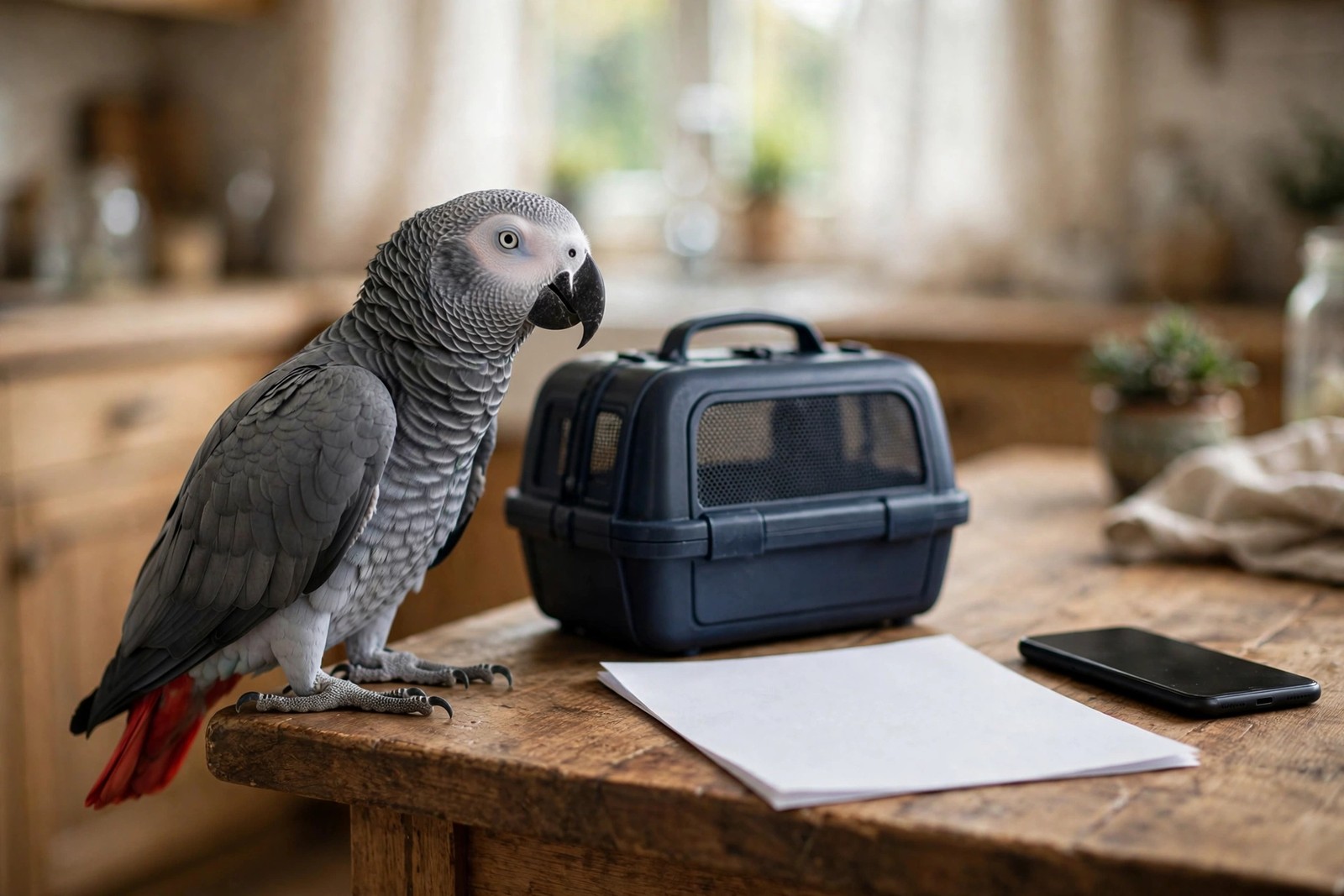
Parrots hide illness with great skill, so by the time a parrot looks genuinely unwell, the situation is often already urgent. That is exactly why an emergency plan cannot be improvised at midnight. A good plan answers four questions in advance: who treats birds after hours, how the parrot travels, what information travels along, and who in the household does what.
Decide Your After-Hours Cover in Advance
Start by registering your parrot with a veterinarian who has real avian experience while the bird is still healthy, and ask that practice one direct question: what happens when a bird emergency lands outside regular hours? Some practices run their own on-call schedule, some refer to a particular emergency hospital, and some emergency hospitals have an avian veterinarian available only on certain nights. You need to know which of those is true for you before the night it matters. Save the after-hours number in your phone, write it on the plan posted by the cage, and note the street address of the emergency hospital rather than just its name, because a stressed driver should not be searching for directions.
The Carrier, Ready Before You Need It
Transport should be boring. Keep a small, sturdy travel carrier or travel cage assembled and stored near the main cage, lined with plain paper or a towel that shows droppings clearly, with a low, secure perch and no swinging toys that could injure a panicked bird. Practice matters as much as equipment: a parrot who enters the carrier calmly for treats on ordinary days is far easier to load in a crisis. On the day itself, keep the carrier covered, warm, and quiet, drive smoothly, and never transport a parrot loose in a car, where a startled flight can injure the bird and endanger everyone. Bring a towel, and call ahead while you travel so the team can prepare.
Signs That Mean Leave Now
Some presentations should never wait for morning: breathing with an open beak, a tail that bobs with every breath, sitting fluffed on the cage floor, bleeding that does not stop with gentle pressure, collapse, seizures, a suspected poisoning or fume exposure, straining that could suggest a stuck egg, or a bird who has simply gone quiet and still in a way that is wrong for that individual. If you are unsure whether what you are seeing qualifies, phone the after-hours service and describe it; triage advice by phone is part of what the plan is for. Minor bleeding is the plan's one piece of hands-on care: gentle pressure with a clean cloth while the after-hours service is called — and a broken blood feather that keeps bleeding follows the same rule, pressure and a prompt veterinarian, with no other home treatment attempted.
What Information Travels With Your Parrot
An emergency veterinarian meeting your parrot for the first time needs a compressed history, fast: species, age, sex if known, typical weight and recent weights, usual diet, current health conditions, any medications exactly as prescribed, recent illnesses, and your regular practice's contact details. Write the essentials on an emergency card as well — your veterinarian's number, the after-hours number, species, typical weight, and medications exactly as prescribed — and file the card inside that packet, so anyone in the household can act without searching. That bundle is precisely the job of the Pet Passport on KinsLe — the bird's health and records packet in one place, ready to be handed over or read aloud over the phone.
Rehearse the Plan Once
A plan nobody has practiced is a hope, not a plan. Walk through it once with everyone who might be home when an emergency strikes: where the carrier lives, which number gets called first, who drives, where the written plan hangs, and what goes out the door with the bird. The packet should live beside the carrier, ready to grab without thinking, and storing those details in the Pet Passport on KinsLe means whoever rushes out the door hands the emergency team the same complete record.