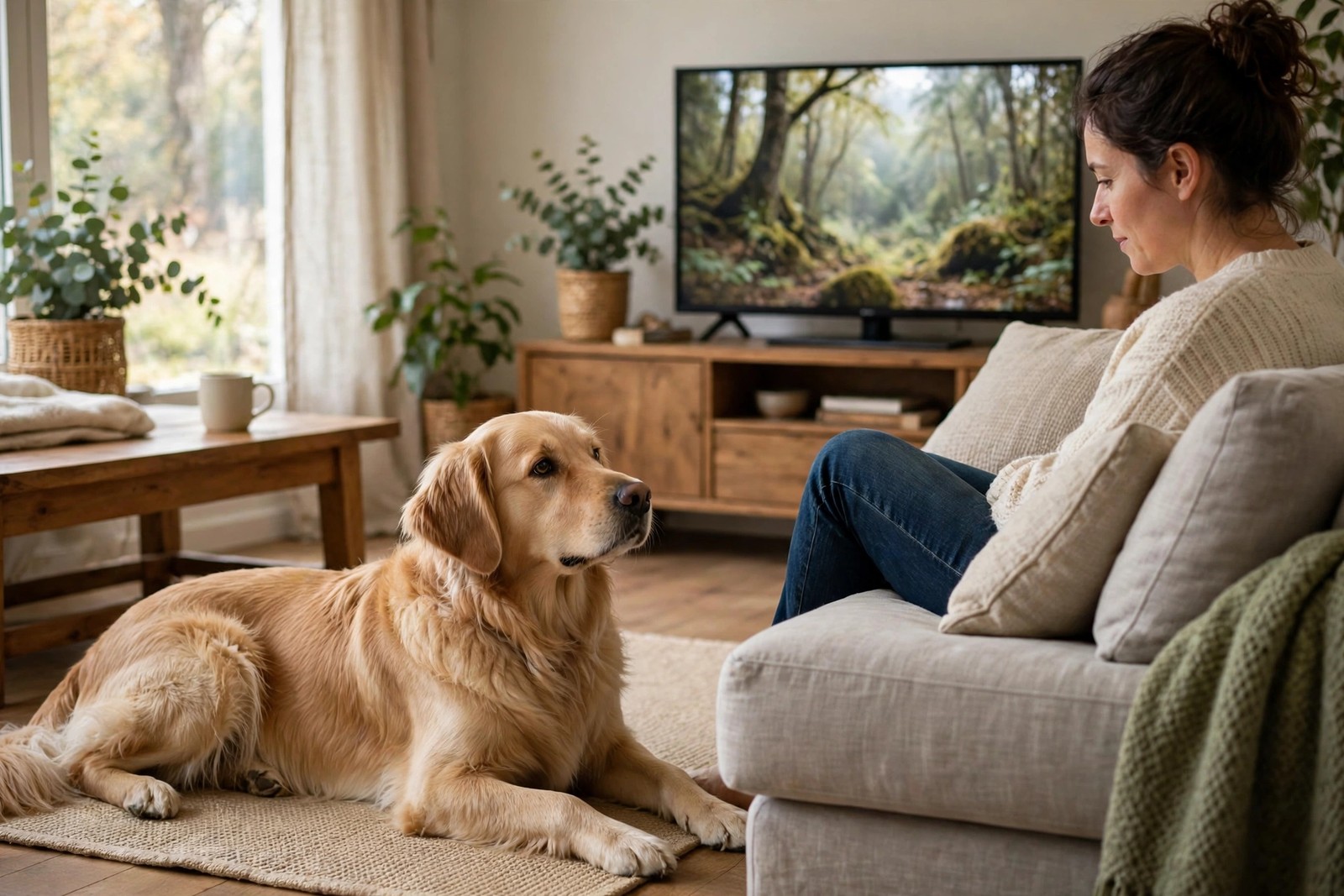
A dog barking, lunging or whining at the television is usually reacting to something specific — another dog on screen, a doorbell sound effect, horses, a football crowd — and is often frustrated that the intruder never arrives or never leaves. Shouting over him just adds a second excited voice to the room. What works is slower: shrink the trigger until he can notice it without losing his head, pay him well for calm, and manage real viewing while the training catches up.
Work Out Exactly What Sets Him Off
Keep notes for a few evenings. Is it animals moving, animals standing still, barking on the soundtrack, doorbells and knocks, or fast motion and crowd noise? Does he react to the sound with the screen dark, or only to pictures? Some dogs are sound-reactive and barely glance at images; others fixate on movement and ignore audio. Note how quickly he recovers — a dog who barks twice and sighs is a different project from one who stays wired for ten minutes, scratching at the screen or racing to the front door to check. That trigger list becomes the training plan, one item at a time.
Desensitise Below Threshold, Then Build in Small Steps
Practise outside real viewing, in short sessions. Play a clip of his trigger — a nature programme for animal-reactive dogs, a doorbell sound for sound-reactive ones — at a volume low enough that his ears prick but his body stays soft. The moment he looks at the screen calmly, or better, looks away from it to you, mark it and pay with a good treat. Several easy repetitions, then stop while it is still boring. Across days, raise the volume or move his mat a little closer to the screen, one small step at a time. If he erupts, you jumped too far: lower it again and rebuild. Most dogs need a couple of weeks of these dull, successful sessions, not one long battle.
Teach a Settle That Pays Better Than Barking
Give him a job that competes with reacting. Train a mat settle away from the TV until it is solid without the screen on: go to the mat, lie down, stay, with treats arriving slowly for staying put. Then use it during trigger practice, feeding a stuffed chew toy or a lick mat on the settle mat so calm behaviour on that spot becomes deeply rewarding. During real programmes, cue the settle before known trigger scenes and reward check-ins with you. If he does go off, stay boring: no shouting, no wrestling him away — calmly lead him out by the collar or a house line, let him reset, and lower the difficulty next time.
Manage the Room While Training Catches Up
Until the work holds, manage the setup. Place his bed or mat to the side of the screen rather than directly in front, keep some distance between dog and television so a lunge cannot connect, and use a baby gate or lead for programmes heavy with his triggers. Turn the volume down ahead of adverts and doorbell-heavy scenes, and give him a chew in another room for viewing you know will be too much — management is not failure, it is how he practises not rehearsing the habit. Lunging that risks injury, fixation that will not break, or aggression redirected at people or other pets deserves a qualified behaviourist's eyes. Consistency across everyone on the sofa is what makes it stick, and KinsLe's Family Sharing helps by letting you share this dog's trigger list, settle cue and session notes with the whole household, so nobody undoes the training by laughing, filming or winding him up.