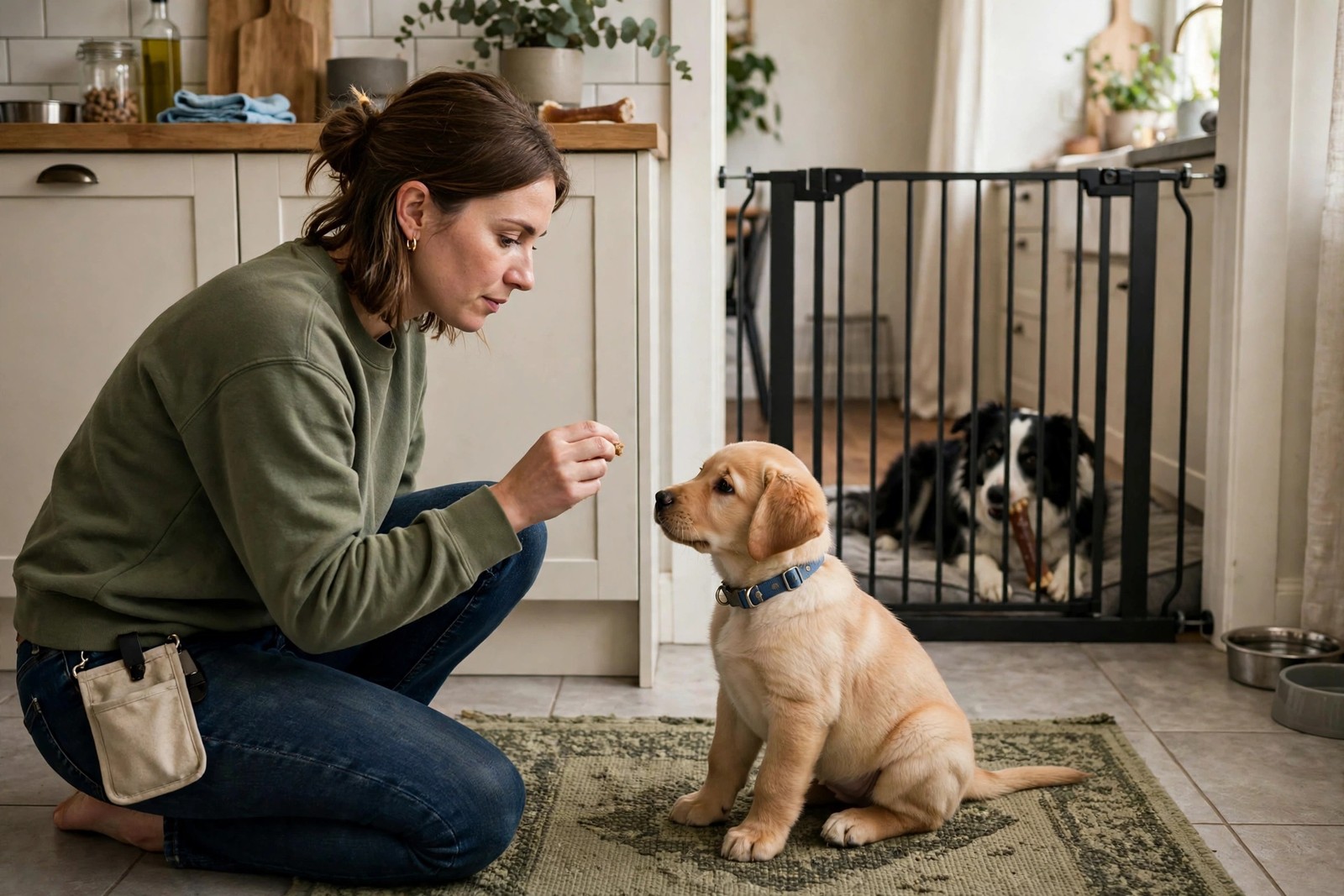
A resident dog who barges into the new dog's training is not being jealous in the human sense; training sessions are simply where the treats, praise and interesting movement are, and your first dog has a long history of those things belonging to it. Trying to teach the newcomer through the interruptions teaches both dogs the wrong lessons: the new dog learns skills are chaotic and half-paid, and the resident learns that barging in works. The answer is structural. Each dog gets its own training time, the waiting dog gets a defined, rewarded place to be, and joint practice comes last, not first.
Give the Resident Dog a Station That Pays
Before you teach the newcomer anything, build the resident dog's station: a mat, bed or spot behind a baby gate or in an adjoining room where that dog settles with a long-lasting chew or a stuffed food toy. Practise the station on its own first, in short sessions where settling there is paid generously, so the setup feels like employment rather than exile. On training days, settle the resident dog at the station before the newcomer appears, not in a scramble after the barking starts, and keep sessions with the newcomer short enough that the station dog is released while still content.
Alternate fairly. Give the resident dog its own short refresher sessions too, on skills it already knows, paid at the same rate. A first dog who still gets private training time, walks and greetings has far less reason to invade the newcomer's, and you will spot early whether the resident dog's own manners are slipping under the new regime.
Teach the Newcomer the Rules Solo
Run the new dog's lessons in five to ten minute blocks, one dog, one handler, one skill. Prioritise the house rules in the order daily life needs them: responding to its name, toileting outside on a schedule with praise on the spot, settling on its own bed, waiting briefly at doors rather than barging through, walking on a loose lead around the house and garden, and leaving food and counters alone through management first, closed doors, cleared surfaces, while leave it is taught as its own lesson.
Keep the newcomer's world small at first: the rooms covered by the rules it has learned, with gates managing the rest. Expect the resident dog's example to help with routines like going to the door, but do not rely on it for teaching; new dogs copy arousal and shortcuts just as readily as good habits, including any rule-bending the resident dog has perfected over the years.
Bring the Dogs Together in Stages
Once the newcomer can perform a skill alone and the resident can hold its station calmly, practise side by side at a distance: parallel settles on separate mats, both paid; recalls one at a time while the other holds a stay with a second handler if you have one; calm walking together after solo lead skills exist. Feed the dogs separately with a barrier between them until you are certain both eat relaxed, rest them in their own spaces, and supervise all shared time until the pattern of the household is boringly predictable.
Watch for the real problems early: guarding of food, toys, beds or people, one dog shadowing or blocking the other, or either dog unable to relax in the other's presence. Those need separation, a slower plan and, if they persist, a qualified behaviourist, not more joint sessions. Households usually find that three to four weeks of mostly separate training buys months of easy living afterwards. In KinsLe, Care Teams keeps each dog's profile, session list and station routine separate and visible, so family members rotate the dogs the same way and neither dog's training quietly lapses.