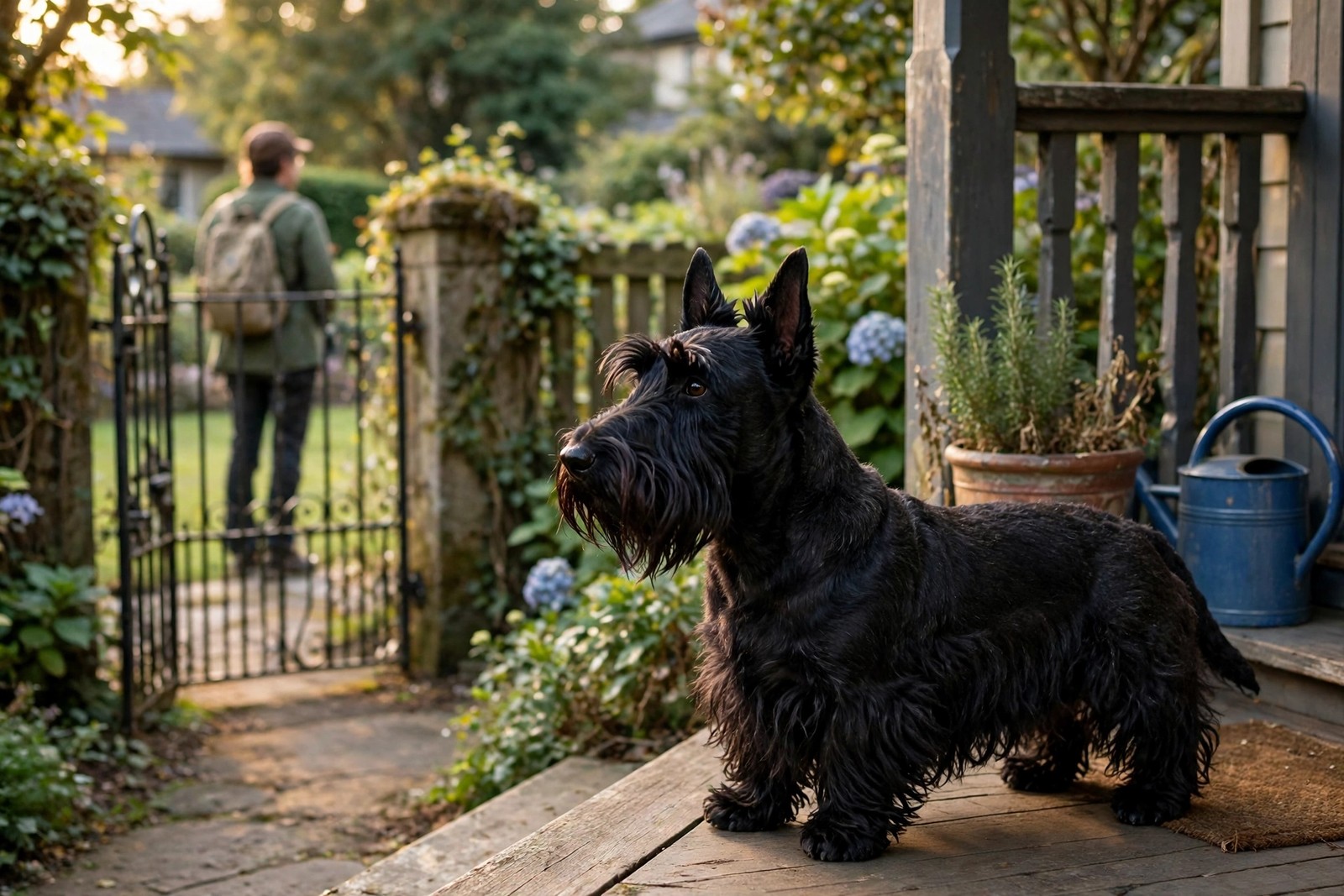
The Scottish Terrier's reserve is not shyness, fear, or poor socialization, and misreading it is the most common mistake prospective owners make. This is a breed built to work independently, underground and out of sight of the handler, and that history produced a dog who assesses situations personally rather than looking to the room for cues. Expect self-possession first and friendship, when offered, on the dog's own terms.
The Diehard Character With Strangers
Scotties earned their Diehard reputation through tenacity, but the same self-reliant streak shapes their social life. A typical Scottie meeting a stranger will stand, watch, and weigh the person up, often at a slight distance, and may accept a brief greeting without soliciting more. Many never become dogs who work a room; they choose their people and invest there instead. Forced sociability backfires with this breed: a visitor who corners a Scottie for enthusiastic petting teaches the dog that strangers ignore signals, while a visitor who lets the dog approach, sniff, and retire at will often gets quietly accepted over repeated visits.
This reserve has a practical shape at home. Expect a dog who alerts to arrivals, inspects them, and then settles once the household does.
Devoted at Home, Independent by Habit
Reserve toward strangers coexists with real devotion indoors. Scotties commonly follow their people from room to room, supervise household projects from a chosen vantage point, and maintain strong opinions about routine. The independence shows in smaller ways: a Scottie often entertains itself contentedly, accepts affection warmly but may end a cuddle when it has had enough, and can be notably stubborn about requests it sees no reason to obey. Owners who enjoy a dog with a mind, rather than a dog seeking constant direction, tend to find this combination deeply satisfying.
Early socialization still matters enormously, not to manufacture an outgoing dog, but to teach this naturally cautious breed that the world's ordinary sights are safe background, so reserve stays dignified rather than hardening into suspicion.
Compared With Friendlier Terrier Types
Terrier breeds share energy and determination, but their social defaults differ. The West Highland White, by typical breed character, presents itself to visitors with cheerful confidence and expects admiration as a right. A Cairn Terrier is usually busier socially, curious about everyone in the room and inclined to investigate rather than observe. A Scottie, set beside either, usually looks aloof: slower to approach, quicker to finish the interaction, and more selective about laps and handling.
These are breed-character contrasts, not a league table, and variation within every breed is wide. An unusually sociable Scottie and an unusually reserved Westie both exist, and upbringing shifts any individual. Choose by the default you would enjoy living with for a decade, then meet the actual dog or the breeder's adults to see how this line expresses the breed's tendencies.
Living Well With a Reserved Dog
A Scottie household runs best on a written visitor routine that every person follows. Decide in advance who answers the door, who holds the lead or manages the dog's retreat route to a quiet room, who tells guests to let the dog choose contact, and who watches for signs the dog has had enough. Giving each person a name and a job on paper stops well-meaning improvisation, which is what overwhelms a reserved dog.
That household plan is exactly what Care Teams on KinsLe is built to hold: named members, assigned duties for arrivals and walks, and the dog's own preferences written down where a guest-sitter or family member can read them before the doorbell rings.
Choose a Scottie if a self-possessed, loyal, faintly formal companion appeals, and pass the breed by if you dream of a dog who adores every stranger at the park. Neither temperament is better; they are different contracts, and the Scottie's contract asks for respect in exchange for devotion.
Care Teams, arranged through KinsLe around a Scottie's preference for chosen company, keeps visitor handling, retreat space, and daily duties consistent across the whole household.