
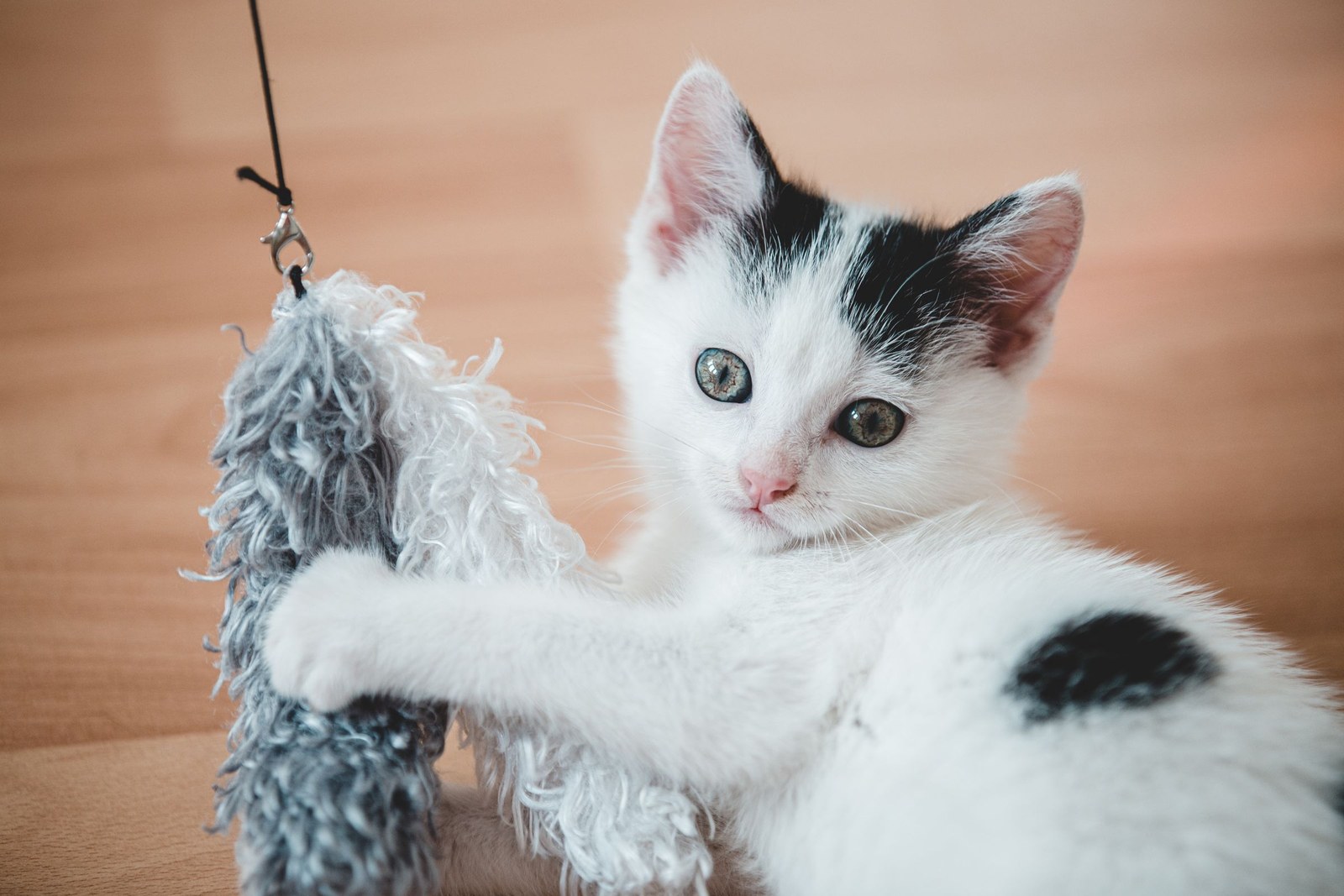
Most indoor cats thrive on about 20 to 30 minutes of interactive play a day, split into two or three sessions of roughly 10 to 15 minutes each. That is the sweet spot for the average adult cat: enough to burn off hunting energy, satisfy her instincts, and help her settle into rest — without turning play into an exhausting chore for either of you.
Time it to her natural clock
Cats are crepuscular, meaning their active peaks land around dawn and dusk. You will get far more engagement from a session at 7 a.m. or in the early evening than from one attempted at mid-afternoon, when most cats are deep in a nap. Watch your own cat for a few days: the pre-breakfast prowl and the evening "zoomies" are her telling you when playtime belongs. Anchoring sessions to those windows also pays off at night — a good hunt before your bedtime often means she sleeps instead of staging a 3 a.m. concert.
Structure each session like a hunt
Quality matters as much as minutes. Run the sequence her instincts expect:
- Stalk — drag a wand toy slowly away from her, around corners, letting her crouch and calculate.
- Chase — quicken the pace with short bursts; let the "prey" freeze and twitch rather than dangling it in her face.
- Catch — let her actually grab and bunny-kick it several times. A cat who never catches anything gets frustrated, not tired.
- Eat — end with a small meal or a few treats, then let her groom and doze. Hunt, catch, eat, groom, sleep is the full cycle.
Adjust for age and personality
Kittens are the exception to every schedule — they need many short bursts across the day and will invent play if none is offered. Senior cats still benefit from daily sessions, but keep them gentle and floor-based: a slowly dragged ribbon beats aerial acrobatics for arthritic joints, and five good minutes count. High-energy breeds like Bengals and Abyssinians may happily take three or four sessions, while a laid-back British Shorthair might declare two plenty. Let her behavior grade the schedule — a cat who keeps bringing you toys wants more; one who walks away mid-session has had enough.
Signs you have found the right amount: she settles calmly after sessions, pesters less at night, and keeps a stable weight. Signs to add more: ankle ambushes, counter surfing, and play demands escalating in intensity.
Solo play counts, but differently
Puzzle feeders, crinkle balls, and a box fort fill the hours between interactive sessions and are absolutely worth providing. But they do not fully replace you — the responsive, unpredictable movement of a toy you are driving is what truly satisfies the hunting sequence. Think of solo toys as snacks and interactive play as the meal.
Share play duty with Care Teams
In a busy household, play sessions get doubled by one person and missed entirely by everyone on the same day. KinsLe's Care Teams let family members assign duties — feeding, walks, meds, grooming — and play fits right into that rhythm, with timestamped completions showing who ran the evening hunt and who is up next. Everyone sees the day's sessions at a glance, so your cat gets her play and no one burns out. Curious how much play other pets need? Her evening hunt stays covered when play duty rotates through the Care Teams roster on KinsLe, with each session assigned to a family member and checked off by timestamp.