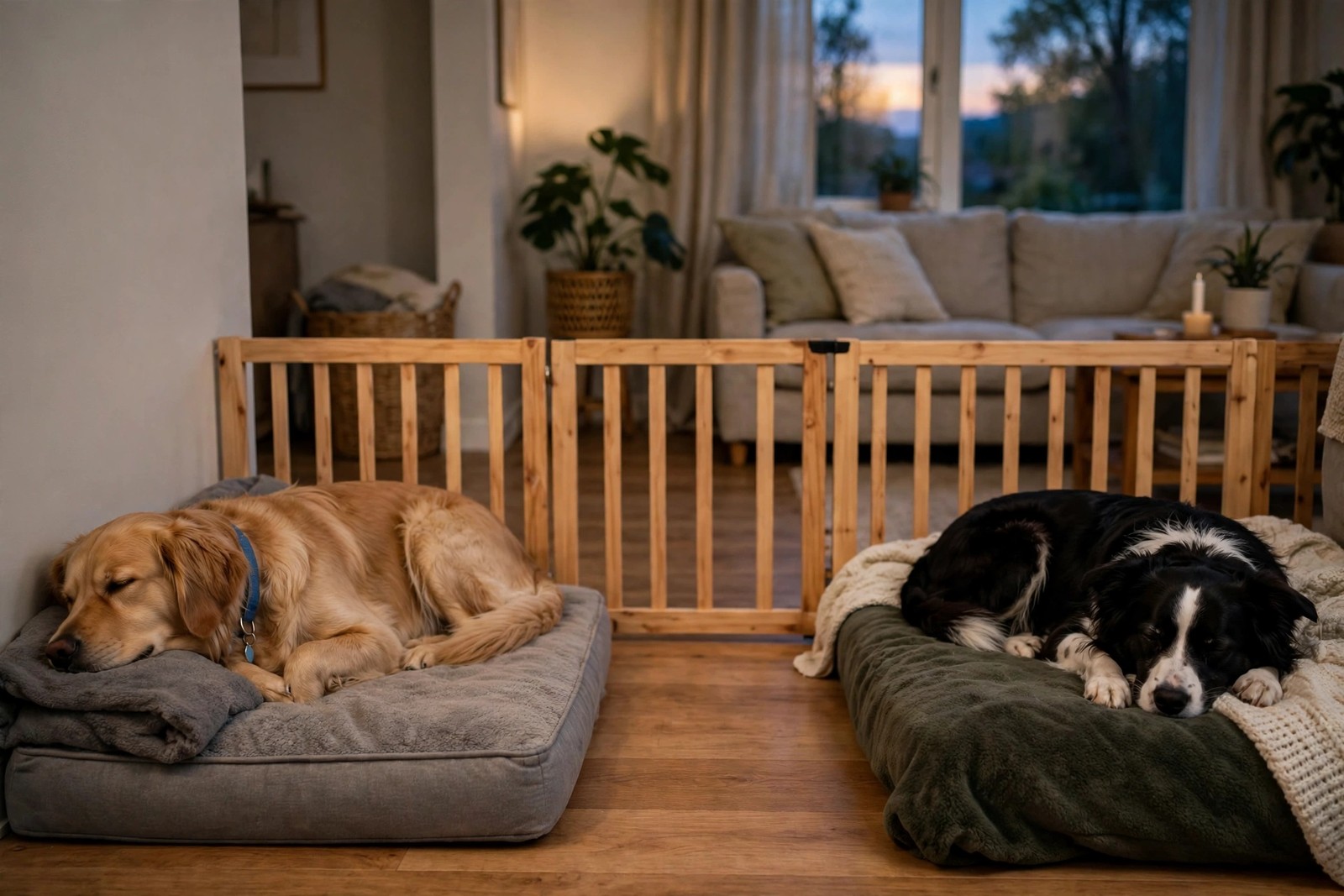
Manage the evenings immediately and assume nothing. Snapping over a resting place is a dog asking for space in the clearest language he has left, and because it happens when both dogs are tired, settled, and close together in a dim room, it escalates faster than daytime squabbles. Your job while professional help is arranged is simple: make the conflict physically impossible, and protect the warning instead of punishing it.
Separate the Resting Geography Tonight
Set up two genuine resting areas with real distance between them — different ends of the room at minimum, different rooms if your home allows it. Each dog gets his own bed, his own blanket, and his own water, and neither dog is allowed to drift onto the other's bed. End shared sofas and shared beds completely for now, including the tempting “they are both asleep, it is fine” evenings, because a half-asleep dog startled by another dog settling against him is exactly the dog who snaps without deciding to.
Use gates, pens, or closed doors to make the separation effortless rather than relying on everyone remembering rules after a long day. When both dogs are loose together in the evening, someone is actively supervising: awake, in the room, and close enough to call one dog away cheerfully at the first stiffen, hard stare, or slow creep toward the other's bed. If nobody can supervise, the dogs are separated. That is not a punishment for either dog; it is rest, protected.
Look Hard at the Snapping Dog
A dog who has started this recently has usually changed for a reason. Tired dogs have shorter fuses, so audit total rest honestly: a dog who is walked late, played with by children all evening, and never given an undisturbed place to sleep may simply be exhausted. Pain is the other common driver, and evening is when sore joints and aching teeth announce themselves after the day's activity. Book a vet check for the snapping dog before assuming it is purely behavioural, and mention the timing and the trigger precisely.
Do not punish the snap, scold the dog for growling over his bed, or force the dogs to “sort it out.” Punishing a warning does not remove the discomfort underneath it; it removes the early signal, so the next protest may arrive as a bite. Equally, do not comfort-crowd the dog who was snapped at by pulling him onto the sofa beside the other dog. Calm separation serves both dogs better.
While You Wait for Help
Keep evenings deliberately dull for a while. Feed the dogs separately, give chews only in their own separated areas, and settle each dog in his own space before the household relaxes, rather than letting positioning become a nightly negotiation. Walk or play with them earlier so the evening itself holds no high-arousal games on the contested floor.
If snapping repeats despite separation, breaks into fights, or starts appearing over food, doorways, or people, a qualified behaviourist should assess the household in person, with the vet's findings in hand. Bring notes: when it happens, which bed, who moved first, and what the rest of the day looked like. Rotate which dog settles first each evening, so neither dog learns that the other always claims the favoured room and the favoured person. That record turns a vague worry into a workable plan.
KinsLe Care Teams helps the household hold this plan on tired evenings too, because you can assign the gate check, the separate settling routine, and each dog's evening walk to named family members and see every completed task marked with a timestamp.