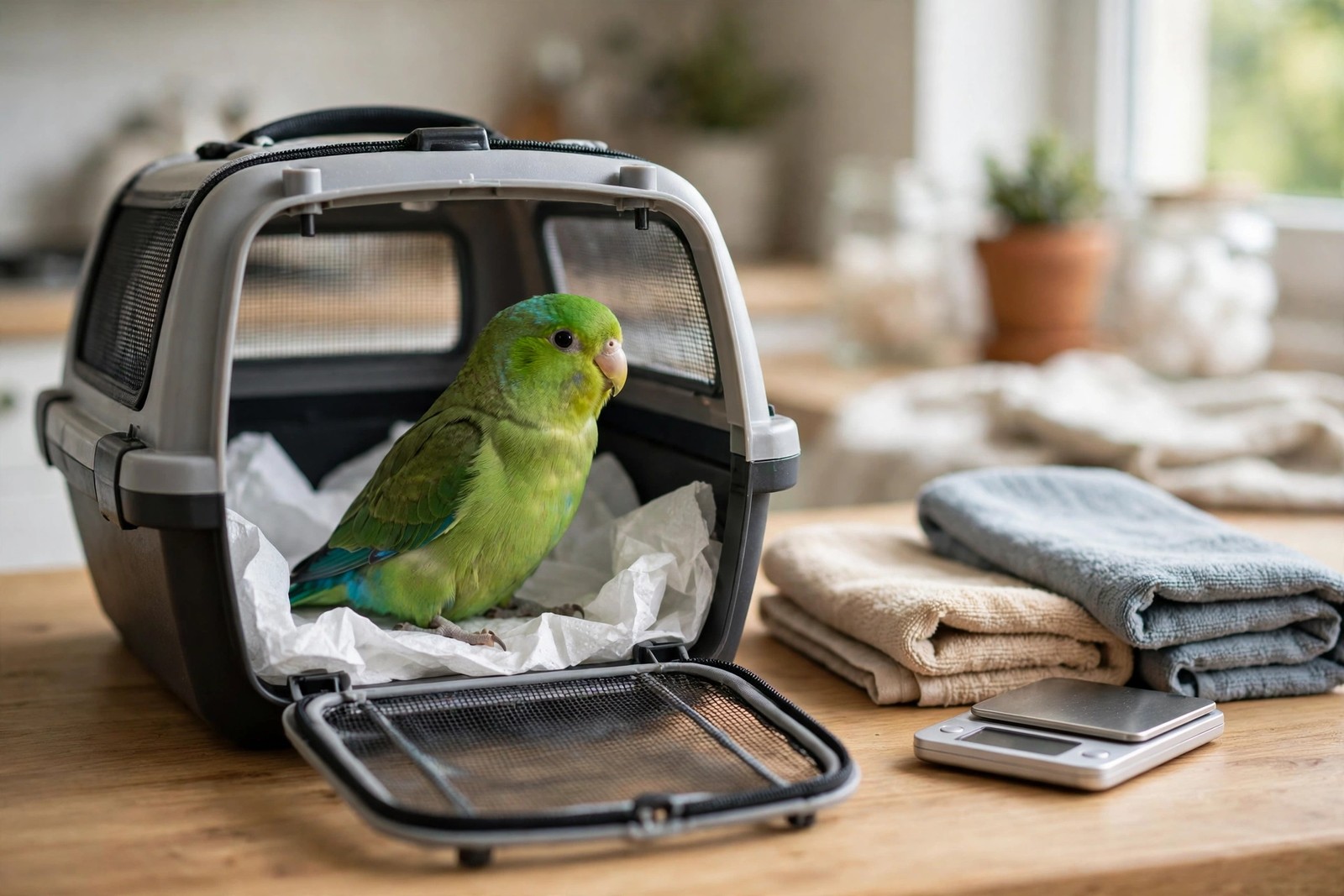
A bird first-aid kit has a narrow, honest purpose: it holds the bird safely and buys a calm, quick trip to a veterinarian. Birds are small and they hide how unwell they are, so the kit that helps most is the one that shortens the distance between noticing an accident and getting professional care. Anything beyond that belongs to the veterinarian, not the kitchen drawer.
The Carrier and Holding Supplies Come First
The single most useful item is a small, secure travel carrier with a solid floor, kept assembled rather than stored flat. Line it with paper towels, which show blood clearly and give footing without loops that catch toes. Keep two or three soft, plain towels with the carrier for gentle, brief restraint during a transfer, used only if you already know how to hold your bird safely, since handling must stay minimal and loose and never squeeze the chest.
Gentle, steady warmth helps a shocked or injured bird on the way to care, so many owners keep a way to warm one side of the carrier and check it often, leaving the bird room to move away from the heat. A small flashlight earns its place too, for spotting blood on pale feathers or checking a foot without bright ceiling light.
Small Items That Save Real Time
Clean gauze pads and paper towels cover the common minor accidents. For a broken nail or a broken blood feather, the one minor procedure worth knowing is simple: apply cornstarch or a styptic pencil to the tip with gentle pressure while the veterinarian is being called, and keep the bird warm and still. Sterile saline, kept sealed in the kit, rinses dust or debris from an eye or a patch of skin without adding anything a bird's body has to deal with. It is worth asking your own veterinarian at a routine visit to walk you through that pressure step once, because calm hands matter more than the powder.
A gram scale belongs in the kit even though it is not first aid in the dramatic sense. Weighing a bird weekly in health gives you a baseline, and a weight taken after an accident is one of the first things an avian veterinarian will ask about. A notebook and pen kept with the kit let you record what happened while it is still fresh.
What Stays Out of the Kit, and What Is Never Minor
No medications belong in the kit at all: no antibiotics, no wound creams or oils, and no human painkillers. Several medicines that are routine for people or for dogs and cats are dangerous to birds, and an old prescription was chosen for a different problem on a different day. If a product is not clearly labeled for birds and your veterinarian has not approved it for your bird, it does not go in the kit and it does not go on the bird.
Some accidents are never minor, however small the bird looks afterward. Breathing difficulty, bleeding that does not stop, weakness after a fall, or any contact with a cat means an emergency veterinarian immediately, even when the bird appears unmarked, because a cat's mouth carries bacteria that make any bite or scratch an emergency on its own.
The Paperwork Half of the Kit
Supplies are only half of being ready. The other half is information: the kit list itself, your avian veterinarian's number, the after-hours route to a clinic that sees birds, your bird's usual weight range, and a short history of past illnesses, injuries, and current care. Finding those details while holding a towel is how time disappears.
That record is what the Pet Passport on KinsLe is built to hold, gathering the supply list, the emergency contacts, the weight history, and the visit notes into one packet you can pull up in the car or hand to a clinic that has never seen your bird. Check the physical kit a couple of times a year and replace anything used, so the next minor accident meets a household whose first call is already prepared through the Pet Passport file on KinsLe.