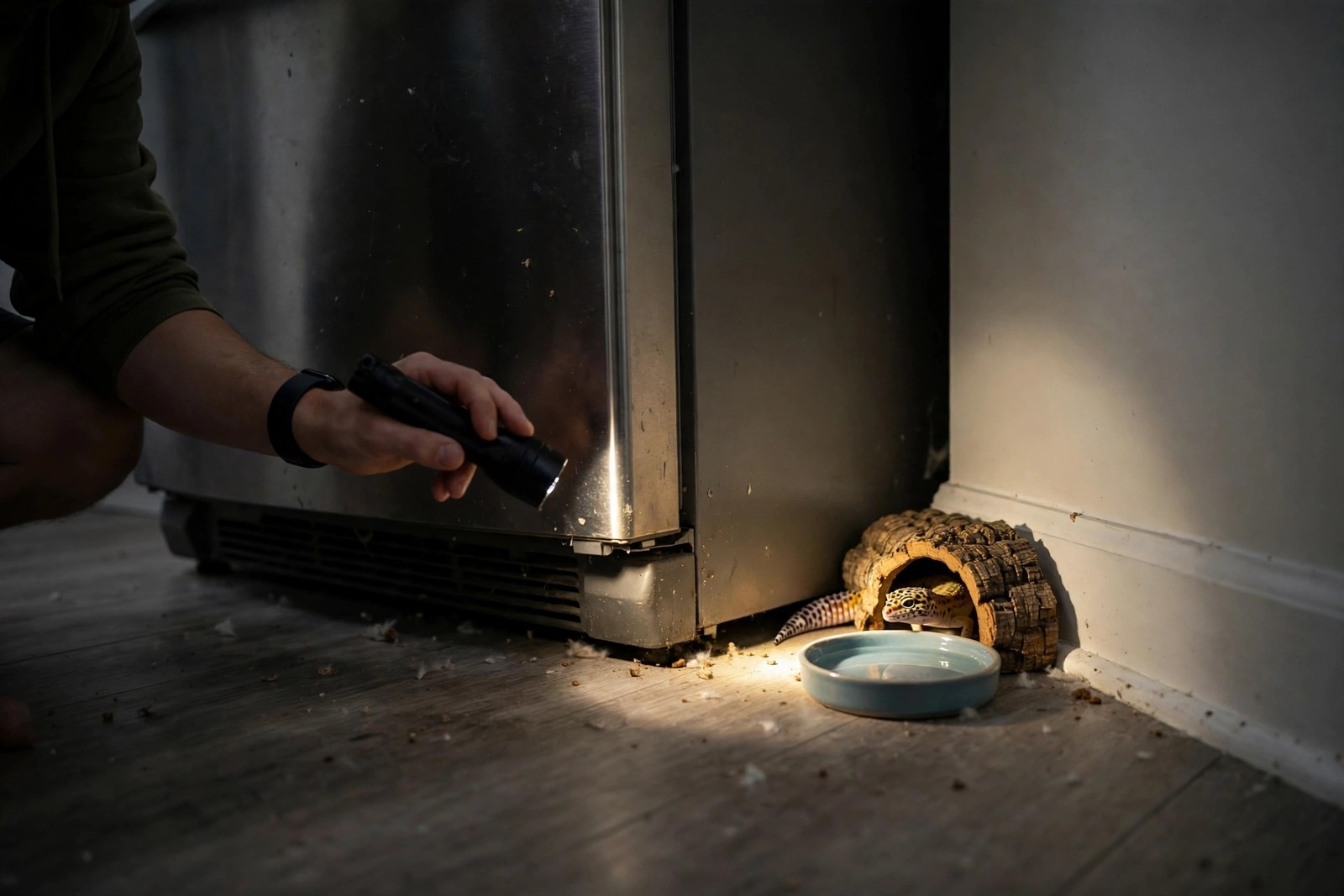
A leopard gecko loose in a house is not wandering at random. It is a nocturnal, ground-dwelling lizard looking for a gap that touches its body on several sides, stays dark through the day, and ideally holds some warmth. Search low, search slowly, and think like an animal roughly the length of a hand that can flatten into surprisingly narrow spaces behind objects you would normally never move.
Start With Heat and the Room of Escape
Begin in the room where the enclosure sits, because a gecko that climbed out often travels only a short distance before finding cover. Check behind and underneath the enclosure stand itself, then work outward along the walls. Warm appliances are prime hiding places: behind a refrigerator where the motor gives off heat, under a washing machine or tumble dryer, behind a dishwasher, and beneath an oven. Slide a torch beam into each gap rather than relying on overhead light, and use a phone camera or a small mirror for spaces your head cannot reach.
Feel as well as look. A gecko pressed into the warm void behind an appliance may show only a tail tip or the edge of a spotted flank. Move appliances gently and only a short distance at a time, checking the floor as you go, because an animal sheltering underneath can be injured by a dragged machine or bolt further into the room when the cover suddenly moves.
Furniture, Flooring, and Everyday Clutter
Next, search the insides of furniture. Sofa and armchair bases often have a thin fabric underside with a hollow frame above it, and geckos climb inside through small tears or gaps. Check recliner mechanisms carefully before anyone sits down or operates the chair. Look inside wardrobes, drawers left ajar, cupboard corners, and the warm space behind stored boxes, and lift the edges of rugs and any loose flooring or skirting that leaves a gap at floor level.
Then work through portable cover at floor height: inside shoes and boots, in open boxes and bags, under piles of laundry, bedding, and towels, inside a cat or dog bed's folds, and behind curtains that pool on the floor. Shake clothing out over a bathtub or a clear floor area rather than over other clutter, so a gecko that drops out lands somewhere visible and contained. Check plant pots and the space behind them, and look inside any hollow decor, tubes, or spare hides stored near the enclosure.
Search in a Way That Finds Rather Than Scatters
Close the door of each room before you search it, block the gap under the door with a towel, and do not move on until that room is finished. Search again at dusk and during the evening, when a leopard gecko naturally wakes and may cross open floor toward warmth or water. Leave a shallow water dish, a familiar hide, and a gentle heat source on the floor along a wall in the escape room overnight, and check them quietly before switching bright lights on. A line of flour or fine substrate dust across a doorway or in front of a suspected gap can show small footprints and tail drag marks by morning, telling you which room is occupied even when you have not yet found the animal itself.
Keep other pets out of the search area entirely, and warn everyone in the house before opening recliners, running the washing machine, or moving heavy furniture. If a full house search over successive evenings finds nothing and doors to the outside were open, widen the effort beyond the house. Through KinsLe, the Lost Pet Alert System adds your gecko to the map at no cost, and a neighbour who spots the small spotted lizard out in a garage or on a porch can reach you with a direct message.