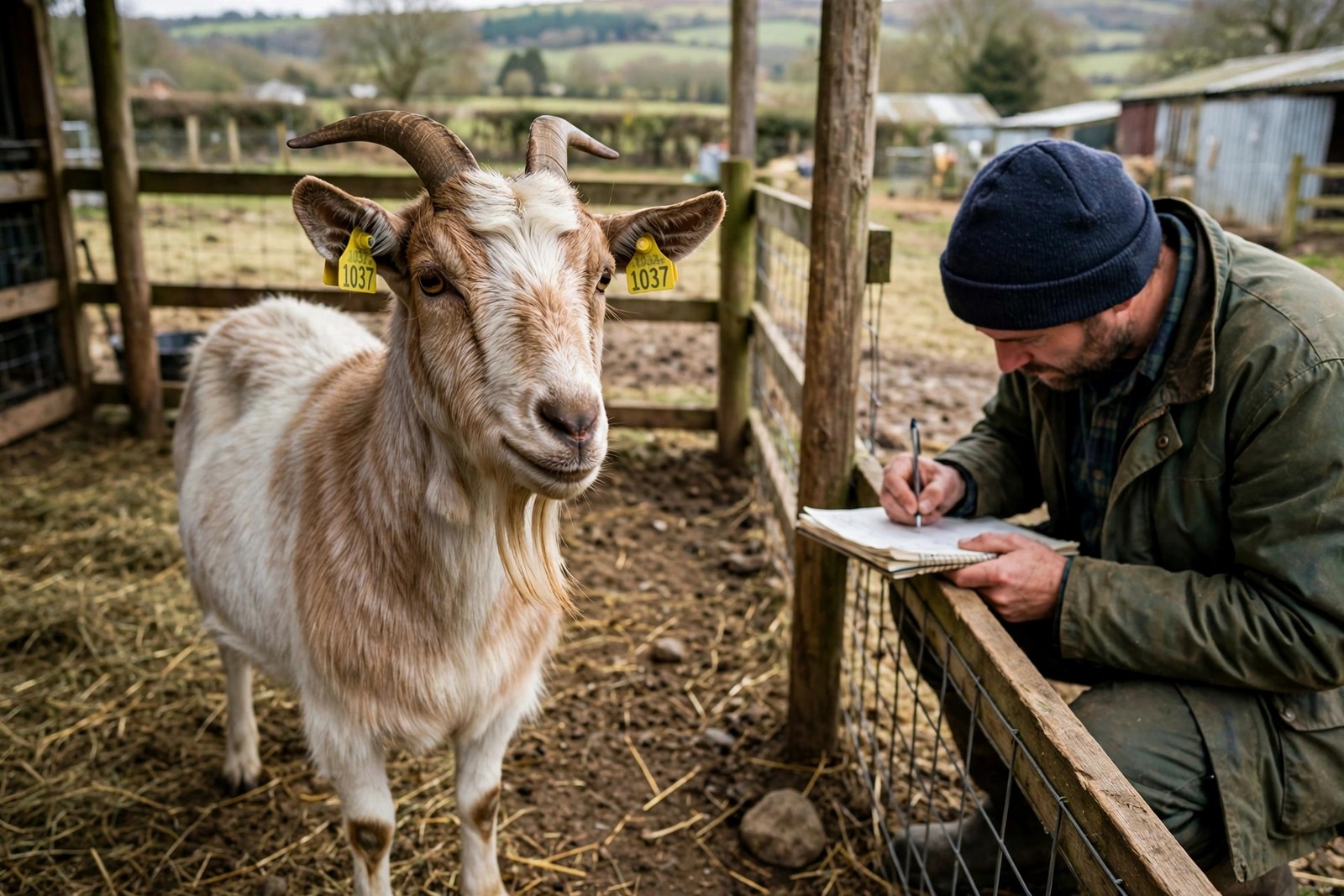
A finder cannot return an animal they cannot identify, and a straying goat or sheep carries no collar, no name tag and no way to speak for itself. Tracing one home rests on three linked steps: a durable identifier on the animal, that identifier tied to your holding in official records, and your own register that turns a number into a description a finder or official can act on. Set the system up while every animal is standing in your own pen, and a stray becomes a phone call rather than a loss.
Ear Tags That Carry Your Holding Identity
The working identifier for sheep and goats is the ear tag. Official tags carry your holding number and an individual animal number, and in many areas a flock or herd mark as well, so a single read of the tag points straight at your holding. Tag according to the rules that apply where you keep livestock, replace a lost tag promptly — a gap in tagging is a gap in traceability — and check tags at routine handling, because ears tear and tags work loose, especially on goats who rub fences. Fit a second, management tag in the other ear as a backup: it can carry your numbering in large, readable digits, so a neighbour who finds your animal can read it at arm's length without handling kit or a scanner.
Permanent Backups: Tattoos, and What Does Not Suit Sheep and Goats
Tags can be lost, so a permanent backup earns its place. Goats are commonly tattooed — in the ear, or in the tail web on breeds with small or drooping ears — and a tattoo recorded in your register survives every lost tag. Microchips are used in some goats and sheep, but a chip only helps if the finder takes the animal somewhere with a reader, so treat it as a supplement to tags, never a replacement. Freeze branding belongs to horses, whose large, flat muscles and short coats hold a readable brand; it is not a practical identifier for sheep under a fleece or for goats, and temporary wool or fleece marks wash and shear out, so they serve for sorting your own flock at home, not for tracing a stray.
The Holding Register That Proves the Match
A tag number is only useful if your records complete it. Keep a register — a notebook by the feed store or a simple spreadsheet — where every tag number has a matching line: breed, sex, colour and markings, age or year of birth, and the management number if the animal carries one. Add a clear, recent photo of each animal, full-body from the side plus any distinctive mark close up: a torn ear, an unusual patch, a crooked horn. Update the register the day an animal arrives, is tagged, is sold or dies, and keep your movement and holding records in the same folder. When you report an animal missing, this register is what lets you give the tag number, the description and the photo in one message, instead of reconstructing them from memory.
When an Animal Is Found or Lost
If you find a stray goat or sheep, secure it in a pen with water, read and write down both ear tags if present, photograph the animal, and report it through the channels keepers around you actually use: neighbouring holdings, the local animal warden or authority, nearby vets and markets. If yours is the one missing, move in the first hours: walk fences and lanes, ask neighbours, and circulate the tag numbers, description and photo the same day, while the animal is still close. Never chase a panicked stray across open ground; lure it with feed into a pen or a corner instead. That circulation moves faster with KinsLe's Lost Pet Alert System: an alert created free from the animal's profile appears on a map view, and whoever spots the animal can reach you by direct message through KinsLe.