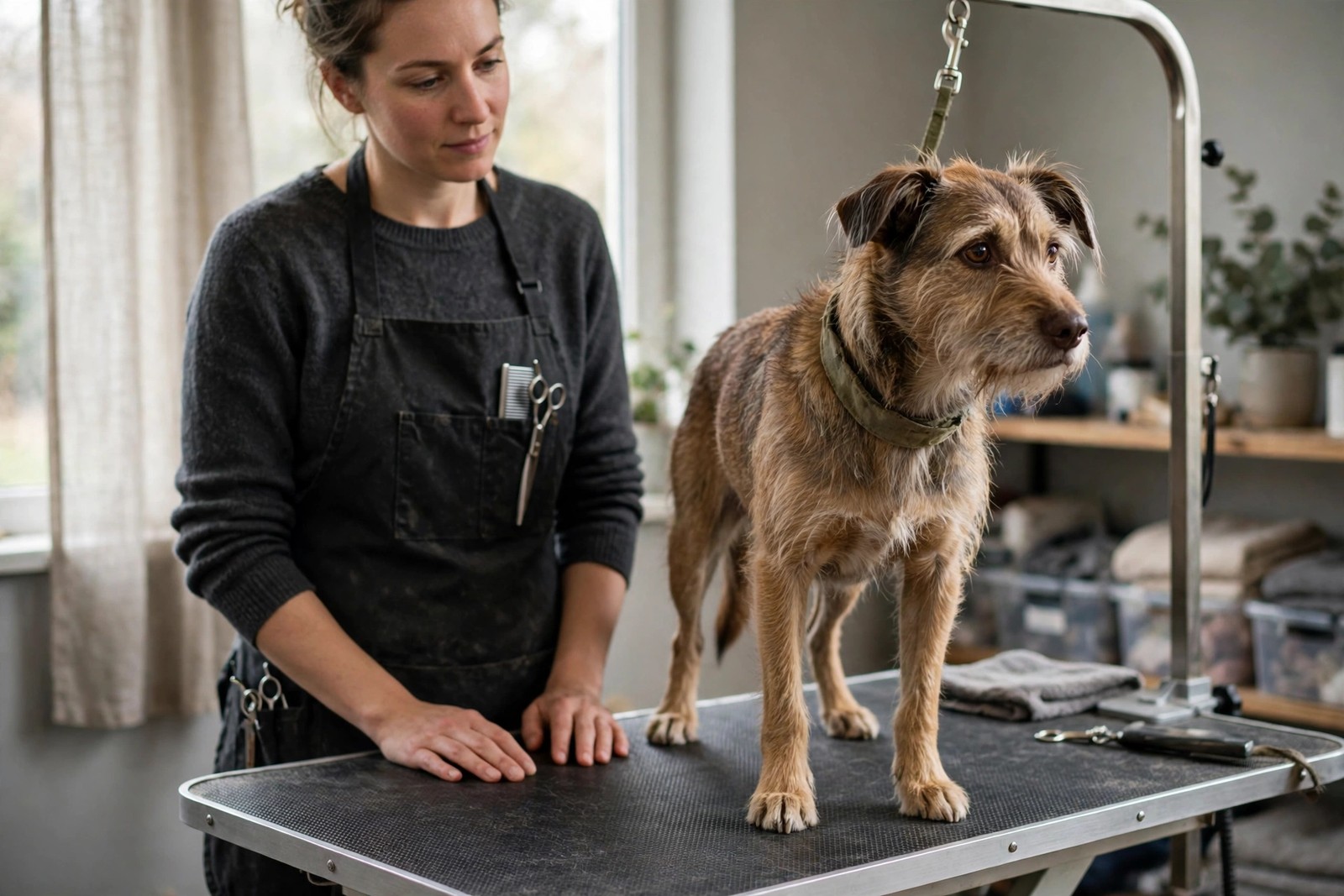
A rescue dog with a known story gets a first appointment planned around that story. A dog with an unknown history gets something different: an appointment planned around the gaps. Nobody knows this dog's vaccination status, health, past handling, or what has been done to it before, and every one of those unknowns changes how the first groom should run. The visit is less a grooming session than a careful fact-finding exercise in which some grooming also happens, and treating it that way is what keeps the dog, the groomer, and future appointments safe.
Unknown Health Status May Put a Vet Visit First
Start with the gap that can stop the appointment outright: vaccination and health status are unknown. A groomer may require evidence of current vaccination before accepting any new dog, and with nothing to show, the salon can reasonably refuse or postpone the booking. A vet visit may therefore need to come first — to check the dog over, establish its health as far as can be known, and start whatever vaccination cover the vet advises. That visit also surfaces what a groomer needs to know and nobody currently does: skin problems under the coat, ear trouble, lumps, sore teeth, or pain on movement. Arriving at the groomer with a vet's findings turns a dog of pure unknowns into a dog with a genuine medical starting point.
Go-Slower Handling, Stop Signals From the First Touch
With no history to read, handling proceeds as a series of small tests. The groomer starts with brief, ordinary touch in the places dogs usually accept readily, watches the response, and only then works toward feet, ears, face, and rear, pausing wherever the dog tightens, freezes, pulls away, or warns. Stop signals are watched from the first touch, not once trouble starts, because with this dog there is no baseline to compare against — the groomer is building the baseline in real time. Breaks come sooner and more often than a standard appointment allows, tasks are dropped the moment they stop being safe or fair, and the session ends early if the dog's signals say so. Nothing about this is wasted time; it is how the dog's actual tolerance gets discovered without anyone being bitten finding it out.
No Assumptions About Touch Tolerance Anywhere
The discipline of the visit is assuming nothing. A dog that leans happily into a neck scratch may panic at a lifted paw; a dog fine with clippers may be terrified of the dryer; a dog relaxed everywhere may guard one ear that hurts. With an unknown history, each area of the body and each tool and sound is its own question, asked separately and gently. Mats are a particular trap: a badly matted coat on a dog whose handling tolerance is unknown is not a combing project for visit one, because an hour of tugging at painful mats teaches the dog exactly what grooming means. Where the coat cannot be made comfortable within what the dog can accept, the groomer stops, and the next step is a conversation with the vet about how the remaining work can be done fairly.
Everything Observed Gets Recorded for Visit Two
The output of this appointment is knowledge, written down. Everything the groomer observes gets recorded: which touches were accepted and which were not, where the dog flinched or warned, what the skin and ears looked like once the coat was opened up, which sounds or tools caused trouble, and what was left undone and why. That record is shared with you and kept for the next booking, so the second visit starts from knowledge instead of repeating the discovery process from zero — the groomer already knows to go slowly at the left ear, skip the dryer, and leave more time for the feet. Over a few visits the record becomes the history this dog arrived without, built from observation rather than guesswork.
KinsLe keeps those first-visit findings from being lost, because Care Teams duties for this dog preserve what handling was tolerated, what was skipped, and what needs a slower approach.