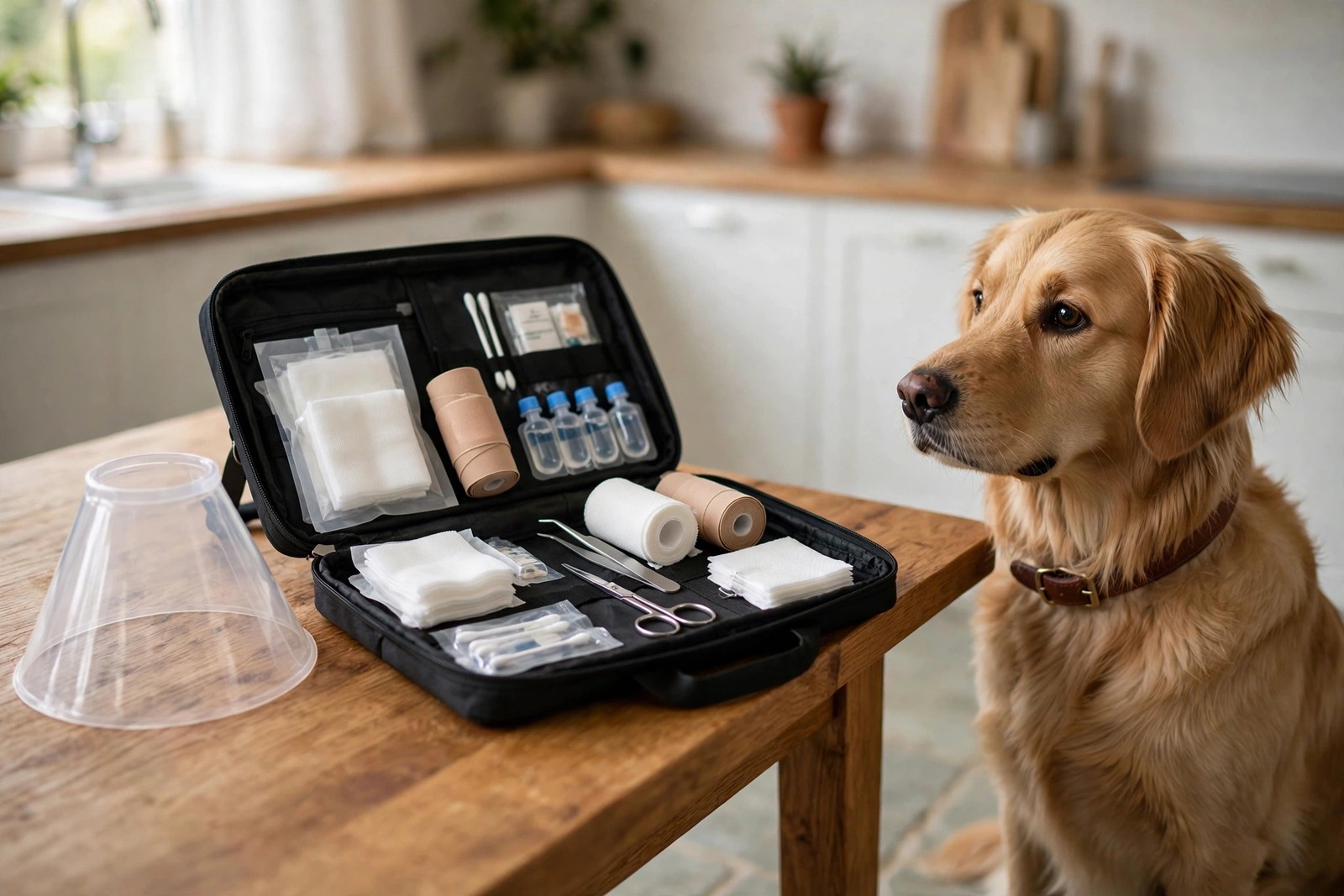
A dog first aid kit has one job: help you stabilise your dog, protect an injury from getting worse, and get to a veterinarian without hunting through cupboards while stressed. It is not a home treatment cabinet. Every item in the list below earns its place by supporting that narrow job, and the kit works only alongside two rules: use nothing beyond what your vet has directed for this dog, and treat the kit as a bridge to professional care whenever an injury is deep, bleeding heavily, involves an eye, affects breathing, or follows a suspected poisoning or fracture.
Dressings and Bandaging
Non-stick dressings go directly against a wound so the covering does not cling to damaged skin when a vet removes it. Gauze pads work for gentle cleaning support and for padding, while gauze rolls build up a protective layer over a dressing. Self-adhesive bandage wrap holds those layers in place without sticking to fur, and adhesive tape secures the end of a wrap or fixes a dressing on a flatter area. Cotton wool serves as padding between toes or under a wrap, where pressure needs softening. Keep these items sealed, clean, and dry until needed. A wrap should feel secure without being tight, and toes or the paw below a leg wrap should be checked for swelling or coolness, with the wrap loosened and veterinary advice sought if either appears.
Tools and Cleaning Basics
Blunt-ended scissors cut bandage material and tape without the pointed-tip risk near a wriggling dog. Tweezers handle small surface debris or a thorn your vet's guidance covers, while a tick remover is shaped to grip a tick close to the skin for the twisting or sliding removal method its instructions describe. A digital thermometer, used with lubricant and only if you have been shown how, gives a reading you can report accurately when you phone the clinic. Disposable gloves protect both you and the wound during any handling. Sterile saline pods are the cleaning basic in the kit: they let you gently flush loose dirt from a wound or rinse an irritated eye area while you arrange veterinary care, without adding anything a vet has not approved. A flashlight helps you see into a mouth, ear, or paw and to check a wound in poor light at night or outdoors.
Dog-Specific Items and the Information Layer
A protective collar, fitted to your dog beforehand, stops licking and chewing at a wound or dressing during the journey to the clinic. A spare lead keeps control when a collar slips or a lead snaps during an incident, and a soft muzzle can protect handlers because even a gentle dog may snap when hurt. Never use a muzzle on a dog that is vomiting, coughing repeatedly, or struggling to breathe, and never leave a muzzled dog unattended. A foil emergency blanket helps keep an injured or shocked dog warm during transport. Paperwork completes the kit. Keep the clinic numbers where you can read them without searching, the vaccination record where a covering vet can see it quickly, and a note of ongoing treatment the vet has directed, labelled clearly so nobody guesses under pressure. Do not stock human pain relief or leftover medicines for general use; the only medication in the kit should be what your vet has directed for this dog, labelled and in date.
Storing, Checking, and Practising
Keep the main kit where you can reach it quickly at home, and consider a smaller duplicate with dressings, saline pods, a tick remover, and a spare lead for the car or walks. Check the whole kit regularly and after every use, replacing used, opened, or expired items straight away so the kit is never half ready. Practise calm handling when nothing is wrong: paw checks, gentle thermometer handling if your vet advises it, and trying the protective collar on for short, rewarded periods. In KinsLe, Pet Passport stores the kit list beside the emergency numbers, so a quick check before travel takes seconds.