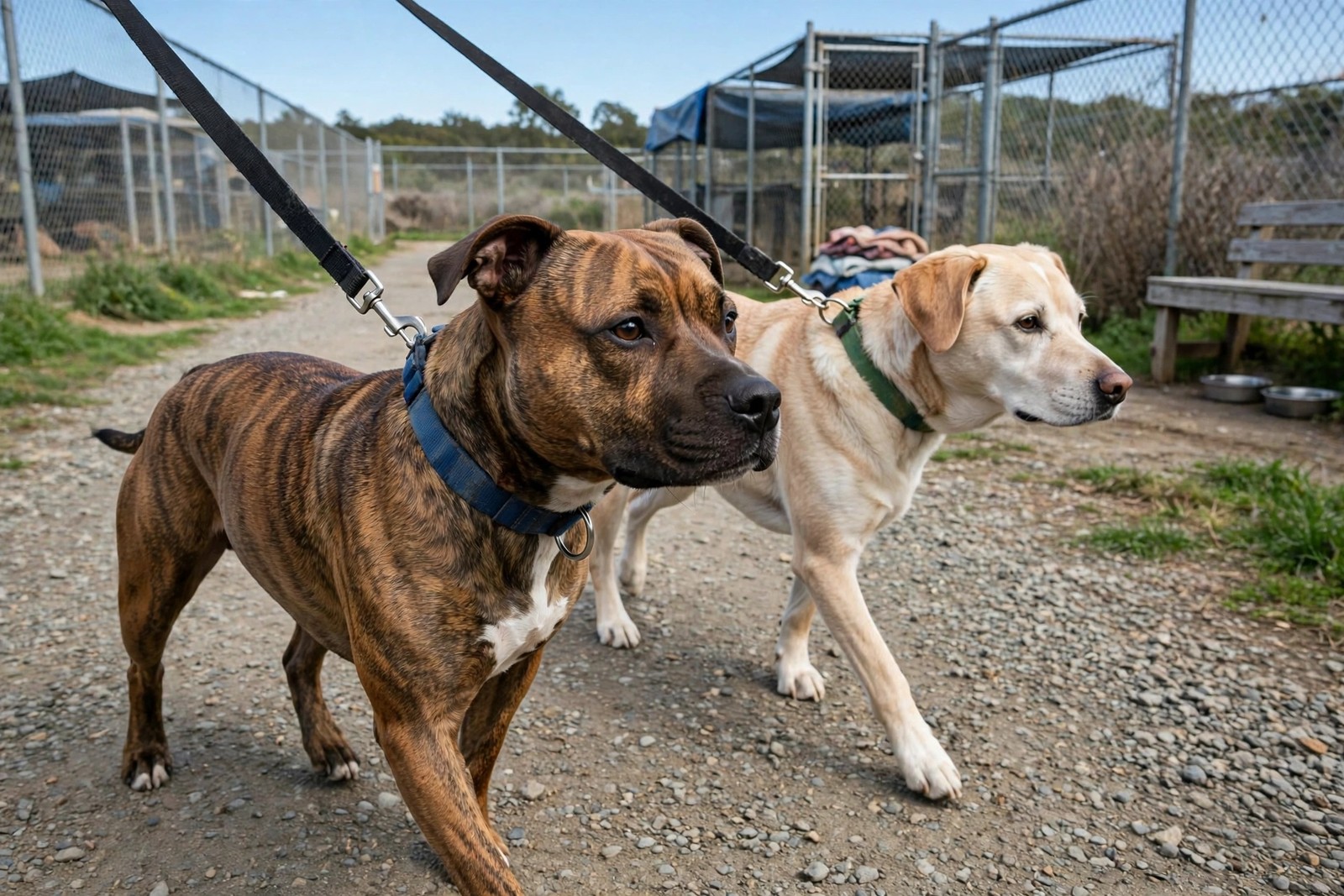
'Good with dogs' is the most overworked phrase in rescue listings. It can mean a dog who plays joyfully with every dog met, a dog who tolerates calm adults but guards toys, or a dog who has simply never been tested and has not yet had the chance to object. With a strong, dog-selective-prone breed like the Staffordshire Bull Terrier, adopting on a slogan is a gamble your resident dog did not agree to. The rescue's job is to know the individual; your job is to ask questions specific enough that the real history has to surface.
Ask for Assessments, Not Impressions
Request the actual dog-to-dog assessment record: which dogs the Staffy was introduced to, of what sizes, sexes, and energy levels, in what setting, and what the assessor observed. Useful notes describe behavior in plain terms: loose and wiggly greetings, a stiff first moment that softened, play that needed interrupting, interest that stayed polite on parallel walks. Ask how many introductions went well and whether any were cut short, and by whom. Foster-home notes are often worth more than kennel assessments: a fosterer can report how the dog shares space hour after hour, whether relaxation around a resident dog grew over weeks, and what happens at fences, doors, and food bowls when nobody staged anything.
Incidents, Play Style, and Guarding
Ask directly whether any incident history exists: bites, fights, pinning that needed separating, or complaints from previous homes or foster placements, and listen for specifics rather than verdicts. Then get precise about play style. Some Staffies play in a full-contact, wrestling style that delights similar dogs and overwhelms gentle ones; others are chasers, ball-focused dogs who ignore playmates, or social butterflies who check in constantly. Play style decides compatibility more often than friendliness does, because a mismatched pair can be miserable while both dogs are, individually, perfectly pleasant. Ask separately about guarding around other dogs: toys, chews, food bowls, beds, and favorite people are the usual pressure points, and a dog who guards from dogs but shares happily with humans needs a managed home, not a rejected application, as long as you know before day one.
On-Lead Behavior Is Its Own Question
Separate on-lead reactivity from off-lead behavior in every conversation, because the two routinely disagree. A Staffy who lunges and barks at dogs on walks may play politely in a yard, frustrated by the barrier rather than hostile, while a dog who walks past others beautifully may be tense and guardy in close off-lead contact. You need both answers, since your daily life will include both settings. Ask to walk the dog yourself near other dogs, watch a greeting the rescue arranges, and then set up the decisive test: a meet-and-greet with your own resident dog on neutral ground, starting with a parallel walk at a distance, closing gradually if both dogs stay loose, sniffing briefly, and walking on again. Finally, ask whether a trial period or foster-to-adopt arrangement exists, because some incompatibilities only appear when a new dog stops being a guest and starts being a resident.
Make the History Travel With the Dog
Adoption day is exactly when paperwork gets lost, and a dog's assessed history is too valuable to leave in a kennel file. When the adoption goes ahead, ask the rescue to pass the assessment notes, foster observations, and incident record into the Transferrable Profiles record on KinsLe so the history transfers with the dog into the new home. The adopter then starts from evidence: known play style, known guarding triggers, known difference between lead behavior and yard behavior, all available to a trainer, a sitter, or a future veterinarian without anyone reconstructing it from memory. That continuity is what turns a careful pre-adoption check into years of informed handling rather than a good first week followed by guesswork.
KinsLe's Transferrable Profiles keeps foster notes, incident history, and meet-and-greet results attached to the dog when the profile moves to the adopter.