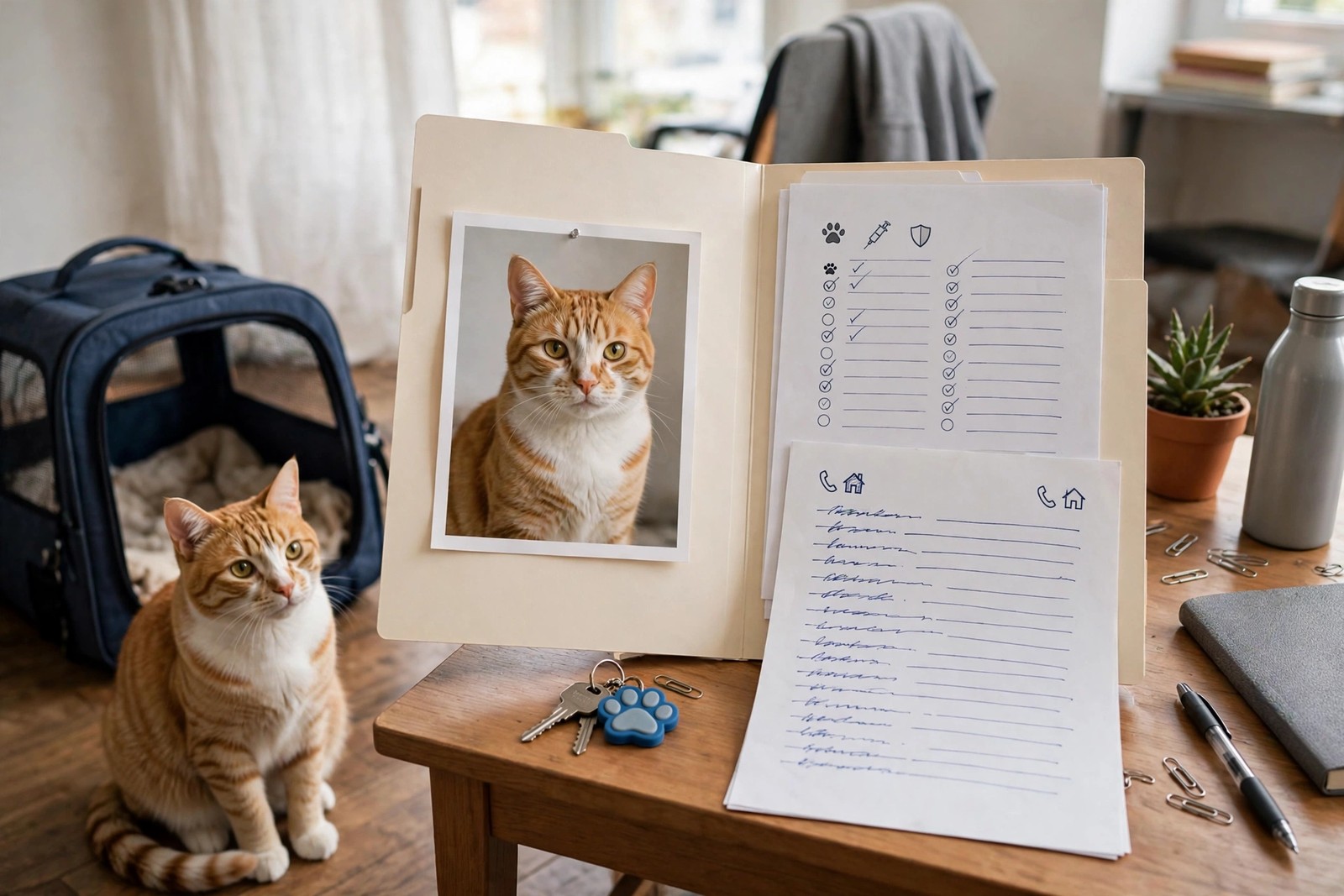
A boarding folder has one job: everything the facility needs, and everyone the facility might need to reach, in one place that works even when both students are in lectures, in exams, or out of signal. In a shared apartment the folder matters twice as much, because no single person holds the whole picture — one student may know the veterinarian's name while the other knows the feeding routine.
Records and the People Who Can Be Reached
Open the folder with the vaccination record, since the facility will ask for it before anything else, and add a clear recent photograph of the cat, full body and face, so records and cat are easy to match at a glance. Behind those go the health contacts in order: your usual veterinary practice with its phone number, the emergency contact to use when the practice is closed, and a short health page noting ongoing conditions in plain language. Then the contact page, written for real student life: both students' mobile numbers in the order they should be tried, honest about reachability — the student whose phone stays on during exams is first contact — plus one nearby backup person, a friend or neighbor who knows the cat, for the hours when both students are traveling or dark.
Feeding and Medication, Written Exactly
The care brief should read the way care actually happens at home. Write the feeding exactly as it is served: the food itself, the amounts as served at home following the packaging guidance and your veterinarian's view, and the times. If the cat takes any medication, the rule is exactness without improvisation: the medication appears only exactly as prescribed, with its routine written out in the veterinarian's own terms — name, timing, and how it is given at home — copied faithfully rather than summarized from memory by whichever roommate happens to be packing.
Habits, Hiding Places, and Handling
Records say what the cat is; this page says who the cat is. Note the daily habits the staff will actually meet: how the cat takes to strangers, whether being picked up is welcome or stressful, the treats that work, the games that settle, and anything that reliably frightens. Name the favorite hiding places honestly — under-bed equivalents exist in every facility run, and a cat who has wedged somewhere predictable is far easier to check on than one whose hiding is a surprise. Add carrier behavior too, since staff may need to move the cat during the stay.
Permission for Emergency Care, Agreed in Advance
Emergencies are the wrong time to negotiate authority, so settle the wording before the stay. Discuss with your veterinarian, in advance, the permission you want on file: that the facility may arrange emergency veterinary care for the cat, where the cat should be taken if staff judge a veterinarian is needed, and which of the named contacts can authorize treatment that cannot wait for a phone answer. Write down the pickup rule alongside it — which named people may collect the cat — and complete the facility's own forms before drop-off day rather than at the counter.
How the Folder Reaches the Caregiver
The paper folder travels with the cat, and its contents reach the caregiver digitally through KinsLe's Care Pass: whichever student is organizing the stay grants the named boarder or sitter access to the cat's brief — the records, contacts, feeding and medication routine, habits, and permissions assembled above — scoped to that cat and that caregiver only. The access is time-boxed to the stay itself: it opens when the stay begins and expires on return, so the boarder is not carrying your cat's details into next term, and either student can see exactly what was shared. Paper in a drawer at home helps nobody at the facility, so passing the brief through the Care Pass on KinsLe means the boarder you named sees exactly what the folder holds, for exactly the days of the stay, and nothing beyond them.