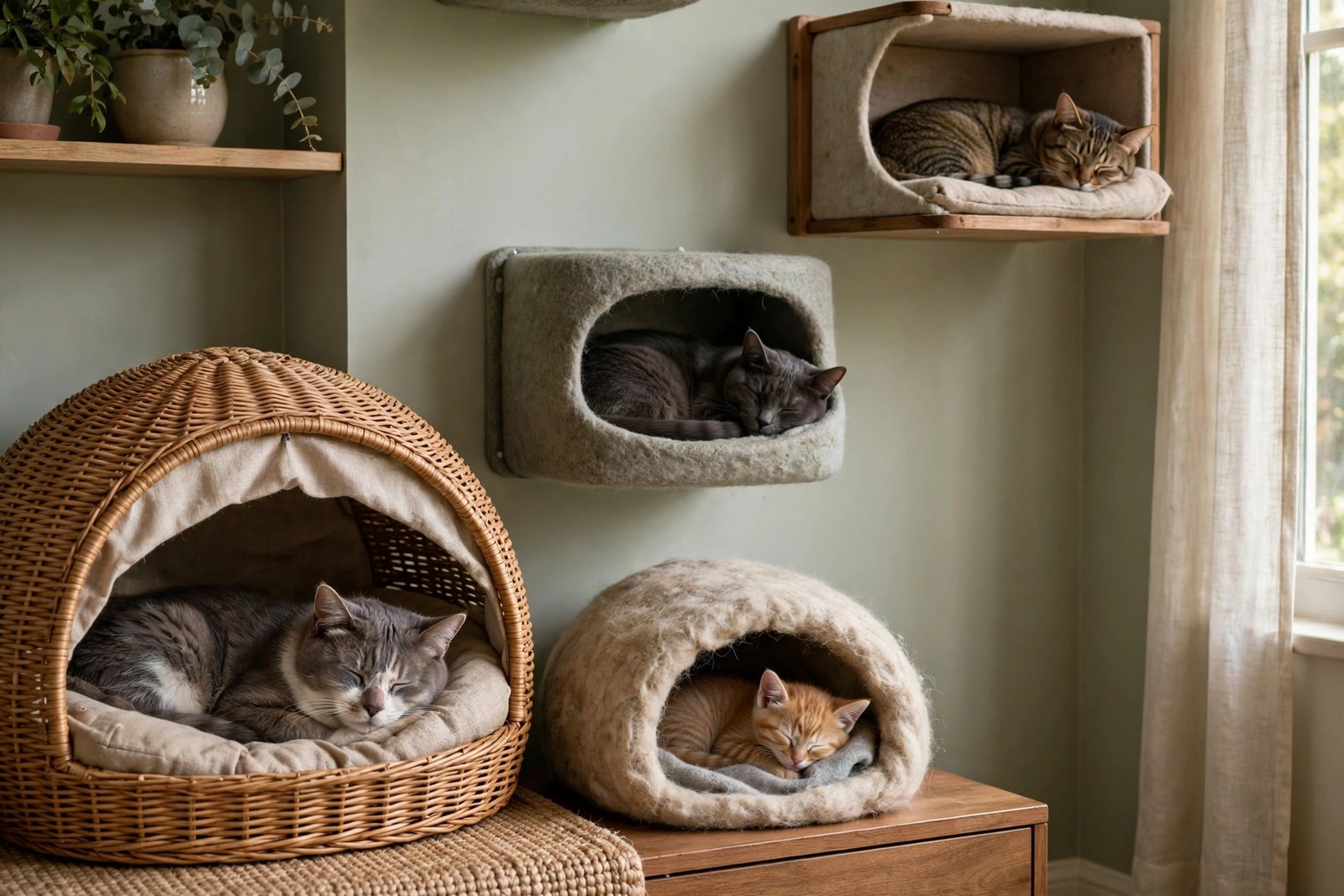
A household with a kitten, two adults in their prime, and a senior is really four households sharing one address. Each cat needs somewhere to be unreachable — a place where visitors, vacuums, doorbells, and each other stop existing — but the right refuge looks different at each age. Planning retreats by life stage, and then defending them with one firm household rule, turns a noisy open-plan home into a place where every cat can regulate its own day.
Match the Level to the Cat
The senior's retreat comes first and sits at ground level: a covered bed, a box den, or a low hideaway entered without climbing, jumping, or squeezing, because stiff joints and reduced muscle make a high perch a place a senior may still reach yet pay for later. Line it warmly and place it in the quietest room the cat already favors. The kitten needs the opposite geography in miniature — a small enclosed den fairly near household life, since young cats retreat in short bursts between expeditions and feel safer re-emerging close to familiar sounds. Between those extremes, most adults choose by temperament: a shy cat wants a covered, single-entrance shelter in a low-traffic corner, while a confident cat prefers a high, enclosed perch where it can watch a room full of guests from above the commotion.
More Retreats Than Cats, Spread Well Apart
Provide at least five solid retreats for four cats. The extra spot is not generosity; it is conflict prevention, because a cat that finds its usual refuge occupied needs somewhere equally good to go, not a reason to displace the occupant or wander stressed. Scatter the retreats across different rooms rather than clustering them in one cat corner, and keep them away from the genuine noise sources: washing machines, televisions at evening volume, the hallway the front door opens into. Where two cats could corner each other, favor arrangements that cannot become a trap — a den positioned so another cat cannot sit and guard the only way out. Food and litter stay out of retreats completely. A refuge that contains dinner becomes a resource to defend, litter makes rest smell like a toilet, and both errors quietly destroy the one thing a retreat sells, which is undisturbed sleep.
Visitor Hours Test the Whole System
Retreats earn their keep when guests arrive. Before a gathering, open access to every refuge, close off none of the routes to them, and let each cat choose its own distance; some will supervise from the high perch, others will vanish until the house is theirs again. Children and visitors need the rule in plain words before they go looking for the cats: a cat in a retreat is off duty — no reaching in, no coaxing out with treats waved at the entrance, no lifting the lid for a look. Check on a hidden senior quietly afterward rather than during, by listening and glancing from a distance, so the refuge never becomes the place where people come to extract its occupant.
Write the Agreement Down Where Everyone Sees It
Four cats and several humans produce endless small misunderstandings — a well-meaning guest follows a cat into its den room, one family member assumes another checked the senior, nobody remembers which cat claimed the study box. Family Sharing carries the household agreement in one shared roster: each cat's chosen retreat, its level and location, the rule that nobody pulls a cat out, and the visitor routine, all visible to everyone who lives there or stays over. New information lands in the same place, so when the senior stops using a mid-height spot, the roster notes the change and the ground-level option gets improved instead of the cat quietly going without. The roster is a small document, but it converts good intentions into a system the cats can rely on every day. Keep the retreat roster in the Family Sharing record on KinsLe, and a visiting grandparent can learn each cat's refuge before the first doorbell rings.