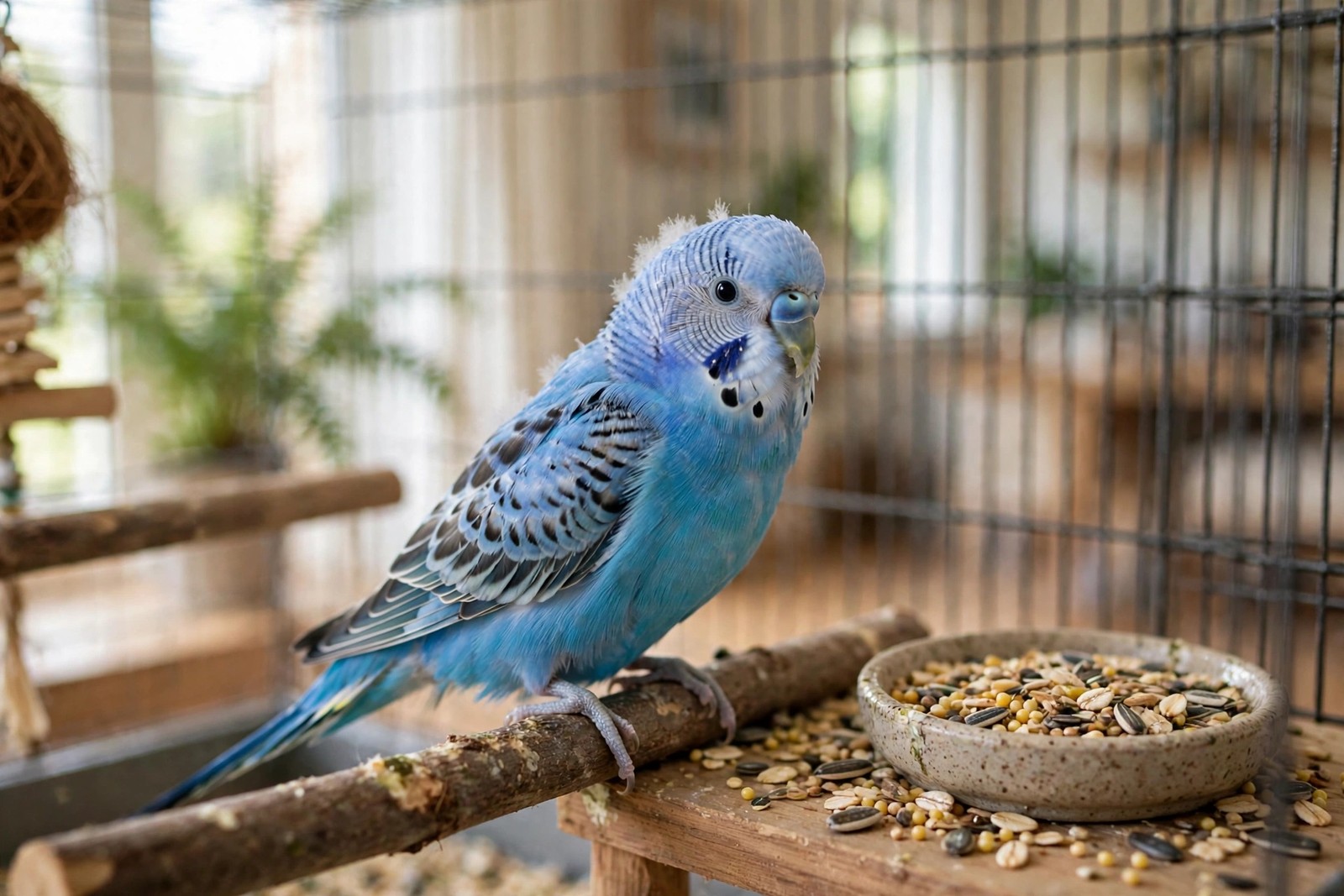
Most baby budgies are ready to leave the nest and their parents at around six to eight weeks old, yet the calendar is only a rough guide. Budgie chicks fledge, meaning they first leave the nest box and try their wings, at roughly four to five weeks, and they spend the following weeks learning to fly, land, and feed themselves while their parents still top them up. A chick is ready to move to its own cage or a new home only when that learning is finished, and individual chicks in the same clutch can be days apart.
Feathers, Flight, and Perching
A ready chick is fully feathered, with no bare patches and no waxy pin feathers still emerging across the head and body, because a partly feathered chick cannot regulate its temperature or fly properly. Watch it fly across the cage: it should take off deliberately, steer around perches, and land where it aimed, not flutter to the floor and climb back up. On the perch it should sit upright and steady, grip with both feet, and shuffle along without toppling. Chicks that still spend most of the day crouched on the cage floor, fluffed and begging at every passing adult, are telling you they need more time.
The Real Test: Eating Alone
Independence is decided at the food dish. A weaned budgie hulls seed with its beak, dropping empty husks, or crunches pellets rather than just picking them up and dropping them, and it visits the water dish and drinks by itself. Offer spray millet, seed, pellets, and a little finely chopped vegetable at floor level as well as in dishes, because young budgies learn to eat by exploring low down where they feel secure. Look for several consecutive days of self-feeding with a comfortably full crop by evening and normal, well-formed droppings. A chick that begs, is fed by a parent, and then ignores dishes is practising, not weaned.
Weight Tells the Truth
Weighing a chick at the same time each morning gives an honest answer when behaviour is ambiguous. A weaning budgie may lose a little weight as it becomes more active, but the figure should level out and hold steady while it feeds itself. A chick that keeps losing weight, feels light with a sharp breastbone, or has an empty crop morning and evening needs to stay with its parents longer, and a chick that stops eating during weaning needs prompt advice from an avian vet, because small birds have very little reserve. Never rush a chick out because a buyer is waiting or the parents seem eager to lay again; separate the parents instead and let the chick finish weaning.
Making the Move Easy
Set up the new cage with low perches, food and water within easy reach on the floor as well as higher up, and the same seed or pellet mix the chick already knows, changing diets only after it is settled and eating confidently. Keep the room calm for the first days, handle the youngster briefly and gently, and keep watching droppings, dishes, and weight until self-feeding is beyond doubt. Keepers who log those daily weights, dish checks, and first flights through KinsLe's Care Teams share one clear record of each chick's progress, so the move out of the nest happens chick by chick, on evidence, not on age alone.