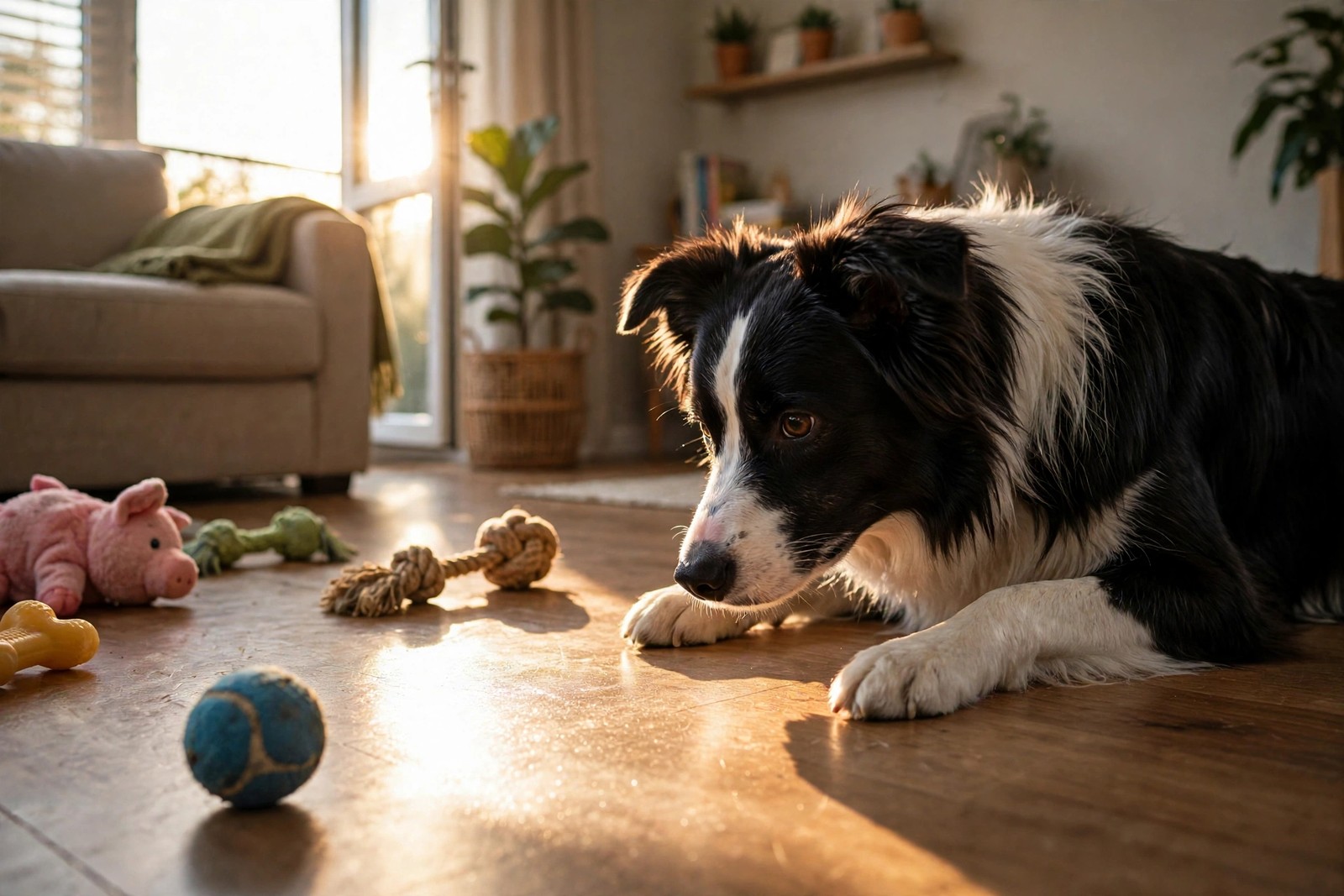
Light and shadow chasing begins innocently. Movement is the trigger for the predatory sequence — orient, stalk, chase, grab — and a reflection sliding across the floor is pure movement with nothing attached. The problem is built into the target: a reflection cannot be caught, pinned, or shaken, so the sequence never reaches its completing step and never switches off. The dog stays aroused, keeps scanning for the next flicker, and rehearses the loop again. In susceptible dogs, herding breeds prominent among them, repetition turns a game into a habit the dog starts without any visible trigger at all.
Why the Toys Sit Ignored
Owners read the ignored toys as fussiness; the dog's brain reads them as irrelevant. A ball is stationary until thrown, predictable in flight, and catchable — after hundreds of failed captures on light, a fixated dog's attention system is tuned to flicker and contrast instead: the glint off a watch face, a phone screen reflection on the ceiling, shadows thrown by passing cars. Once the loop is established, ordinary play cannot compete because it does not match the trigger the dog is scanning for. That is also why scolding fails: your dog is not choosing the reflection over you, and in mid-episode many dogs barely register voices at all.
What To Stop, and What To Do Instead
- End laser-pointer and torch games completely, for every person in the house, permanently; they are a common training ground for this fixation.
- Interrupt episodes early, before arousal peaks: call your dog away in a bright tone, or step between your dog and the wall, then immediately offer a job with a completable ending — a scatter of treats to find in the grass, a snuffle mat, a chew, a tug game that ends with a catch.
- Reduce the triggers themselves: close curtains against low sun that throws moving shadows, angle lamps that cast flickering reflections, and put glass-fronted items that catch light out of the dog's main room where practical.
- Build the day around scent and problem-solving — nosework games, food puzzles, training with clear finishes — because these satisfy the same seeking drive with an off switch attached.
How Serious Is It?
A dog who chases a sunbeam for a minute, then happily takes a toy or settles, is playing. Act when episodes run for long stretches, happen daily, start without an obvious trigger, intrude on walks or rest, or leave your dog panting, drooling, or unable to respond to its name. At that point this is a welfare issue rather than a quirk, and the route is a vet check — to rule out pain, vision problems, and other medical contributors — with referral to a qualified behaviourist for a structured plan. Caught early, the habit usually shrinks as completable activities take over the day; left rehearsed for months, it tends to spread to new triggers and new rooms.
Consistency Is the Treatment's Backbone
One person still flicking a torch on the wall "because it's funny" can undo weeks of work, because the fixation needs only occasional rehearsal to stay strong. Everyone who spends time with your dog needs the same script: no light games, interrupt early, redirect to scent work, praise the switch. Putting that script in KinsLe's Care Teams, with redirection duties and enrichment sessions assigned and marked complete by whoever is home, keeps the response identical at every episode — and for a dog learning to let a flicker pass, identical responses are what make the new habit stick.