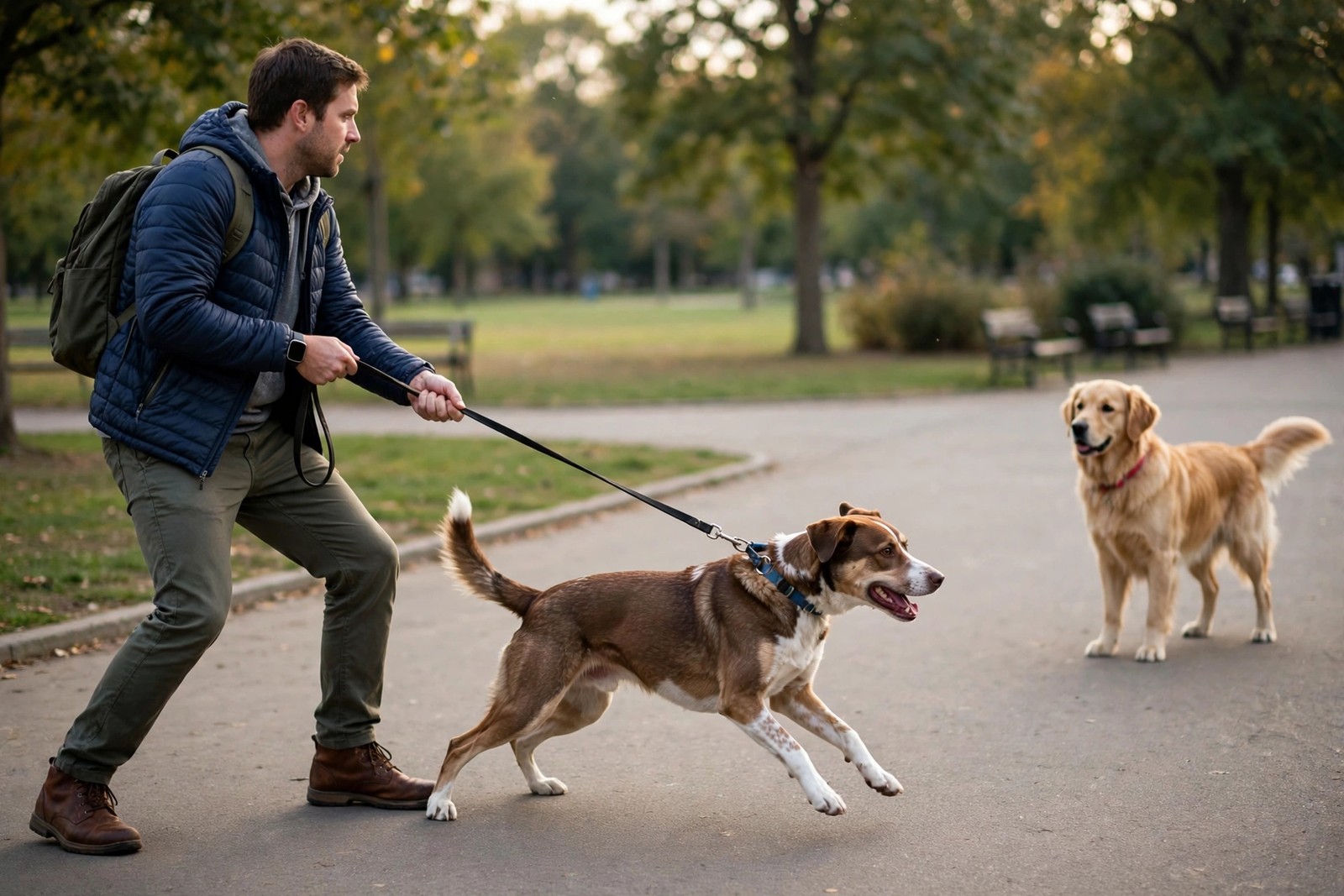
Owners often describe this dog as two different animals. At daycare the staff report relaxed, polite play with good manners around new dogs. On the street the same dog spots a dog a block away, leans into the harness, barks, lunges and scrabbles to get closer, looking for all the world like a dog spoiling for a fight. Both reports are true, and the difference is the lead. Understanding that removes the worry that the daycare dog is the act and the street dog is the truth.
What the Lead Changes About a Greeting
Free dogs rarely greet head-on at speed. They curve in, approach side-on, sniff, circle and read each other continuously, speeding up or backing off as the information changes. A lead removes nearly all of that. Your dog is held in a straight line, facing the other dog, body tense from pulling, unable to curve, retreat or complete the approach at a natural pace. Frustration builds exactly because the social intention is strong and the route to it is blocked, and frustration at the end of a lead commonly surfaces as barking, lunging and frantic pulling. Tight leads add a second problem: tension from your hand travels down the line, your dog feels restrained and braced, and the other dog reads a stiff, staring, forward-leaning stranger, which can turn a wanted greeting into a defensive exchange for both dogs.
Training the Lead Picture Specifically
Daycare skills do not automatically transfer to the lead, so train the lead picture as its own behaviour. Start at a distance where your dog can see another dog and still look back at you, and pay that check-in generously. Work on loose-lead walking past dogs at that comfortable distance before you work on greetings at all. Practise a cheerful turn-away: see the dog, mark, reward, and arc away together, so passing dogs predict good things from you rather than a straining contest. Keep early sessions short, choose wide pavements, crossings and open park edges where you control distance, and skip on-lead greetings for a while if greetings are where the frenzy rehearses itself. Parallel walks with a calm, known dog, walking in the same direction at a comfortable spacing, give a sociable dog real social time in a format the lead can actually support, and the spacing can narrow gradually as both dogs relax.
What to Stop Doing, and When to Get Help
Avoid lead corrections, jerking the line or scolding the barking; punishment layered onto frustration raises arousal and can genuinely create the aggression you feared, because your dog begins to associate other dogs with discomfort. Avoid letting your dog drag you into greetings in the hope she will calm down once she arrives, since the dragging itself is being rewarded with exactly what she wanted. Avoid retractable lines for this work, because variable tension makes the picture harder to read. If the reaction is intense, starts at great distances, redirects onto you, or your dog is large enough to pull you over, bring in a qualified reward-based trainer to set distances and watch body language in person. A trainer who has seen your dog at daycare and on lead can build a plan that uses her genuine social skill instead of treating her as an unfriendly dog.
Tell anyone who walks her exactly how passing dogs are handled, because one walker allowing dragged greetings can undo a week of careful distance work. KinsLe's Pet Services Directory helps you look for trainers and walkers in your area whose approach matches that plan, so the help you hire reinforces the same calm routine.