
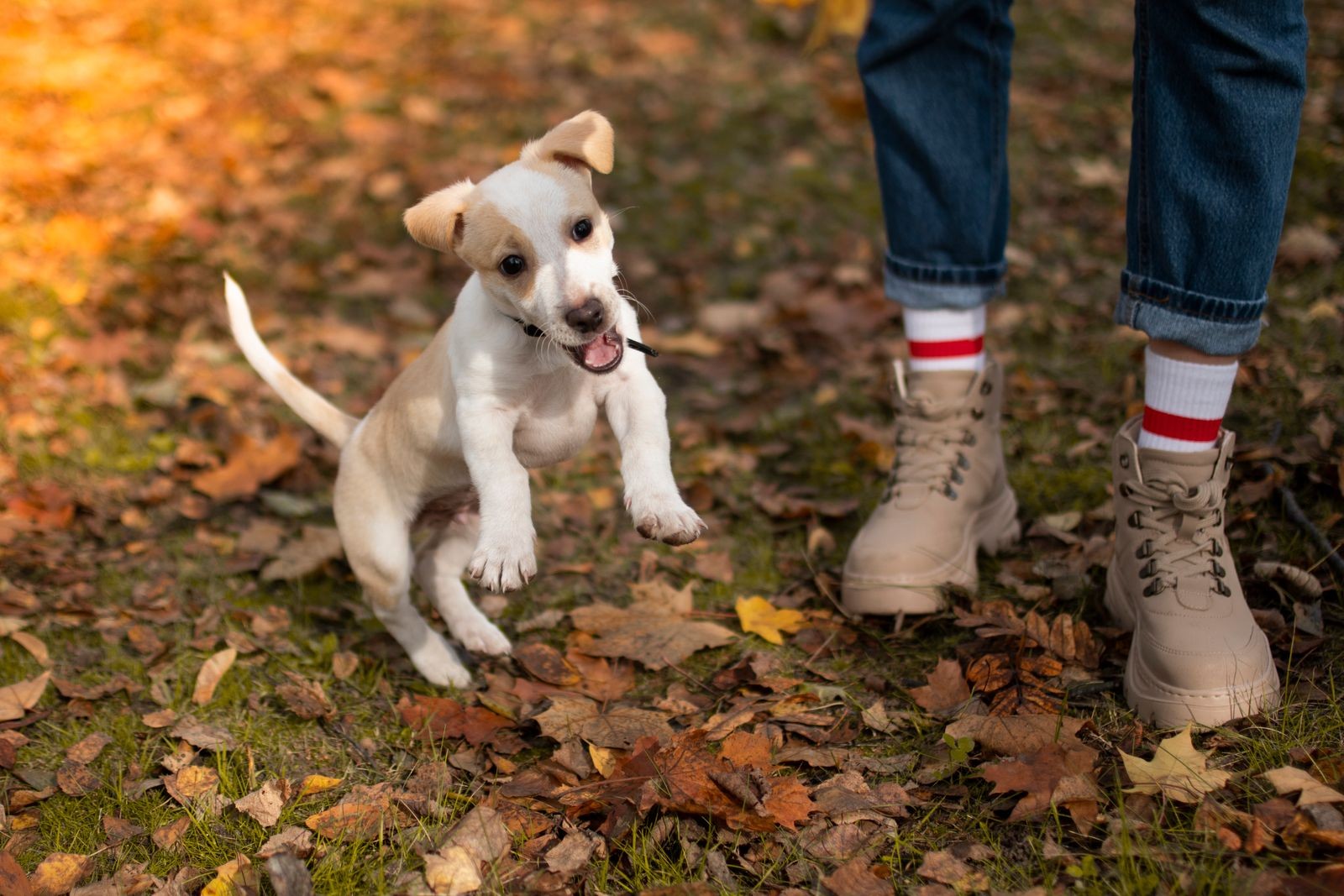
Your puppy jumps on everyone because face-to-face greeting is natural dog manners and because people are the most exciting thing in her world. Adult dogs greet by sniffing faces and licking muzzles, and puppies do the same to their mothers, so your puppy is aiming for your face with the best social intentions she knows. She is not being rude — she just has not learned the human rule yet.
The Reward Problem Starts Immediately
Puppies get paid for jumping almost every time. Visitors gasp, laugh, bend down, and fuss her; even being gently pushed off involves hands and attention. Meanwhile, standing quietly on the floor tends to get a puppy ignored. From her point of view the math is obvious. Add a puppy's short memory, limited impulse control, and a bladder-level of excitement about anything new, and jumping is simply the default setting for her age and stage.
This is also why now matters. Lessons learned at four months become the adult dog's habits, and it is far easier to shape a five-kilo puppy than to retrain a thirty-kilo adult who has rehearsed jumping for two years. Breeds that mature into big, bouncy greeters — Labradors, boxers, standard poodles, springer spaniels — make early consistency especially valuable.
What to Teach Instead
- Reward four paws on the floor constantly. When she greets with feet down, treats and fuss arrive fast and low, at her level.
- Make jumping boring. Turn sideways, fold your arms, look away, and wait. The moment her paws land, the attention switches back on.
- Teach a sit for greetings once she knows sit in quiet moments, and have helpers approach only while she holds it.
- Give her something to do with her mouth — a toy she can grab during greetings channels excitement beautifully.
- Keep greetings short and calm at first, ending before she boils over into bouncing and mouthing.
Socialization Without the Free-for-All
Your puppy still needs to meet plenty of people; that is how she grows into a confident adult. Just structure it. Ask admirers to crouch down — which removes the need to jump up — wait for calm feet before petting, and stop if she escalates. One calm greeter teaches more than ten squealing ones. At puppy class, on walks, and with visiting friends, the same rule applies: attention flows when paws are down.
Watch for the tired, overstimulated puppy, too. Jumping that gets frantic late in the day, paired with mouthing and zoomies, often means she needs a nap in a quiet pen or crate more than she needs another lesson.
Keep Every Human on the Same Page
Puppy training unravels when one person enforces the rule and another scoops her up mid-jump because she is adorable. When a visitor breaks the rule or a greeting goes sideways, you can ask Kinny on KinsLe what to try next: whether to wait for four paws down before any fuss, how to set up a sit before the door opens, or what to change when she gets too wound up. That answer gives you a clear next step for the next hello, instead of guessing while she bounces.
Kinny in KinsLe answers the follow-up questions you ask about her jumping at guests, with replies drawn from the KinsLe Answers library.