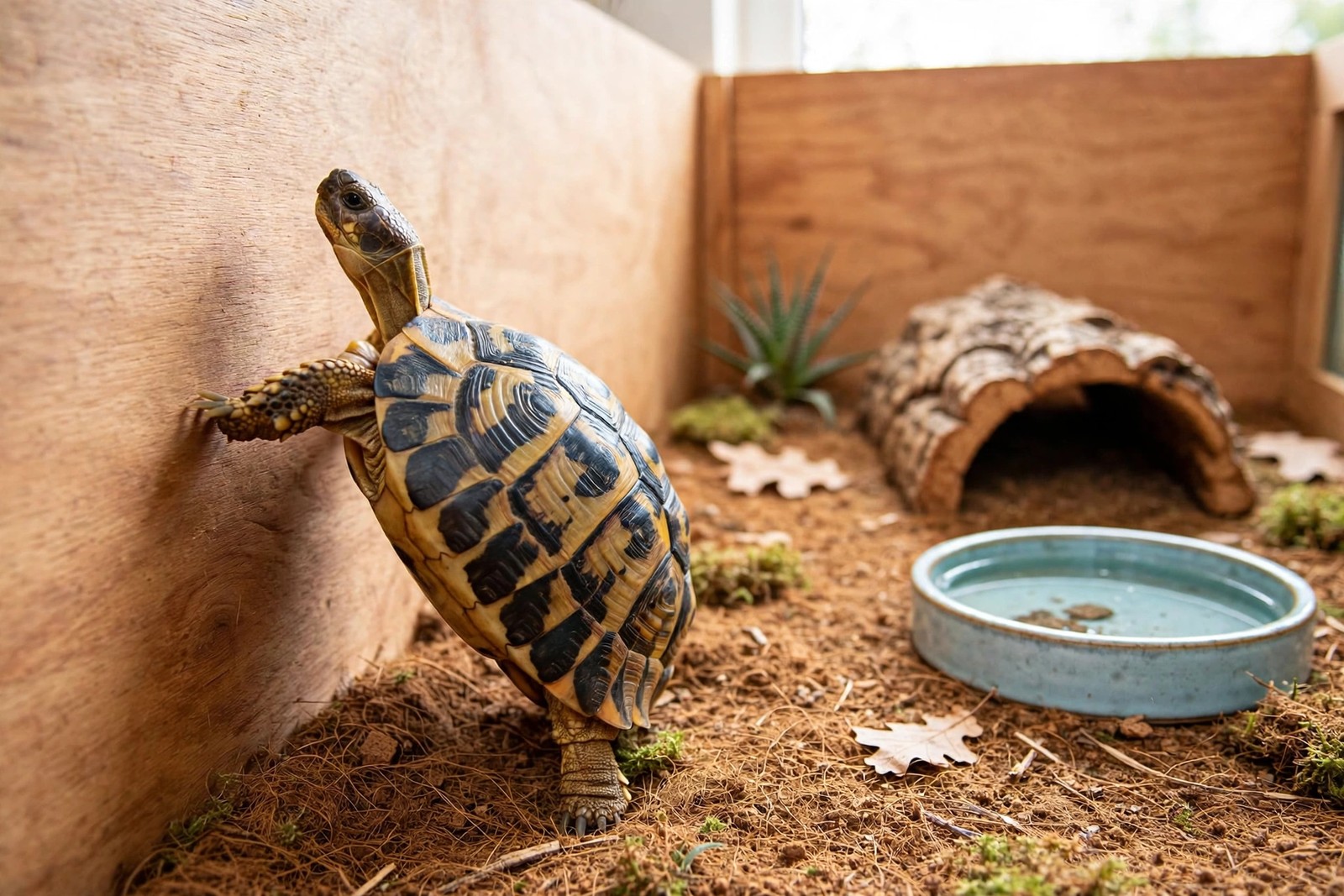
A tortoise scrabbling at the corner of its enclosure, front legs working at the wall and shell tipped against the side, is not misbehaving. It is walking the boundary of its world and finding the boundary unreasonable. A tortoise judges by sight: ground it can see is ground it expects to reach. Remove the reasons it wants to leave, and make the walls read as the end of the world rather than a window, and the climbing usually fades.
Visible Barriers a Tortoise Cannot Understand
Glass tanks and low open pens create the classic problem. Through glass, the tortoise sees the room's floor continuing and pushes toward it for hours, wearing itself out and sometimes flipping onto its back in a corner. A low wall it can see over works the same way, because the garden or floor beyond is visibly there. The fix is to make the barrier opaque and tall enough that the tortoise cannot see over it: line glass with an opaque panel well above eye level, or build pen sides it cannot see through. Owners are often surprised how completely this settles a climber, because the world beyond the wall has stopped existing.
Too Small, Too Hot or Too Bare
Climbing is also a complaint about the inside. A tortoise in a small enclosure reaches a wall every few steps, and persistent boundary-walking is a recognised sign the animal needs more floor space to patrol, graze and choose temperatures. Check the gradient with a thermometer: a tortoise trapped at the hot end with no cool retreat, or one that cannot reach a warm basking area around 95°F (35°C) at the warm spot with a much cooler area to move into, will climb trying to escape the discomfort. A bare interior adds to the restlessness, so add hides at both the warm and cool ends, a shallow water dish it can sit in, and obstacles such as rocks and branches that break the enclosure into places rather than one open floor.
Roaming, Seasons and Breeding Restlessness
Some climbing is seasonal rather than environmental. Tortoises are especially active and wide-ranging in warm weather, and mature males in breeding condition pace, climb and attempt to mount objects or other tortoises with an energy that surprises owners each spring. A female carrying eggs may also patrol and test corners, looking for a place to dig. Supervised time in a secure outdoor pen answers much of this: real ground to graze, genuine distance to walk, and natural light, with solid fencing the tortoise cannot see through, dig under or climb, and shade always available. Never leave a tortoise loose in a garden with gaps under gates, because a determined climber is also a determined escaper.
The Risks That Make Climbing Worth Fixing
Persistent climbing is not harmless exercise. A tortoise that tips onto its back and cannot right itself can overheat under a lamp or drown in a water dish, and repeated falls wear the shell's edges and can crack it. Climbing at wire or mesh can trap toes and damage claws and beak. Until the changes are made, check a climbing tortoise several times a day, right any overturned animal promptly, and move the water dish away from the climbing corner. Treat the climbing as information about the setup rather than a habit to block with a lid alone, because a lid leaves the underlying problem untouched.
Working Through the Fixes in Order
Change one thing at a time so you learn what your tortoise was asking for. Make the sides opaque first and watch for a week, then address space and layout, checking temperatures as you go. A tortoise that still climbs after the barrier, space and temperature fixes, and especially one that has also stopped eating or become lethargic, should be examined by a veterinarian who treats reptiles, because pain and illness can present as restlessness. Recording each change and the climbing that followed it in KinsLe's Care Teams, where enclosure duties are marked complete with a timestamp, builds a clear before-and-after record instead of a muddle of half-remembered adjustments.