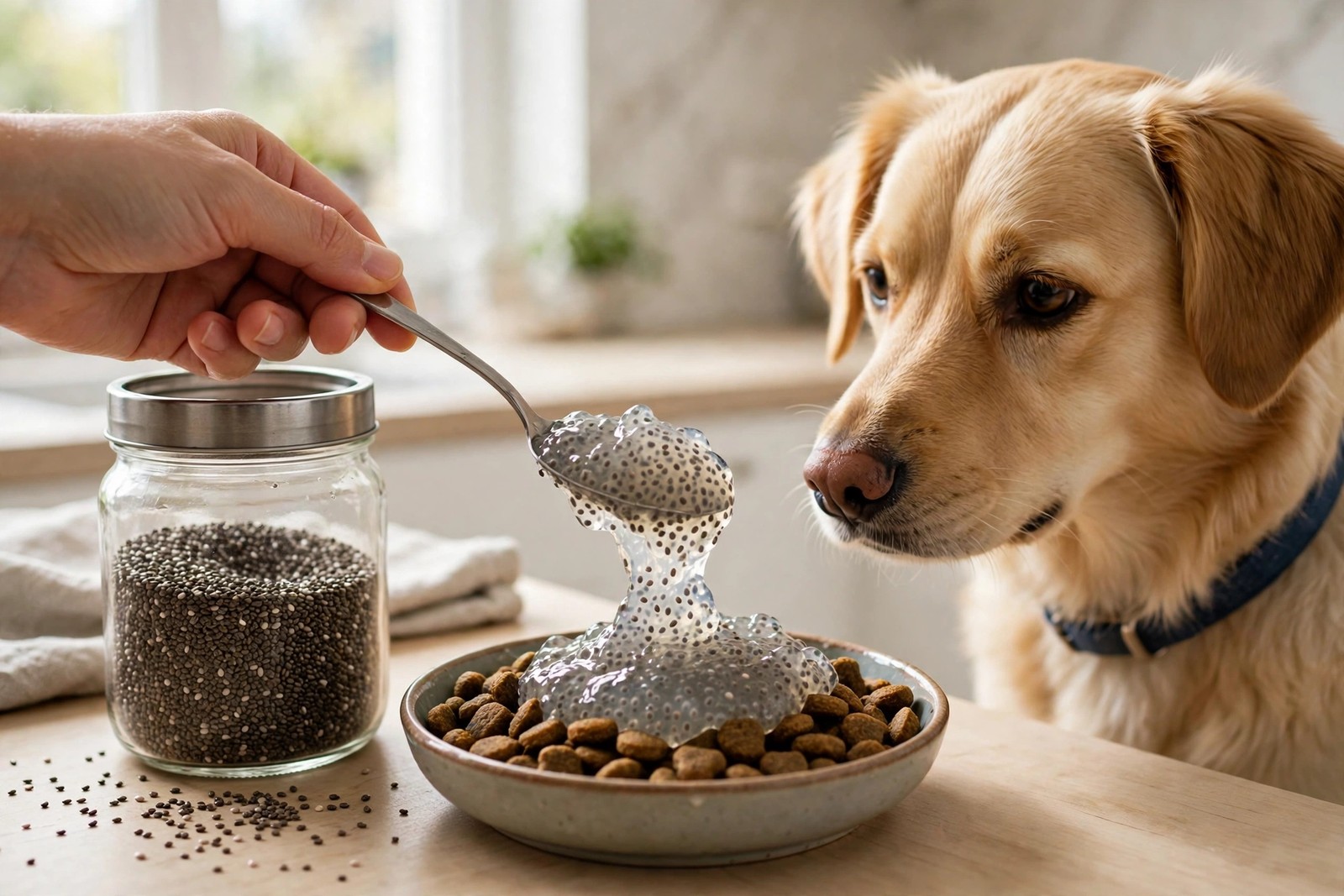
Yes, chia seeds are safe for dogs in small amounts, and owners usually reach for them as a fibre and omega-3 extra to stir through food. The seed is tiny and nutritionally dense, which cuts both ways: a pinch delivers the useful part, while a careless spoonful delivers more fibre and calories than a dog's meal needed. How the seeds are served matters as much as how many, because chia behaves unusually once it meets water, and that behaviour decides the safe format.
Soaked or Ground, Never a Dry Spoonful
Chia seeds absorb many times their weight in water and swell into a soft gel, which is the property that makes them useful and the property that rules out dry servings. A spoonful of dry seeds can clump as it picks up moisture, making it awkward to swallow, and seeds that swell after swallowing draw water as they go. The two sound formats are simple. For the gel, stir the measured seeds into a little water and leave them for fifteen to twenty minutes until they swell fully, then spoon the gel over food. For the sprinkle, grind the seeds and scatter them over a meal, with drinking water available as always. A soaked batch keeps in the fridge for a couple of days; make small batches rather than a jar for the month.
Measuring by Dog Size
Chia is concentrated, so the scale runs from a pinch to a teaspoon across the whole range of dogs. A small dog needs only a pinch of soaked gel, a medium dog does well with about half a teaspoon of seeds before soaking, and a large dog's serving tops out around a teaspoon. Count the chia inside that soaked gel honestly — soaking changes the texture, not the amount of seed. Introduce it at half the intended serving for the first few days and watch the stool, because the fibre that steadies one dog loosens another, and the correct dose for your dog is the one its digestion confirms. Dogs already eating a fibre-rich diet, or taking a fibre supplement a vet has recommended, may not need chia at all.
What Too Much Looks Like
Excess chia announces itself in the stool first: softer, bulkier motions and extra wind are the usual signs that the serving outran the dog. Because the seeds are calorie-dense for their size, daily heavy servings can also add quiet weight over a season, particularly in a small dog whose whole day's food is not large. Chia also absorbs water in the bowl and the gut, so a dog eating it regularly should always have fresh water within reach, and a dog that seems unusually thirsty or produces very dry stools is telling you the balance is off. None of this makes chia a bad extra; it makes it a measured one, treated more like a supplement than a food.
Fitting a Supplement Into Shared Feeding
Supplements fail in shared households through enthusiasm: two people each add the healthy sprinkle, and the dog quietly gets double every day. Put the chia, its amount and its meal into the written feeding plan and treat it like any other assigned task rather than a freestyle addition. KinsLe's Care Teams supports that discipline by letting you list the chia serving as a duty for a named helper, marked complete with a timestamp, so the gel appears once, in the right amount, in the right bowl.