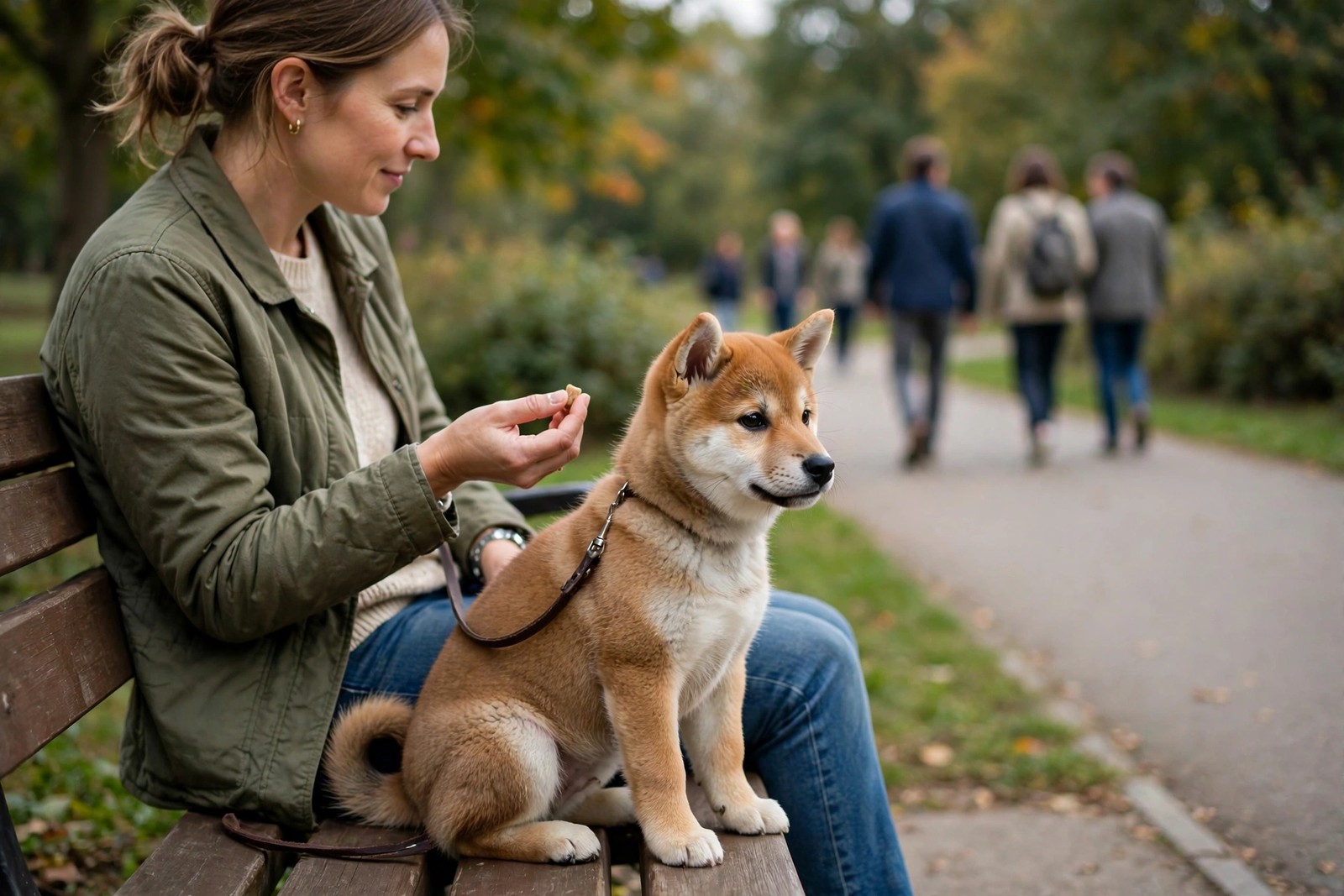
Build the plan around watching the world calmly from a distance she can cope with, not around meeting everyone. A cautious Shiba Inu puppy who already finds strangers and handling worrying does not need a longer list of people to endure; she needs repeated evidence that new things appear, stay manageable and go away without demanding anything from her. Socialisation done that way builds confidence, while forced greeting builds a puppy who snaps later because every softer signal was ignored.
Observation is real socialisation
Take her, several times a week, to places she can watch from a comfortable distance: the quiet edge of a park, a bench set back from a pavement, or a garden gate where people and dogs pass without approaching. Let her look, sniff the air, take food and move away when she wants. Sessions should be short, often just a few minutes of watching, and should end while she is still relaxed rather than when she has had enough.
If she stops taking food she normally loves, stares fixedly, tucks her tail, tries to leave or goes very still, the distance is too small. Increase distance, move behind a car or hedge as a visual break, or leave for the day without treating it as failure; leaving early is the plan working.
People: her choice, brief and side-on
Ask helpers to ignore her at first, stand side-on, avoid reaching over her head, and let her approach if she chooses. If she does approach, one brief scratch on the chest, then hands off and see whether she asks for more. If she moves away, that answer stands. Children need the closest supervision and the simplest rule: no chasing, no hugging, no picking her up, and no following her when she retreats.
Do not hand her to visitors to be held, pass her around a room, or let a well-meaning crowd gather around the cute puppy. A Shiba who learns early that people respect her signals is more likely to stay tolerant as an adult than one who learns that signals do not work and stronger ones are required.
Handling, built in tiny home steps
At home, build handling separately from strangers. Pair brief touches with food in a clear sequence: touch a paw for a second, feed, stop; lift an ear flap gently, feed, stop; rest a hand on her collar, feed, release. Keep each session very short, work on a surface where she can walk away, and stop for the day if she moves off repeatedly. Walking away must remain allowed, or the exercise teaches entrapment instead of cooperation.
Extend the same approach to grooming, nail care, harness fitting and vet-style checks over days and weeks, adding one small element at a time. Practise the car, the waiting-room sounds and the journey to the vet as separate experiences with their own rewards, so her first necessary handling by a stranger does not arrive stacked on top of travel and a strange building.
Dogs, classes and what to avoid
Choose calm, stable adult dogs for brief parallel walks and shared sniffing at a distance before any close play, and keep interactions short enough to end well. A small, well-run puppy class that allows observation from the edge and does not insist on free group play may suit her; a chaotic session built around puppies wrestling in a crowd may not. Ask any class provider how they handle a puppy who wants to watch rather than join, and leave if the answer involves forcing participation.
Skip crowded markets, busy pet shops, festivals and doorways where strangers can reach her before you can intervene. Those settings compress distance, noise and reaching hands into exactly the combination she already finds worrying.
Through KinsLe's Care Teams, you can assign those short observation outings and home handling steps across the household, record what she watched and how she coped, and keep the pace gradual and consistent several times a week.