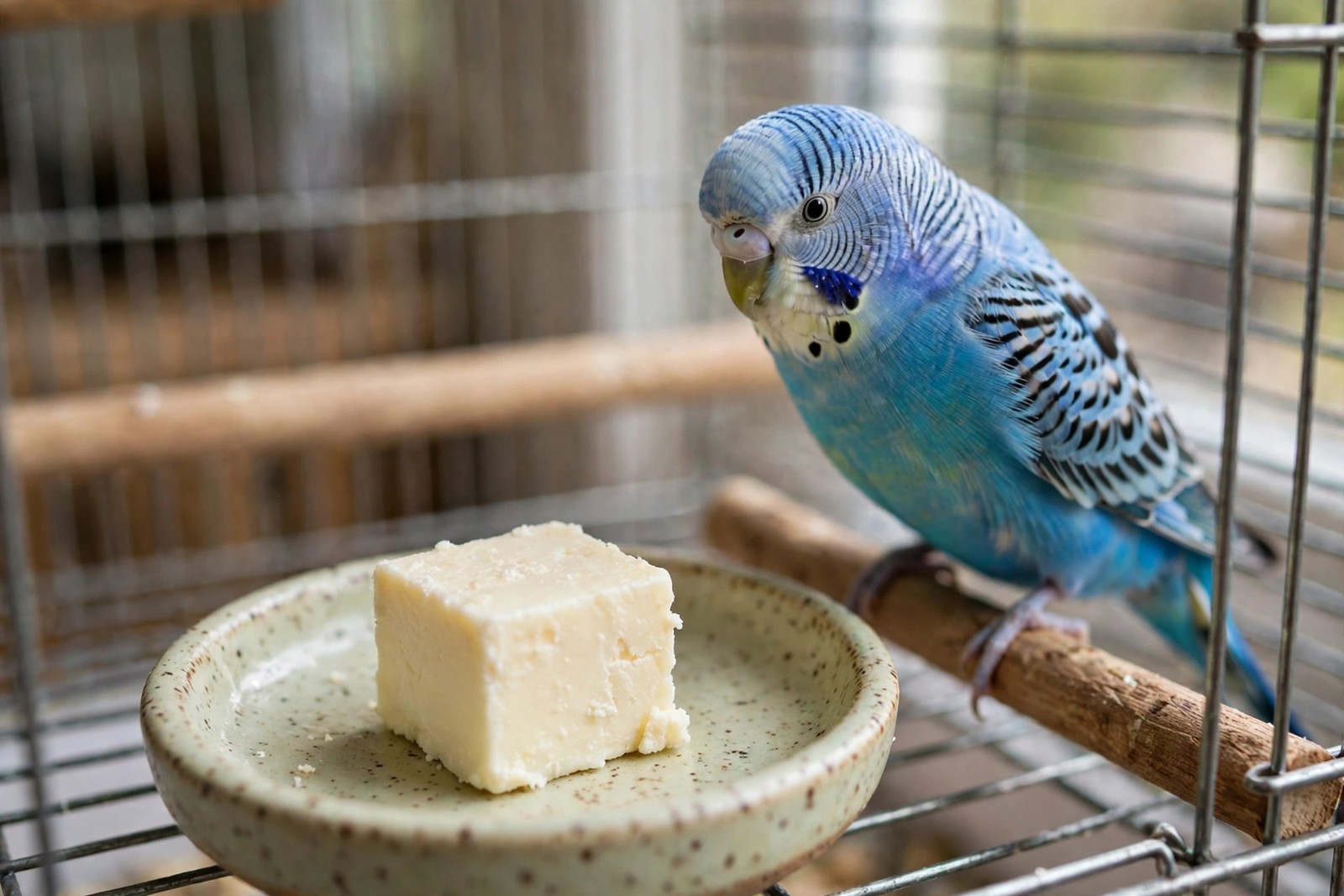
No, budgies should not eat cheese. This is not a food to offer in a smaller portion or on special occasions, because the problems are built into cheese itself rather than into the amount: lactose a bird cannot digest well, salt a tiny body cannot spare, and fat that adds nothing a budgie needs.
Why Cheese Does Not Suit a Budgie
Birds do not produce enough of the enzyme that breaks down lactose, the sugar in milk, so dairy tends to pass through causing loose droppings and digestive discomfort. Cheese-making concentrates milk fat and salt, and budgies are especially sensitive to excess salt because of their small size and fast metabolism. A crumb that looks trivial beside a cracker can be a meaningful salt load for a bird of roughly thirty grams.
Hard cheese is sometimes described as lower in lactose, but that does not make it suitable. It is still salty, still fatty, and still offers no nutrient a budgie cannot get more safely from greens, vegetables, egg food in breeding season under guidance, or its base diet. Soft cheeses, processed slices, and cheese-flavoured snacks add further problems, including oils, flavourings, and in some snack coatings onion or garlic powders that birds should not have.
The Shoulder-Snack Problem
Most budgie cheese incidents happen outside the cage. A bird riding on a shoulder during lunch will lunge at a sandwich, pizza edge, or cheese board faster than most owners expect, because budgies investigate food with their beaks socially, copying what the flock appears to enjoy. A single stolen beakful is unlikely to be an emergency for a healthy bird, but you should move the food away, offer fresh water, and watch droppings and energy over the next several hours.
Repeated access is the real risk, so set the household rule plainly: no feeding the bird from plates, and no dairy left within reach of the play stand. Children need the reason, not just the rule, because a budgie begging prettily is hard for a young helper to refuse. If your bird swallowed a larger piece, seemed off colour afterwards, stopped eating, or produced persistently watery droppings, contact an avian vet promptly rather than waiting it out.
Better Foods for a Curious Beak
If the appeal is giving your budgie a shared treat, redirect that instinct. Offer a small piece of apple with seeds removed, a floret of broccoli to shred, cooked sweet potato cooled and mashed, or leafy greens clipped to the bars for tearing. Budgies often enjoy the activity as much as the taste, so foods they can hold, strip, and scatter satisfy the same urge cheese was filling.
Keep a short allowed-and-never list on the cage or fridge: daily base food and water on one side, fresh foods in rotation in the middle, and never foods including cheese, chocolate, avocado, and salty snacks on the other. Review the list whenever a new helper starts, and after any food scare, while the lesson is fresh. Put that same never list in KinsLe Care Teams with the daily duties, so a sitter covering a weekend sees the cheese rule before the first feed, not after a mistake.