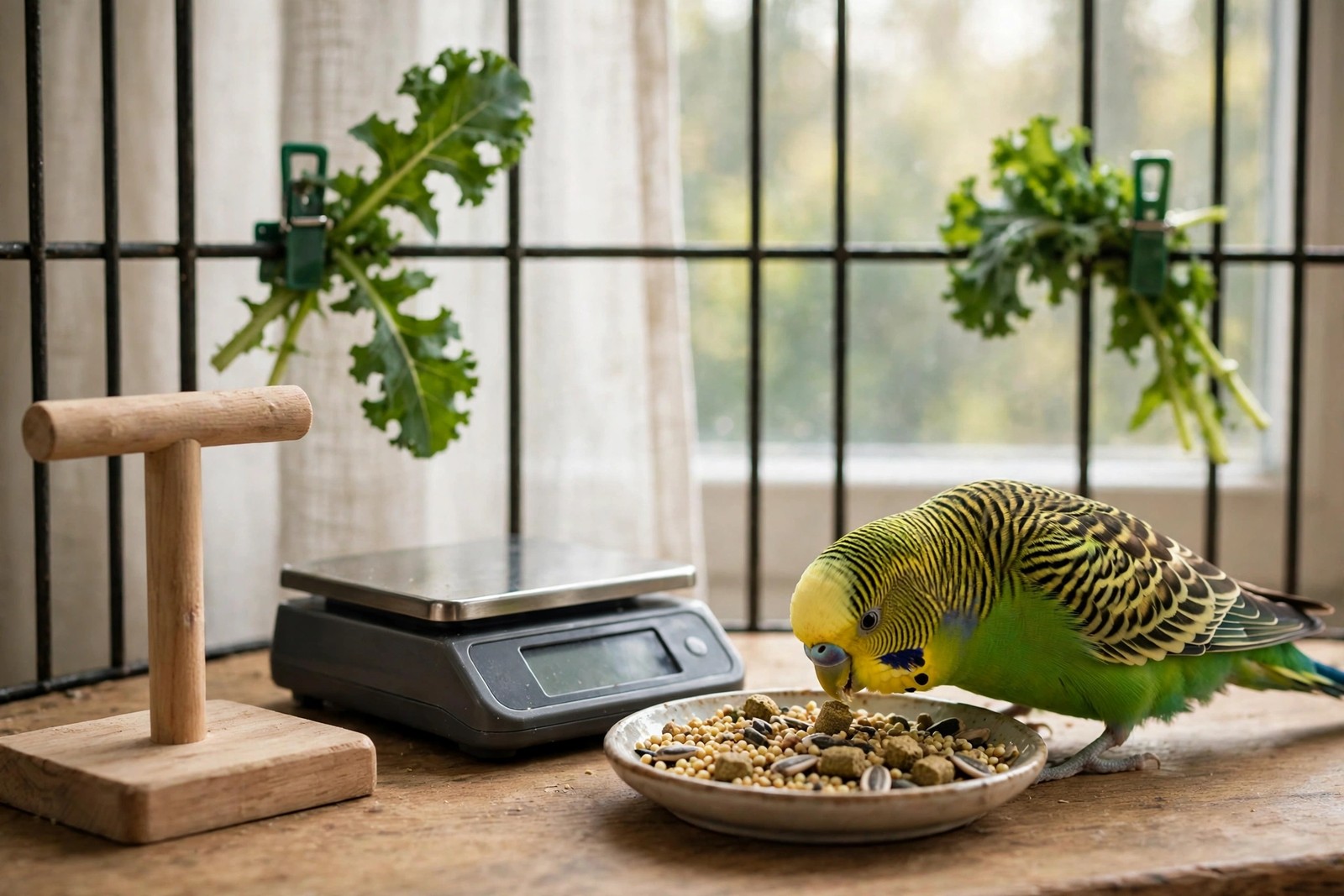
Budgies are cautious eaters with strong habits, and a seed-raised bird may genuinely not recognise a bowl of pellets as food. That single fact shapes the whole conversion: the goal is to teach your bird that pellets are edible and worthwhile while seed is still available, then shift the balance slowly. An all-seed diet is high in fat and low in several nutrients, which is why the change is worth making, but a rushed change is dangerous, because a small bird who stops eating loses condition fast.
Set Up the Conversion Properly
Choose pellets made for budgies or small parakeets, in a crumble or mini size your bird can handle, and weigh your bird before you start on a kitchen scale that reads in grams, perched on a small stand or in a light container your bird will accept. A typical pet budgie weighs roughly 30 to 40 grams (about 1 to 1.4 ounces), and your bird's own starting number, not the range, is the baseline that matters. Note it, along with normal droppings: firm, green to brown with a white urate portion, produced frequently through the day.
Work at a pace of weeks, not days. Most conversions take two to six weeks, and stubborn older birds can take longer. Plan one main seed dish to convert, and keep water fresh and close by, because dry pellets make birds drink more as they adapt.
Mix, Sprinkle and Offer at the Right Moment
Begin with a dish that is mostly seed with a small share of pellets, roughly three parts seed to one part pellets, and increase the pellet share by a small step every few days only while your bird is eating well. Grind some pellets to a powder and sprinkle it over the seed so the flavour coats food your bird already trusts, and press a few whole pellets into a familiar treat or a piece of moist vegetable to teach the texture.
Offer the freshest mix first thing in the morning, when your bird is hungriest and most willing to experiment, and leave it in place through the day rather than swapping it back to pure seed at lunchtime. Eating near your bird, or offering a pellet from your fingers during out-of-cage time, uses flock behaviour honestly: budgies try what companions are eating. Chop and leafy greens can run alongside the conversion as familiar fresh food, but keep them as a side dish rather than a replacement while pellets are the lesson.
Monitor Weight and Droppings Every Day
This monitoring is what makes gradual conversion safe. Weigh your bird every two or three days at the same time, and step the mix back one stage if weight drops by more than a small amount or keeps falling. Count and look at droppings daily: far fewer droppings, very dark or watery droppings, or a bird who sits fluffed, quiet and uninterested in food are stop signs. Restore seed straight away and contact an avian veterinarian, because a bird who is not eating is an urgent case, not a stubborn one.
Never use the starvation method of removing seed until hunger forces the issue, and never convert a bird who is ill, moulting heavily or newly arrived and unsettled; stabilise life first and convert later. Once pellets make up most of the dish and weight and droppings have stayed steady for a week, you have converted, and a small amount of seed can remain as a treat and training reward rather than the staple. In KinsLe, Care Teams keeps the current mix stage, the morning offer and the weigh-in results assigned and timestamped, so a bird fed by two people never gets its ratio changed twice in one day.