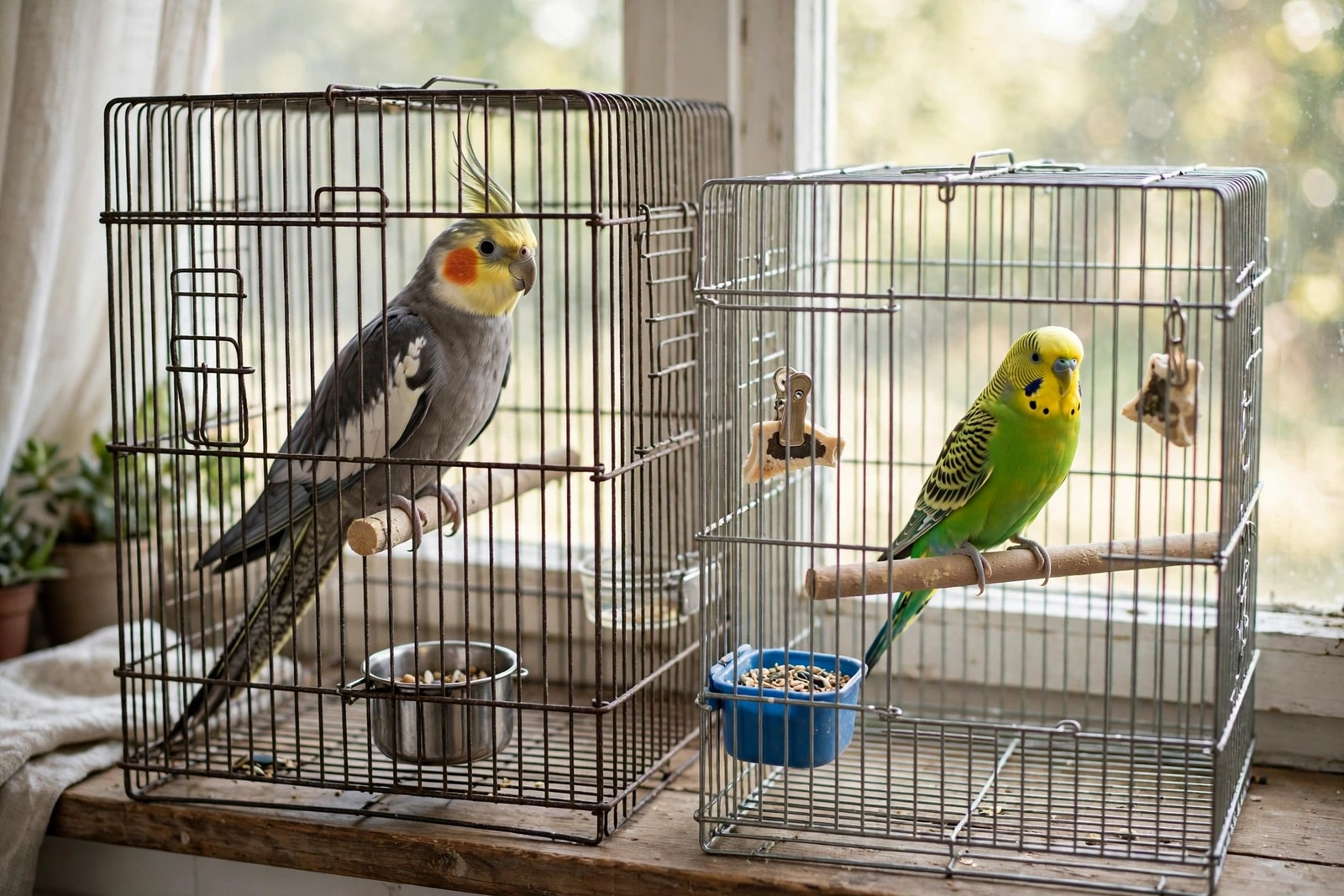
Cockatiels and budgies usually live together best as neighbours, not cage-mates: separate cages side by side, with shared out-of-cage time only while someone is watching. Both are sociable Australian birds who enjoy company and chatter, which is why the pairing is so tempting. The risk sits in the size difference and in the fact that a shared cage leaves the smaller bird nowhere to go.
The Size and Beak Problem
A cockatiel is roughly three times a budgie's weight, with a noticeably larger, stronger beak. Cockatiels are famously gentle, but gentle is a temperament, not a guarantee, and a bird defending its food bowl, favourite perch, or sleep corner at close quarters can bite before a budgie can retreat. One bite can crush or sever a budgie toe, damage a leg, or wound the head, and bird wounds bleed seriously relative to a budgie's small body. The traffic runs both ways. Budgies are quick, busy, and sometimes relentless, and a budgie who climbs over a cockatiel, pulls crest feathers, or will not stop following can stress a placid cockatiel into exactly the snap everyone was trying to avoid. In separate cages, both birds get the flock feeling with a wall between impulse and injury.
The Setup That Works
Place the cages close enough for conversation but far enough apart that toes poked through bars cannot be bitten, and let each bird keep its own food, water, perches, and toys so nothing valuable is shared. Quarantine any newcomer in a different room first, with a veterinary check and several weeks of watching droppings, breathing, and energy before the cages even meet, because a new bird can carry illness that appears only under the stress of a move. Introduce out-of-cage time in a bird-safe room after both birds are settled: close windows and doors, cover mirrors if needed, remove other pets, and offer duplicate play stands and treat cups at opposite ends so the birds choose their distance. End the session while it is still going well.
Reading the Shared Sessions
Good signs are relaxed body language at a comfortable distance: eating, preening, soft contact calls, and choosing to sit near each other with loose feathers and no staring contests. Warning signs are just as clear once you look for them: lunging, beak snapping, chasing, cornering, one bird going silent and still, or one bird always retreating to the furthest point and staying there. At any warning sign, return the birds calmly to their own cages and shorten or pause joint sessions. Never test a pairing by housing the birds together overnight, on holiday, or because a cage broke; use a spare or travel cage instead. A genuinely vast aviary with hiding cover changes the space equation for experienced keepers, but it does not remove the supervision duty, and it is not the typical home setup this question is about.
Daily Life With Two Species
Keep feeding separate even for friendly birds, because a cockatiel's portion control, preferred foods, and supplements are its own, and a shared bowl becomes the one resource worth defending. Clean both cages on a regular rhythm, watch each bird's droppings and appetite individually, since a pile of mixed evidence from a shared floor tells you nothing about which bird is unwell, and weigh small birds periodically if your veterinarian recommends it. Rotate toys within each cage rather than swapping them back and forth during any illness concern.
A Companionship That Lasts
Done this way, the arrangement often gives both species their best life: constant company, a larger social world, and a safe retreat that is entirely their own. Many owners find the birds call back and forth all day and choose perches nearest the shared wall. KinsLe's Care Teams keeps the two-bird routine straight in a busy household, with separate feeding, cleaning, and play-session duties for each cage, each marked complete by the person who actually did it.