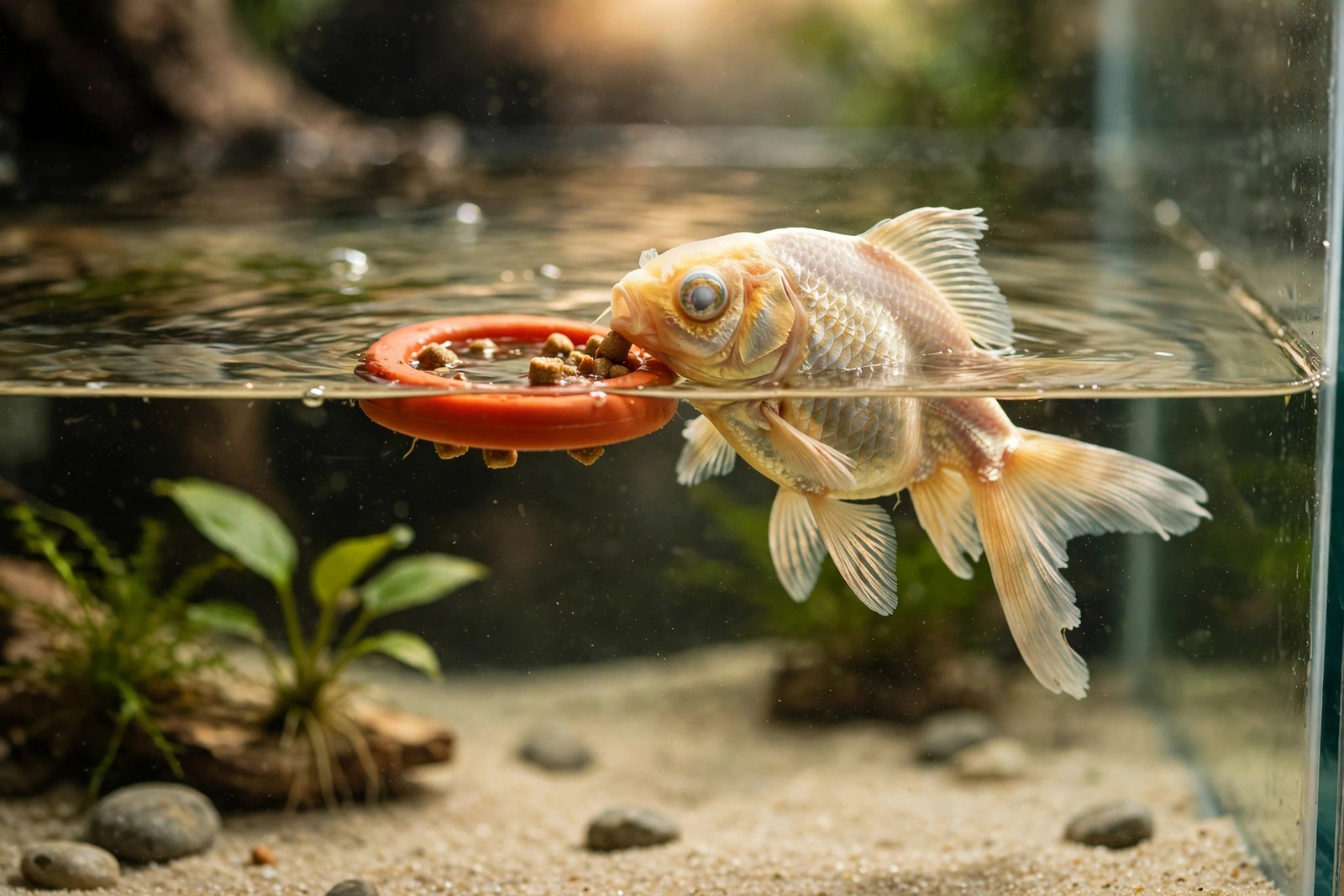
A fish losing its sight — common in older fish and in varieties bred with protruding or heavily hooded eyes — navigates increasingly by memory, water movement, and smell. Your job is to make the tank predictable and to deliver food to the fish, rather than expecting the fish to find food. Small, consistent changes work far better than a single big remodel, which itself can disorient a fish that has memorised the old layout.
Freeze the Layout
Once eyesight fades, stop rearranging. Leave rocks, plants, caves, and the filter outflow in exactly the positions your fish learned while it could see well. If you must change something — replacing a failed plant, for example — change one item at a time and give the fish days to relearn its routes. Keep lighting on a steady timer as well; a fish with limited vision startles more easily at sudden bright light, so avoid switching room and tank lights on abruptly after dark where you can.
Feed in One Spot, With a Cue
Feed at the same corner, at the same times, every day. A floating feeding ring keeps flakes or pellets gathered in that spot instead of drifting across the surface. Just before you add food, tap the tank rim or glass lightly two or three times; most fish learn within a week or two that the vibration means food is arriving in the usual place and will swim toward it. Sinking foods can be placed with tongs near a fish that feeds lower down, and slow, deliberate presentation beats scattering food and hoping.
Make Food Easier to Detect
Use contrast your fish can still use: light-coloured food shows up better dropped over a dark substrate or a plain feeding dish, and strongly scented foods are easier for a fish hunting by smell. Watch an entire feed at least once a week. A fish with fading sight often rises late, circles, and misses repeatedly — if it is getting noticeably less than its share, that observation, not guesswork, should drive your next change.
Deal With Competition Honestly
Fast, confident tankmates are the biggest threat to a poorly sighted fish, because they clear surface food in seconds. Options, in order of disruption, are: feed the competitors at the opposite end first, target-feed your fish with tongs while they are busy, use a divider at feeding time, or move your fish to a calmer tank of its own. For a gentle community fish in old age, a quiet tank of its own is often the kindest and simplest answer.
Consistency collapses if each helper feeds differently, so write the routine down where everyone follows it: with KinsLe Care Teams, the tap cue, the feeding corner, and the weekly watch-a-full-feed check can be set as shared duties for your fish, keeping every carer working to the same sight-friendly system.