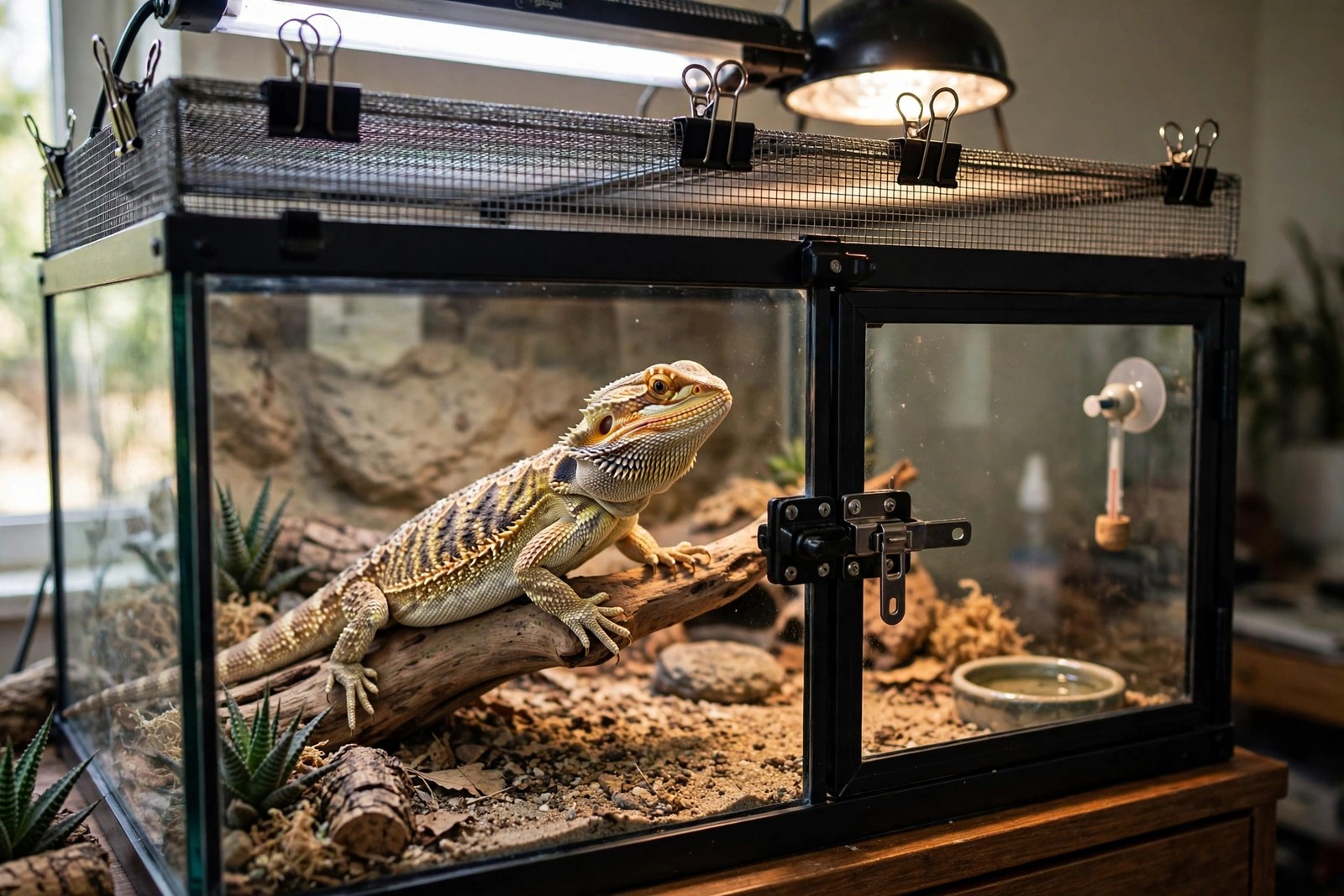
A young bearded dragon does not need strength to escape. It needs one gap, one climbable branch angled toward the rim, or one front door left resting on its runner instead of locked, and a quiet ten minutes. Juveniles are light, bold climbers with narrow bodies that compress through openings an adult could never use, so an enclosure that held last month's dragon may fail this month's.
Lock the Doors a Climber Actually Tests
Front-opening enclosures fail at the doors first. Fit a proper lock or latch to sliding or hinged front doors and use it every single time, including during feeding, because a door pushed shut but not latched can be nudged from inside by a dragon pressing and scrabbling at the glass. Check door runners for built-up substrate that stops a sliding door closing fully, leaving a vertical slit at the meeting edge that a juvenile can flatten against and work through. Run a fingertip along every door edge, vent, and corner after cleaning day. Anywhere a fingertip catches a gap wide enough to feel, a young dragon's head deserves a closer look, and the head is the gauge that matters: where the head cannot pass, the body cannot follow.
Seal Cables, Lids, and Background Gaps
Probe and lamp cables usually enter through holes or notches that are cut generously, and those generous holes are ready-made exits at exactly the height a climber explores. Seal around every cable with a snug grommet, foam plug, or a fitted cover so the cable passes but no animal can, and recheck the seal whenever equipment moves. Where the enclosure has a mesh top, clip the lid down on all sides rather than resting it in place, because a growing dragon pushing upward from tall decor can lift an unsecured corner. Three-dimensional backgrounds deserve the same suspicion. Gaps behind a background panel create a hidden chimney to the top that you cannot see from the front, so seal the panel edges fully and confirm there is no route up behind it before the dragon goes back in.
Arrange Decor So Nothing Reaches the Top
Escapes are usually a staircase problem. A basking branch, stacked rocks, or a tall hide placed beneath a vent or lid edge gives a juvenile the final few centimetres it needs, so position anything climbable away from the walls' top edges and keep any perch well below the rim, remembering that a dragon standing on hind legs with front feet scrabbling reaches considerably further than its nose-to-tail length suggests. As your youngster grows, repeat this audit rather than trusting the original layout: longer reach, stronger pushing, and heavier scrabbling arrive month by month, and decor that was safely low for a hatchling becomes a launch point for a subadult. After every deep clean, when furniture tends to go back in slightly different places, stand back and trace each possible climb with your eyes from floor to lid before you call the job finished.
If a Dragon Still Gets Out
Search warm, dark, low places first: behind the enclosure stand, under appliances, along skirting boards, and inside any cable tangle, moving slowly and checking with a torch rather than pulling furniture out in a rush. Contain the room by closing its door while you search, and place a basking lamp over a hide near the enclosure so a cold dragon is drawn toward heat you control. Prevention stays the real answer, and the enclosure checks above are what make an escape unlikely rather than merely unlucky. Should searching the room fail, KinsLe offers a second layer through its Lost Pet Alert System, which notifies nearby members that a pet is missing and lets anyone who spots your dragon contact you without delay.